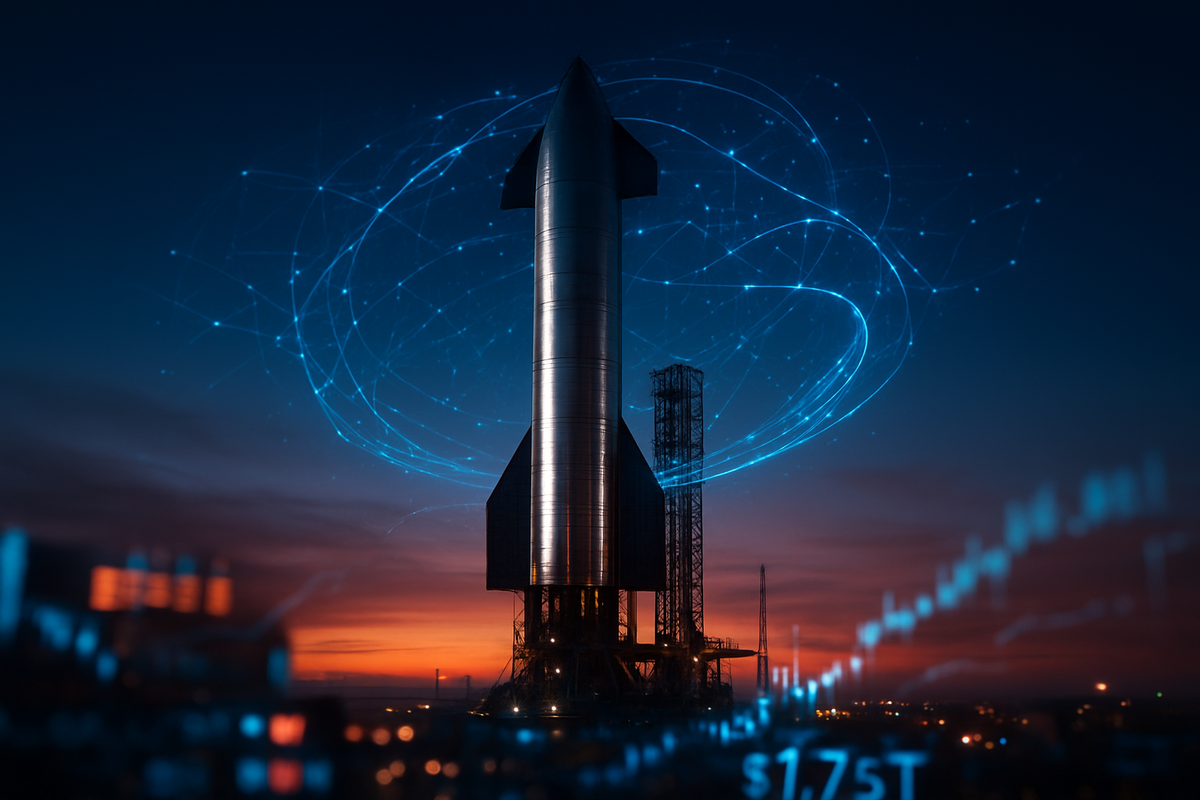
In a move that has sent shockwaves through global financial centers, SpaceX (Private: SPACE-X) has reportedly filed a confidential S-1 registration statement with the Securities and Exchange Commission (SEC) for an initial public offering targeting a staggering $1.75 trillion valuation. This unprecedented filing, which occurred early on April 1, 2026, marks the definitive moment Elon Musk’s aerospace giant seeks to transition from a privately held disruptor to a public juggernaut. The move follows the recently finalized merger between SpaceX and Musk’s artificial intelligence venture, xAI, creating a vertically integrated "Space-AI" conglomerate that aims to dominate the next century of infrastructure.
If the $1.75 trillion valuation holds through the public listing, the combined SpaceX-xAI entity will become the largest IPO in human history, dwarfing the $29.4 billion raised by Saudi Aramco in 2019. More significantly, the valuation places SpaceX ahead of established titans like Meta Platforms (NASDAQ: META), Berkshire Hathaway (NYSE: BRK.B), and even the global oil giant Saudi Aramco. This listing would immediately catapult the company into the top six of the world's most valuable public entities, trailing only the "Trillion-Dollar Club" leaders: Nvidia, Apple, Alphabet, Microsoft, and Amazon.
The road to this historic filing was paved by a series of high-stakes technological and financial milestones throughout 2024 and 2025. The linchpin of the valuation is the "K2" restructuring, a complex corporate maneuver finalized in February 2026 that merged xAI’s "Grok" large-language models directly into SpaceX’s operational architecture. This merger was not merely a financial consolidation but a strategic bet on space-based AI. By integrating xAI’s compute capabilities with the Starlink satellite network, SpaceX now operates what analysts call "orbital data centers," circumventing the energy and land-use restrictions currently plaguing terrestrial AI firms.
The timeline leading to this moment is characterized by a rapid escalation in SpaceX’s launch frequency and revenue. Throughout 2025, SpaceX successfully completed 25 Starship flights, following the historic "Mechazilla" catch of the Super Heavy booster in late 2024. These successes proved the viability of rapid reusability, slashing the cost of access to orbit to under $100 per kilogram. Simultaneously, the Starlink division achieved explosive growth, reaching 9.2 million subscribers by the end of 2025 and generating over $12 billion in annual revenue. This steady cash flow from Starlink has provided the financial bedrock required to convince Wall Street that SpaceX is no longer a speculative venture, but a profitable global utility.
Key stakeholders, including early backers such as Fidelity Investments, Google (NASDAQ: GOOGL), and Founders Fund, are set to see astronomical returns on their initial investments. The filing comes at a time when the broader market is hungry for a new growth engine, and Musk’s promise of a multi-planetary economy, backed by the logistical might of Starship V3, has captivated institutional investors who were previously wary of the high-risk nature of space exploration.
The immediate winners of this listing are undoubtedly the existing private equity holders and SpaceX employees, who have seen the internal share price rise from roughly $112 in mid-2024 to an estimated $850 based on the IPO target. Beyond the inner circle, Nvidia (NASDAQ: NVDA) stands to gain significantly as the primary provider of the hardware driving xAI’s integration into the Starlink network. The demand for space-hardened GPUs and AI accelerators is expected to skyrocket as SpaceX builds out its orbital compute clusters.
Conversely, the "losers" in this scenario include legacy aerospace and defense contractors. Boeing (NYSE: BA) and Lockheed Martin (NYSE: LMT), already struggling to compete with SpaceX’s cost structure, now face a public competitor with a nearly bottomless war chest. Furthermore, the sheer size of the SpaceX IPO could trigger a "liquidity drain" from other tech stocks, as mutual funds and ETFs rebalance their portfolios to include the new aerospace giant. Tesla (NASDAQ: TSLA) shareholders may also experience volatility; while the "Musk Premium" benefits both companies, some investors worry about a "key man risk" or potential capital shifts as Musk focuses his attention on the Starship Mars mission.
This event represents a paradigm shift in how the global market values infrastructure. No longer is space viewed as a government-led scientific endeavor; it is now the "ultimate high ground" for telecommunications and artificial intelligence. The $1.75 trillion valuation signifies that the market is pricing in more than just rockets—it is pricing in the control of global data flow (Starlink) and the future of logistics (Starship).
Historically, the only comparable event was the 2019 Saudi Aramco IPO, which similarly represented a nation-state’s most valuable asset going public. However, unlike Aramco, which is tied to the legacy energy sector, SpaceX is positioned at the intersection of three of the most disruptive sectors: Aerospace, AI, and Satellite Telecommunications. Regulatory bodies, including the SEC and the Federal Aviation Administration (FAA), are expected to scrutinize the filing intensely, particularly given the unprecedented nature of the xAI merger and Musk’s history with regulatory friction. This listing will likely force a rewrite of space law and orbital frequency regulations as SpaceX moves toward a near-monopoly on low-Earth orbit (LEO).
Looking ahead, the short-term focus will be on the SEC’s review of the confidential S-1 and the subsequent "roadshow," where Musk and COO Gwynne Shotwell must defend the $1.75 trillion price tag to institutional skeptics. If cleared, the IPO is expected to take place in late summer 2026. Strategically, the capital raised from this offering—estimated to be between $50 billion and $75 billion—will be diverted into the Starship commercialization program and the first uncrewed Mars missions, currently slated for the 2028 window.
In the long term, the primary challenge will be maintaining the breakneck pace of innovation while satisfying the quarterly earnings expectations of public shareholders. The integration of xAI also introduces a new variable: the "AI-in-Space" race. Competitors like Jeff Bezos's Blue Origin and various Chinese aerospace firms are expected to accelerate their efforts to counter SpaceX’s dominance, potentially leading to a new era of geopolitical and corporate competition in orbit.
The confidential IPO filing of SpaceX at a $1.75 trillion valuation is a watershed moment for the 21st-century economy. By merging the physical logistics of Starship with the digital intelligence of xAI, Elon Musk has created a corporate entity that operates beyond the traditional constraints of the S&P 500. It is a bold bet that the future of wealth lies not on Earth, but in the infrastructure that connects our world to the stars.
Investors should watch closely for the public release of the S-1, which will provide the first truly transparent look at Starlink’s margins and the specific financial terms of the xAI merger. The coming months will determine if the market is ready to embrace a trillion-dollar aerospace venture, or if the gravity of such a massive valuation will eventually bring the stock back to Earth. For now, the "Musk Era" of the public markets has officially reached escape velocity.
This content is intended for informational purposes only and is not financial advice.