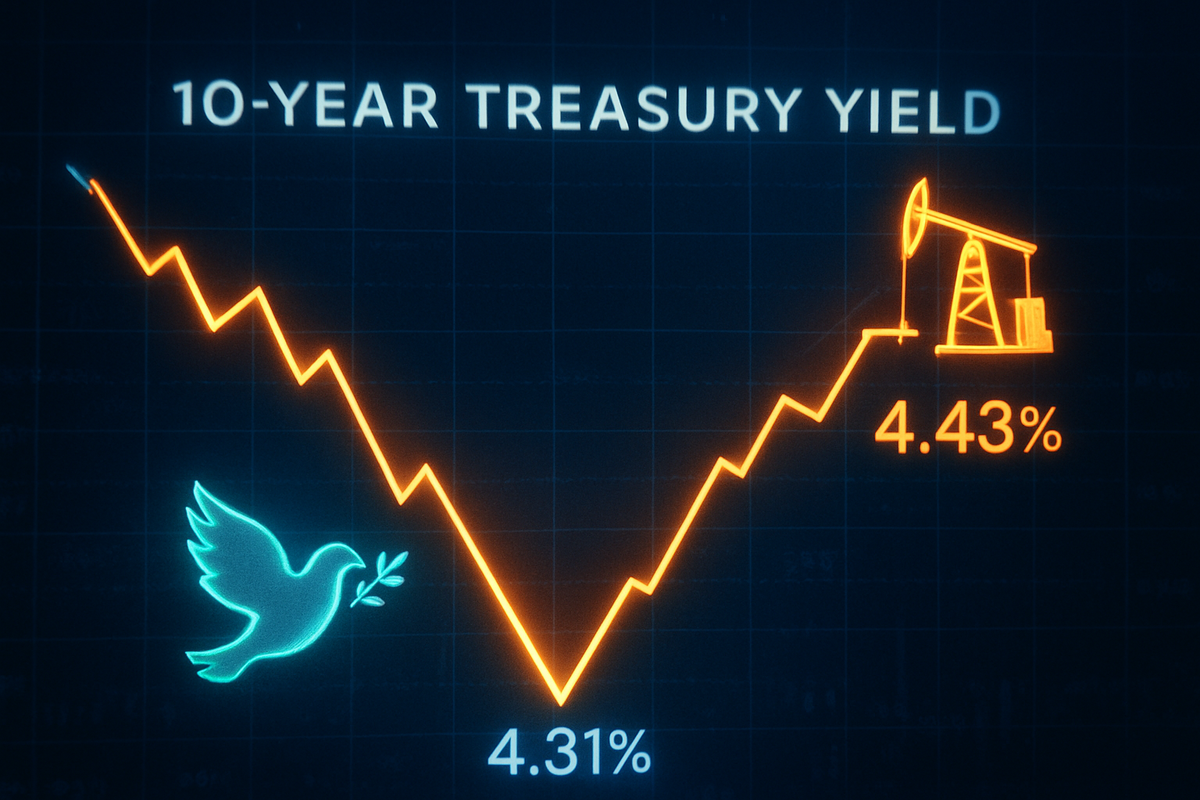
The fixed-income market experienced a day of whiplash on March 31, 2026, as the 10-year Treasury yield underwent a dramatic "round-trip" movement. Early morning optimism surrounding a rumored peace plan in the ongoing Middle East conflict sent the 10-year yield tumbling to a session low of 4.31%. However, the rally in bonds proved fleeting as market participants pivoted their focus back to a harsh economic reality: stubbornly high inflation and a fresh surge in global oil prices, which propelled the yield back up to 4.43% by the closing bell.
This volatility underscores the precarious state of the global economy as it enters the second quarter of 2026. Investors are caught in a tug-of-war between the hope for geopolitical de-escalation and the structural reality of "higher-for-longer" interest rates. The quick reversal in yields suggests that while the market is desperate for a "peace dividend," the inflationary impulse provided by energy costs remains the dominant force driving the Federal Reserve's likely trajectory.
The Morning Hope and the Afternoon Reality
The trading day began with a wave of buying in the Treasury market following reports of a multilateral peace proposal aimed at resolving the U.S.-Israel-Iran crisis. The conflict, which has plagued regional stability for much of early 2026, was rumored to be nearing a diplomatic breakthrough that would include the reopening of the Strait of Hormuz. As the 10-year Treasury yield dropped to 4.31%, the lowest level in nearly two weeks, equity futures initially surged, betting on a rapid cooling of geopolitical risk premiums.
However, the sentiment shifted abruptly during mid-day trading. As specific details of the peace plan remained unconfirmed, fresh economic data and a spike in West Texas Intermediate (WTI) crude prices—crossing the $115 per barrel threshold—refocused the market on the Consumer Price Index (CPI) outlook. The 10-year yield began a steady ascent, eventually hitting 4.43%. This 12-basis-point swing in a single session reflects the intense uncertainty surrounding the Federal Reserve's ability to pivot toward rate cuts if energy-driven inflation remains at its current projected clip of 4.2%.
The stakeholders involved in this volatility extend beyond bond traders. The Federal Reserve, led by Chair Jerome Powell, has maintained a federal funds rate of 3.5%–3.75%, but the rebound in yields suggests the market is pricing in a high probability that the Fed will remain sidelined for the remainder of the year. Industry reactions have been swift, with mortgage lenders and corporate debt issuers halting new offerings to wait for a more stable pricing environment.
Winners and Losers of the Yield Surge
In this environment of rising yields and elevated energy costs, the traditional "winners" are found in the financial and energy sectors. Large-cap banks, such as JPMorgan Chase & Co. (NYSE: JPM) and Bank of America Corp. (NYSE: BAC), typically benefit from a steepening yield curve and higher net interest margins. Additionally, the surge in oil prices has been a massive boon for energy giants like Exxon Mobil Corp. (NYSE: XOM) and Chevron Corp. (NYSE: CVX), which continue to report record quarterly earnings despite the broader market's nervousness.
Conversely, the "losers" are concentrated in sectors sensitive to interest rates and capital costs. Big Tech companies, including Apple Inc. (NASDAQ: AAPL) and Microsoft Corp. (NASDAQ: MSFT), saw their valuations pressured today as higher discount rates reduced the present value of future earnings. The real estate sector also faces a daunting challenge; Prologis, Inc. (NYSE: PLD) and other major REITs are grappling with the highest financing costs in a generation, which has slowed the pace of new industrial and commercial developments.
Utilities and green energy firms are also feeling the pinch. NextEra Energy, Inc. (NYSE: NEE), often a bellwether for the renewable sector, experienced a sell-off as investors worried that the persistent "yield-up" environment would make capital-intensive wind and solar projects less viable compared to the immediate returns of high-yielding government debt.
A Wider Significance: Geopolitics vs. The Fed
The events of March 31 fit into a broader trend of 2026: the "weaponization of energy" and its direct impact on monetary policy. Unlike the transitory inflation shocks of years past, the current volatility is rooted in deep structural shifts. The transition from a decade of low-interest rates to the current 4%+ environment for the 10-year Treasury represents a fundamental repricing of risk across all asset classes.
Historically, this level of volatility is reminiscent of the early 1980s, when energy shocks and inflation expectations created a similarly "stop-and-go" market environment. The ripple effect extends to international partners, as the strong U.S. dollar—fueled by rising yields—puts immense pressure on emerging markets and European allies who are already struggling with their own energy transitions.
From a policy perspective, the rebound to 4.43% confirms that the "Fed Put" (the idea that the Federal Reserve will step in to support the market) is currently inactive. Central bankers are prioritizeing price stability over market volatility, signaling that until oil prices stabilize and headline inflation trends back toward the 2% target, the pressure on the bond market will likely remain.
The Road Ahead: Strategic Pivots and Scenarios
In the short term, investors should prepare for a period of "choppy" consolidation. The potential for a peace plan remains a wildcard; if a formal agreement is signed, the 10-year yield could quickly retest the 4.0% psychological level. However, a failure in diplomacy, coupled with any further disruption in the Persian Gulf, could see yields testing the 4.75% to 5.0% range—a level not seen since the peak of the 2023-2024 tightening cycle.
Corporations are already beginning to adapt. We expect a strategic pivot toward "capital discipline," where companies focus on internal cash flow generation rather than relying on debt markets for expansion. In the energy sector, expect a surge in investment toward domestic supply and energy security projects, as the price of WTI is forecasted to remain volatile throughout 2026.
Market opportunities may emerge in the form of "short-duration" assets. With the yield curve showing signs of persistent inversion or extreme flatness, many institutional investors are moving into Treasury bills and short-term corporate paper to park cash while waiting for a clearer signal from the geopolitical front.
Wrapping Up the Market Minute
The wild ride in Treasury yields on March 31, 2026, serves as a stark reminder that the global economy remains at the mercy of both the diplomat’s pen and the oil tanker’s route. While the 10-year yield’s fall to 4.31% offered a glimpse of a "soft landing" scenario, the rebound to 4.43% reinforces the reality that inflation is not yet defeated.
Moving forward, the market will be hyper-focused on two key indicators: the next CPI print and the status of the Strait of Hormuz. For investors, the takeaway is clear: volatility is the new baseline. The era of predictable, low-rate growth has been replaced by a more complex landscape where geopolitical expertise is just as important as fundamental analysis.
In the coming months, watch for the Federal Reserve's May meeting and any signs of a "mean reversion" in oil prices. If energy costs begin to cool, the bond market may finally find the floor it has been searching for since the start of the year.
This content is intended for informational purposes only and is not financial advice.