
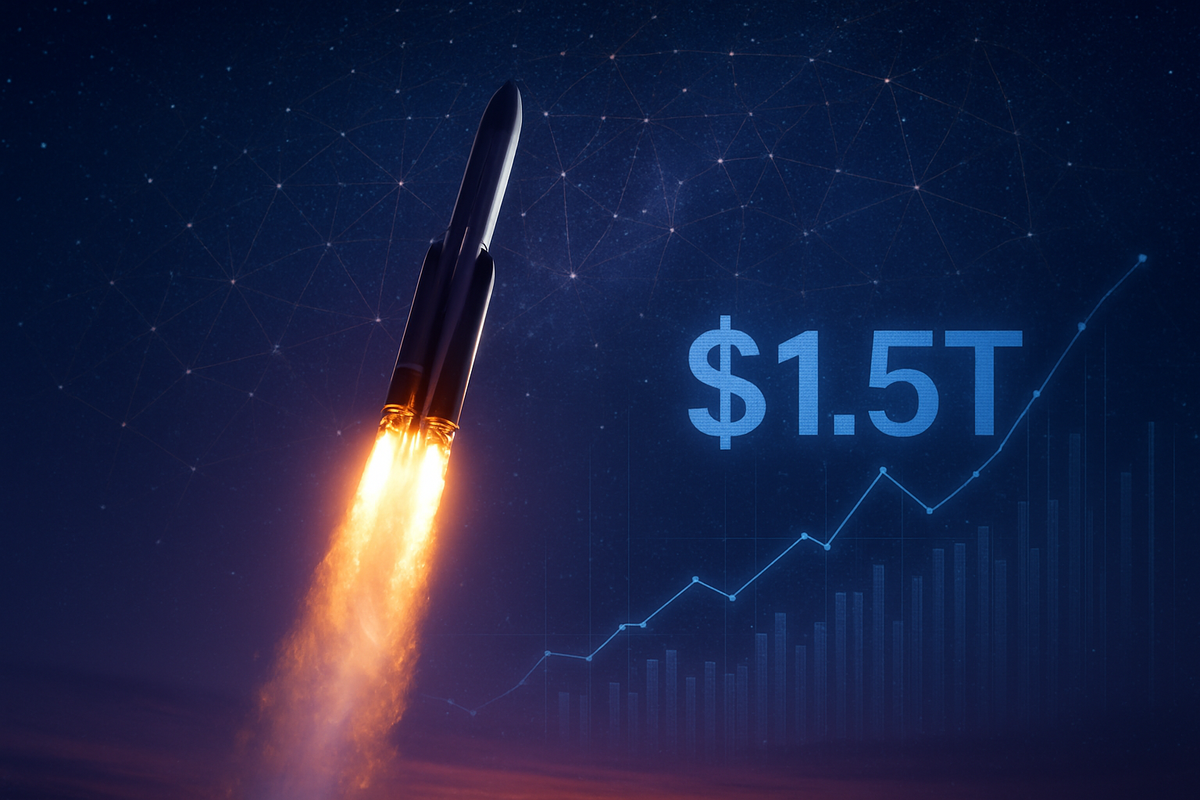
The global financial landscape shifted on its axis this December as rumors of a 2026 SpaceX Initial Public Offering (IPO) transformed into a near-certainty, fueled by a reported $1.5 trillion valuation target from CEO Elon Musk. Following a series of strategic leaks and a succinct "accurate" confirmation from Musk on social media on December 10, 2025, Wall Street is bracing for what is poised to be the largest public listing in history. The move marks a transition for the private aerospace giant from a high-stakes venture to a dominant global utility, leveraging its Starlink satellite constellation and the burgeoning success of its Starship launch system.
The immediate implications of this potential IPO are staggering. At a $1.5 trillion valuation, SpaceX would debut as one of the most valuable companies on the planet, rivaling the "Magnificent Seven" tech giants. The capital raise, rumored to be between $30 billion and $40 billion, would provide the necessary "war chest" for Musk’s more ambitious goals, including the establishment of "Moonbase Alpha" and the eventual colonization of Mars. For the broader market, the IPO represents a "structural reckoning," forcing a re-evaluation of the entire aerospace and defense sector as investors pivot from legacy industrial models to high-growth space-based technology.
The Path to a $1.5 Trillion Debut
The momentum toward a 2026 listing was catalyzed by a pivotal 2025. In August, SpaceX successfully completed Flight 10 of its Starship vehicle, demonstrating a controlled splashdown of the Super Heavy booster and proving the viability of a fully reusable, heavy-lift architecture. This technical milestone was followed by the Federal Aviation Administration (FAA) granting approval for up to 25 annual Starship launches from the company's Starbase facility in Texas. By November 2025, Starlink—the company’s satellite internet division—reported a surge to 8.5 million subscribers, generating an estimated $11.8 billion in annual revenue and achieving consistent profitability.
The $1.5 trillion valuation target, which many analysts initially viewed as hyperbolic, is increasingly supported by a new revenue pillar: orbital AI data centers. In late 2025, internal SpaceX documents suggested a plan to host AI processing units directly on Starlink satellites. By moving compute to space, SpaceX aims to bypass Earth-bound constraints such as power grid congestion and the massive water requirements for cooling traditional data centers. This "Space-AI" integration has fundamentally altered the company's investment profile, shifting it from a "launch provider" to a "critical AI infrastructure layer."
The timeline for the IPO is currently set for mid-to-late 2026, though some lead underwriters, including Morgan Stanley (NYSE: MS) and Goldman Sachs (NYSE: GS), have cautioned that the date could shift into early 2027 to ensure the most favorable market conditions. The private secondary market has already begun to price in this optimism; in a December 2025 internal share sale, SpaceX stock was priced at approximately $421 per share, implying a private valuation of over $800 billion. Musk’s public dismissal of that figure as "too low" has only served to heighten investor appetite for the upcoming public offering.
Winners and Losers: A Sector-Wide Re-Rating
The ripple effects of a SpaceX IPO will create a stark divide between those integrated into the new space economy and those left behind. The most significant public winner is Alphabet (NASDAQ: GOOGL), which made a visionary $900 million investment for a roughly 7% stake in SpaceX back in 2015. At a $1.5 trillion valuation, that stake could be worth upwards of $111 billion, providing Alphabet with a massive liquidity event to fund its own terrestrial AI initiatives. Similarly, EchoStar (NASDAQ: SATS) has emerged as a major beneficiary; after selling wireless spectrum to SpaceX in a deal paid partially in equity, its stock surged 40% in late 2025 as its SpaceX holdings now represent a substantial portion of its market capitalization.
In the mid-cap space, Rocket Lab (NASDAQ: RKLB) and AST SpaceMobile (NASDAQ: ASTS) have seen a "halo effect," with their valuations rising as investors seek "pure-play" proxies for the space sector. Analysts suggest that SpaceX’s premium valuation multiples will lead to a sector-wide re-rating, making companies like ASTS look undervalued in comparison. On the supply side, specialized providers such as STMicroelectronics (NYSE: STM), which supplies RF chips for Starlink, and Hexcel (NYSE: HXL), a provider of advanced composites, are expected to see increased order volumes as SpaceX ramps up its Starship production cadence.
Conversely, legacy aerospace firms like Boeing (NYSE: BA), Lockheed Martin (NYSE: LMT), and Northrop Grumman (NYSE: NOC) face a challenging environment. These "Primes" trade at industrial multiples (1.5x–3.0x sales) that look increasingly unattractive compared to SpaceX’s tech-style growth. Furthermore, the massive size of the SpaceX IPO will trigger a mandatory rebalancing of major ETFs like the iShares U.S. Aerospace & Defense ETF (BATS: ITA). To make room for a $1.5 trillion SpaceX, these funds may be forced to sell billions of dollars in shares of legacy contractors, potentially creating downward pressure on their stock prices throughout 2026.
The Broader Significance: Space as the New Utility
The SpaceX IPO is more than just a financial event; it signifies the transition of the space economy from a government-led frontier to a commercial utility. This shift is mirrored in historical precedents like the Saudi Aramco IPO, which similarly sought to monetize a dominant global resource. However, unlike the oil industry, the space sector is expanding into entirely new technological domains. The emergence of orbital AI processing suggests that the "final frontier" may soon become the primary backbone for global data, bypassing the geopolitical and environmental complexities of terrestrial infrastructure.
Regulatory and policy implications are also at the forefront. As SpaceX moves toward an IPO, its dominance—currently delivering roughly 90% of all global payload mass—has raised antitrust questions. However, the company’s deep integration with U.S. national security and its role in the "Moonbase Alpha" project have provided it with significant political capital. The IPO will likely force regulators to modernize space traffic management and spectrum allocation policies, as a public SpaceX will be under immense pressure to maintain its rapid launch cadence to satisfy shareholders.
Furthermore, the IPO represents a "valuation bridge" for the entire tech sector. By proving that a company can successfully monetize the infrastructure of space at a trillion-dollar scale, SpaceX is paving the way for a new asset class. This "Space-Tech" convergence is expected to draw capital away from traditional sectors and into high-risk, high-reward orbital ventures, potentially accelerating the development of space-based manufacturing, mining, and energy generation over the next decade.
What Comes Next: The Road to 2026 and Beyond
In the short term, investors will be watching for the official filing of the S-1 registration statement, which is expected to provide the first detailed look at SpaceX’s consolidated financials, including the specific margins of the Starlink business. A key strategic pivot to watch is whether SpaceX chooses to spin off Starlink as a separate entity or, as current rumors suggest, proceed with a unified IPO of the parent company. A unified IPO would allow the profitable Starlink division to subsidize the high-risk development of Starship, effectively making SpaceX a "conglomerate of the future."
The primary challenge for SpaceX in the lead-up to 2026 will be maintaining its flawless launch record while scaling Starship operations. Any significant setback in the Starship program could jeopardize the $1.5 trillion valuation, as the vehicle is essential for the "orbital data center" strategy. Additionally, the company will need to navigate an increasingly crowded low-Earth orbit (LEO), where competition from Amazon’s Project Kuiper and various international constellations could begin to impact Starlink’s market share.
Longer-term, the success of the IPO will likely determine the pace of human expansion into the solar system. If SpaceX can maintain its valuation and provide consistent returns to public shareholders, it will unlock a virtually bottomless pool of capital for Mars exploration. However, the transition from a private, founder-led company to a public entity will require a significant cultural shift. Musk’s leadership style and his multiple roles across Tesla, X, and SpaceX will remain a point of scrutiny for institutional investors who demand transparency and predictable governance.
A New Era for Investors
The rumored SpaceX IPO of 2026 stands as a watershed moment for the global markets, representing the culmination of two decades of disruptive innovation. With a $1.5 trillion target, the company is not just asking for capital; it is asking the market to validate a future where space is a central component of the global economy. For investors, the takeaway is clear: the aerospace sector is no longer a slow-moving industrial niche, but a high-growth technology frontier that is rapidly being redefined by vertical integration and AI.
As we move toward 2026, the market will likely see a period of intense volatility and speculation. Investors should closely monitor the quarterly subscriber growth of Starlink and the progress of Starship Flight 11 and 12, as these will be the primary benchmarks for the company's valuation. While the risks of such a massive listing are significant—ranging from regulatory hurdles to technical failures—the potential rewards of owning a piece of the company that "owns the sky" are proving too great for Wall Street to ignore. The countdown to the most anticipated IPO in history has officially begun.
This content is intended for informational purposes only and is not financial advice.