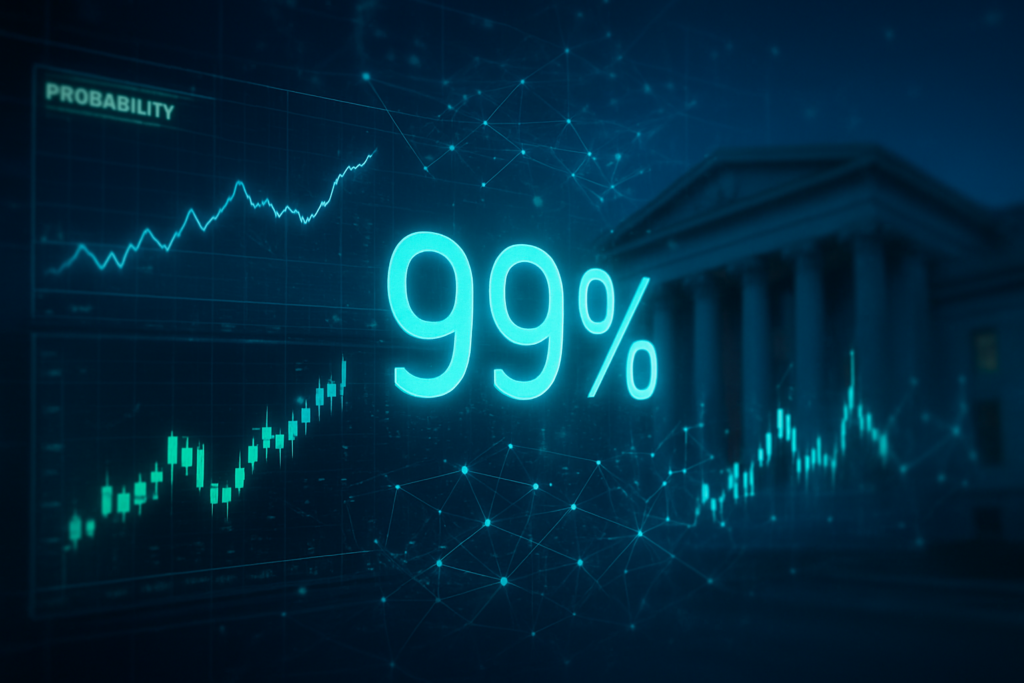
As the Federal Open Market Committee (FOMC) convenes for its first meeting of 2026, the financial world is witnessing a rare moment of absolute conviction. On Polymarket, the world’s largest decentralized prediction market, the probability of the Federal Reserve maintaining interest rates at their current target of 3.50%–3.75% has surged to a staggering 99%. This near-certainty reflects a dramatic shift from late 2025, when traders were still debating the possibility of a fourth consecutive rate cut.
The "No Change" consensus isn't just a hunch; it represents hundreds of millions of dollars in "skin in the game" betting that Chair Jerome Powell will opt for a "wait-and-see" approach. While traditional bank analysts at firms like Goldman Sachs (NYSE: GS) and JPMorgan (NYSE: JPM) were still debating the nuances of "sticky inflation" just weeks ago, prediction markets have been pricing in this pause with cold, mathematical precision. This 99% certainty has transformed the FOMC meeting from a high-stakes guessing game into a validation exercise for the burgeoning field of event-based forecasting.
The Market: What's Being Predicted
The specific market in question focuses on the outcome of the January 27–28, 2026, FOMC meeting. On Polymarket, the "Fed Interest Rate Decision: January 2026" contract has become one of the most liquid markets on the platform, with cumulative trading volume exceeding $471 million. As of this morning, the "No Change" contract is trading at $0.99, meaning a bettor must risk $99 to win a single dollar in profit—a level of confidence rarely seen in macro-economic forecasting.
Other platforms tell a similar story. Kalshi, the federally regulated exchange, shows its "Fed maintains rate" contract trading between 98.5% and 99%. Even the CME Group’s (NASDAQ: CME) FedWatch Tool, which derives its data from 30-day Fed Funds futures, mirrors this sentiment with a 97.2% to 99% probability of a hold. The consistency across decentralized, regulated, and traditional futures markets suggests that the era of "Fed surprises" may be drawing to a close as prediction market liquidity deepens.
The resolution criteria for these contracts are straightforward: the official press release from the Federal Reserve Board of Governors. If the target range remains at 3.50%–3.75% when the statement is released tomorrow afternoon, the "No" contracts will expire at $1.00, rewarding the massive pool of traders who have bet on stability.
Why Traders Are Betting
The 99% certainty is anchored in a trifecta of robust economic data that emerged in early January. First, the December 2025 jobs report showed the unemployment rate ticking down to 4.4%, easing fears of a labor market "hard landing." Second, the Atlanta Fed’s GDPNow tool estimated a blistering 5.4% annualized growth for Q4 2025. Finally, headline CPI has remained stubbornly fixed at 3.0%, well above the Fed's 2% target.
Traders are also employing sophisticated "bonding" strategies. By betting on an outcome with a 99% probability, institutional "whales" are effectively using prediction markets as a high-yield savings account. A 1% return over the 48-hour duration of an FOMC meeting, when compounded throughout the year, represents an annualized return that dwarfs traditional fixed-income products. This "smart money" activity has been bolstered by the Intercontinental Exchange (NYSE: ICE), which recently finalized a $2 billion strategic investment in Polymarket, signaling that the institutional world now views these odds as a primary data source.
Furthermore, a "lame duck" dynamic is influencing the market. Chair Jerome Powell’s term ends in May 2026, and reports of a Department of Justice investigation into the Fed's recent internal protocols have surfaced. Traders believe the Fed will stay the course to maintain a veneer of institutional stability and independence during this period of heightened political and legal scrutiny.
Broader Context and Implications
The shift toward prediction markets marks a fundamental change in how the public and institutions digest economic news. Historically, the "analyst consensus" from major banks like Morgan Stanley (NYSE: MS) or Nomura (NYSE: NMR) was the gold standard. However, data from 2024 and 2025 has begun to flip the script. During the December 2025 "pivot," prediction markets assigned a 95% probability to a rate cut while several major brokerages were still forecasting a hold. The markets were right; the analysts were late.
This trend highlights the "wisdom of the crowd" in absorbing "statistical noise." A late-2025 government shutdown disrupted Bureau of Labor Statistics data, creating confusion for traditional models. Prediction market participants, however, successfully looked past the noisy data to the underlying economic strength, providing a cleaner signal than traditional economist surveys.
Regulatory milestones have also fueled this growth. In November 2025, Polymarket officially returned to the U.S. market after acquiring the licensed exchange QCEX. While Kalshi continues to fight state-level battles in places like Massachusetts and Nevada, the overall trend is toward a regulated, liquid environment where event contracts are treated as legitimate hedging tools rather than mere gambling.
What to Watch Next
While the January "hold" is essentially priced to perfection, the real volatility lies in the "Dot Plot" and Powell’s post-meeting press conference. Traders will be looking for clues regarding the March 2026 meeting. Currently, prediction markets are split, with a 60% chance of a 25-basis-point cut in March, diverging from JPMorgan’s (NYSE: JPM) forecast that the Fed will hold rates steady through the entirety of 2026.
Key milestones to monitor include:
- The February Employment Situation Report: Any spike in unemployment could rapidly shift the March odds.
- The "Shadow Chair" Race: As Powell's term winds down, markets on Kalshi for the next Fed Chair—with names like Rick Rieder and Kevin Warsh leading—will likely begin to correlate with interest rate expectations.
- Inflation Print (Feb 12, 2026): If CPI remains at 3% or higher, the current 60% probability for a March cut may evaporate.
Bottom Line
The 99% certainty on Polymarket and Kalshi regarding the January FOMC decision is more than just a bet; it is a declaration of the new economic order. Prediction markets have evolved from niche experimental platforms into high-fidelity mirrors of reality, often moving faster and more accurately than the most prestigious research desks on Wall Street.
As we move into 2026, the convergence of institutional capital from the likes of ICE (NYSE: ICE) and the regulatory "thaw" for platforms like Polymarket suggests that the "Fed Watch" of the future will happen on a blockchain or a regulated exchange, rather than in a bank's quarterly report. For now, the message from the markets is clear: Jerome Powell has found a level he likes, and he isn't moving until the data forces his hand.
This article is for informational purposes only and does not constitute financial or betting advice. Prediction market participation may be subject to legal restrictions in your jurisdiction.
PredictStreet focuses on covering the latest developments in prediction markets.
Visit the PredictStreet website at https://www.predictstreet.ai/.