
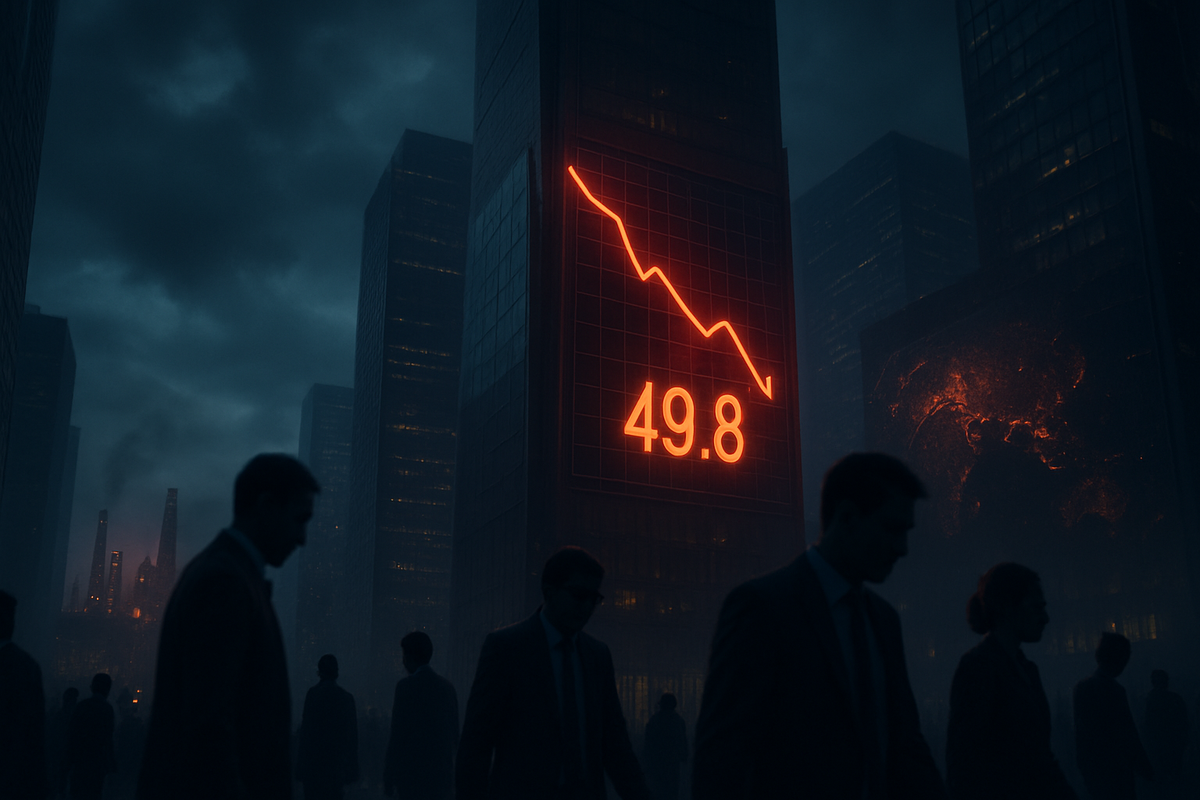
The global economic engine has hit a significant snag as the S&P Global Services PMI plummeted to 49.8 in March 2026, marking the first time the sector has entered contraction territory in over three years. This unexpected dip below the critical 50.0 threshold signals a reversal of the steady post-pandemic recovery and has sent ripples of concern through global markets. The decline is largely attributed to a "toxic cocktail" of skyrocketing energy prices and escalating geopolitical tensions that have abruptly sapped business and consumer confidence.
As the data hit the wires on April 3, 2026, the immediate implications were clear: the resilience of the services sector, which had been the primary driver of GDP growth throughout 2024 and 2025, is failing. Investors reacted sharply, leading to a volatile trading session that saw travel, leisure, and discretionary retail stocks take a significant hit. The narrative in boardrooms and trading floors has shifted overnight from a focus on AI-driven expansion to a defensive posture focused on navigating a potentially stagflationary environment.
The descent into contraction was led by a sharp drop in consumer-facing services, which recorded their steepest declines since the 2009 financial crisis, barring the anomalous pandemic lockdowns. According to the S&P Global report, new business growth has slowed to its lowest rate since early 2024, and for the first time in over a year, service providers have begun a fractional reduction in their workforces. This marks a stark contrast to the robust 51.7 reading seen as recently as February, illustrating how quickly sentiment has soured in the face of external shocks.
The primary catalyst for this sudden downturn is a dramatic escalation in the Middle East, specifically the intensifying conflict involving US-Iranian interests. Following a series of strikes on regional infrastructure, a blockade of the Strait of Hormuz has severely disrupted global shipping and energy flows. This geopolitical "black swan" event has transformed localized instability into a systemic risk for digital infrastructure and global trade, forcing service providers to recalibrate their risk models in real-time.
Fueling the fire is the consequent surge in energy costs, with Brent crude oil prices spiking to between $110 and $118 per barrel. For the services sector—which relies heavily on transportation, logistics, and climate control—this energy shock has been devastating. Input price inflation has reached its highest level of 2026, and unlike previous years, businesses are finding it increasingly difficult to pass these costs onto consumers who are already struggling with "price tag shock" and diminished purchasing power.
Key stakeholders, including the Federal Reserve and the European Central Bank, are now facing a difficult policy dilemma. While the contraction in activity would normally suggest a need for interest rate cuts to stimulate growth, the energy-driven spike in inflation is complicating the path forward. Initial market reactions reflect this confusion, with the S&P 500 recording its worst quarterly performance since 2022 as participants grapple with the dual threats of recession and persistent inflation.
The "Great Divergence" in the markets has never been more apparent, with distinct winners and losers emerging from the PMI data. In the travel and hospitality sector, Marriott International (NASDAQ: MAR) and Hilton Worldwide Holdings Inc. (NYSE: HLT) have been forced to lower their 2026 revenue per available room (RevPAR) forecasts. A noticeable decline in both government travel and discretionary leisure spending has hit these giants hard, as corporate belts tighten and households opt for "staycations" over expensive trips.
The aviation industry is similarly under siege. United Airlines Holdings (NASDAQ: UAL) saw its shares tumble as the cost of jet fuel mirrored the rise in crude oil. The suddenness of the fuel spike has caught many airlines with insufficient hedging, leading to immediate cost-cutting measures. Conversely, the energy giants are reaping the benefits of the supply crunch. ExxonMobil Corp. (NYSE: XOM) and Chevron Corp. (NYSE: CVX) have emerged as the primary "winners" in this environment, hitting record valuations as they capitalize on a global scramble for secure energy supplies.
In the retail space, the impact is bifurcated. Amazon.com, Inc. (NASDAQ: AMZN) has already implemented a 3.5% fuel and logistics surcharge for its third-party sellers to mitigate rising operational costs, a move that could further dampen small business activity on its platform. Meanwhile, Walmart Inc. (NYSE: WMT) has seen its stock hit all-time highs as consumers "trade down" from specialty retailers and mid-tier grocers to seek value. Target Corp. (NYSE: TGT), however, continues to struggle as its reliance on discretionary categories like home goods and apparel makes it vulnerable to the shift in consumer spending toward necessities.
This contraction is not just a statistical blip; it represents a fundamental shift in the broader industry trend from the "goods-to-services" rotation that defined the mid-2020s. Historically, the services sector was seen as the more durable half of the economy, but the current 49.8 reading suggests that even this bastion of growth has a breaking point when faced with systemic energy shocks. The last time the sector dipped below 50 was in January 2023, but analysts note that the current situation is far more "event-driven" and supply-side focused than the demand-cooling contraction seen back then.
The ripple effects are likely to extend to the technology sector, particularly firms specializing in digital transformation and cloud services. As service-oriented businesses like restaurants and consulting firms cut budgets, the "growth at all costs" mentality for software providers may face a reckoning. This mirrors the stagflationary pressures of the 1970s more closely than the 2008 or 2020 crises, as the economy faces a supply shock that cannot be easily solved by central bank liquidity.
On the regulatory front, the contraction may trigger renewed calls for government intervention in energy markets. In the UK and Europe, where new business rates and minimum wage hikes have already squeezed margins, there is growing pressure on policymakers to provide energy subsidies or tax relief to prevent a wave of small business insolvencies. The geopolitical nature of the crisis also means that trade policy will become increasingly weaponized, potentially leading to further fragmentation of global supply chains.
In the short term, the services sector is likely to remain in a defensive crouch. Market participants are split on the Federal Reserve’s next move; while JPMorgan Chase & Co. (NYSE: JPM) suggests a recession probability of 35% by year-end, Goldman Sachs Group, Inc. (NYSE: GS) maintains that a cooling labor market could eventually force the Fed to pivot toward rate cuts despite the energy inflation. This "wait and see" period will likely be characterized by high volatility and a focus on upcoming earnings calls for signs of margin compression.
Strategic pivots are already underway. Many companies are accelerating their investments in automation and AI to reduce their reliance on increasingly expensive labor and energy. The challenge will be managing these capital expenditures during a period of tightening credit. We may see a surge in M&A activity as cash-rich energy and tech firms look to acquire distressed assets in the hospitality and retail sectors at a discount.
Long-term, the 2026 contraction could be remembered as the moment the global economy was forced to finally decouple from volatile energy sources. While the immediate outlook is grim, the crisis may serve as a catalyst for a more rapid transition to renewable energy and more resilient, localized supply chains. However, the path to that future will be fraught with challenges as businesses and consumers navigate the most uncertain economic landscape in a generation.
The dip in the S&P Global Services PMI to 49.8 is a stark reminder that no sector is immune to the forces of geopolitics and energy scarcity. The end of a three-year growth streak marks a pivot point for the global economy, transitioning from an era of post-pandemic recovery into a period of high-stakes risk management. Key takeaways include the vulnerability of consumer-facing sectors to energy shocks and the growing "Great Divergence" between value-oriented retailers and discretionary service providers.
Moving forward, the market will be hyper-focused on two things: the resolution of the Strait of Hormuz blockade and the resilience of the labor market. If employment begins to slide more sharply than the fractional decline seen in March, the narrative of a "soft landing" will likely be abandoned entirely. Investors should watch for the next round of corporate earnings and any shifts in central bank rhetoric that might indicate a change in priority from fighting inflation to supporting growth.
Ultimately, the significance of this event lies in its ability to redefine the market’s expectations. The "AI-driven growth" story of 2025 has been interrupted by the harsh realities of 2026. For the savvy investor, the coming months will require a focus on defensive positioning, a keen eye on energy trends, and the flexibility to adapt as the services sector attempts to find its footing in a fractured global landscape.
This content is intended for informational purposes only and is not financial advice.