
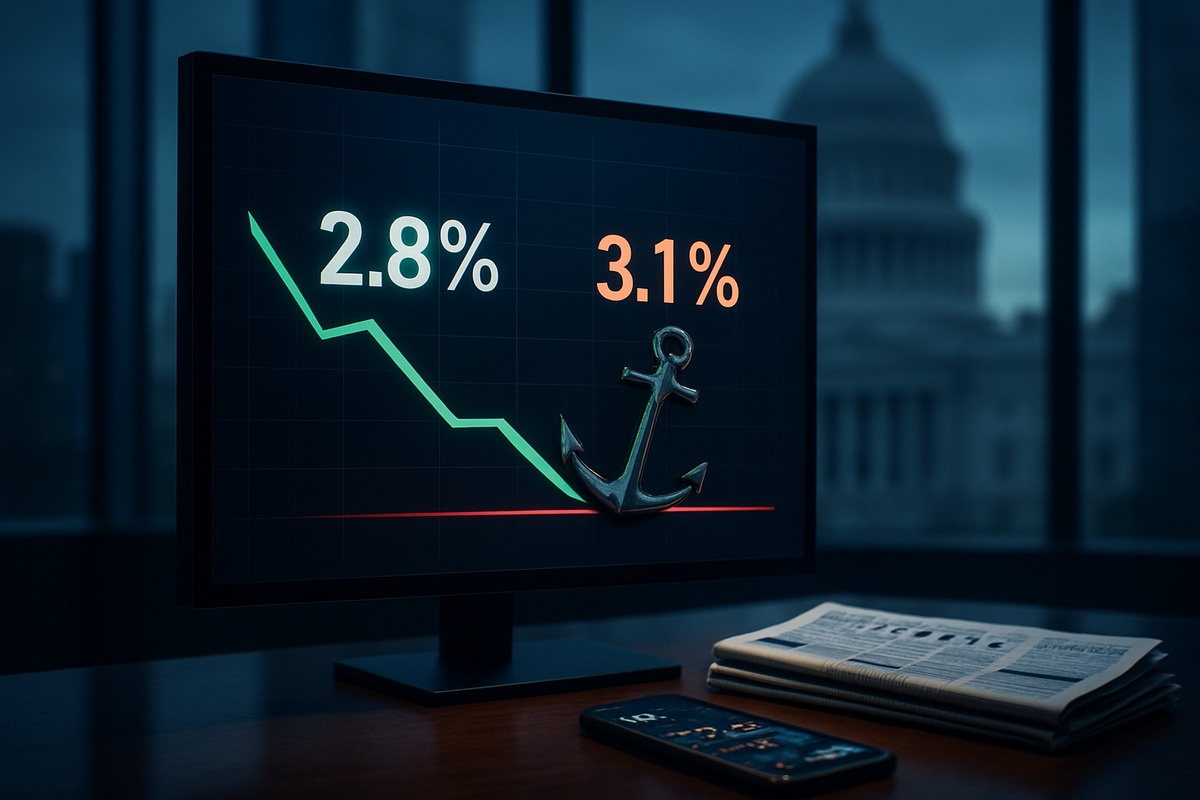
The financial markets were handed a complex puzzle on Friday morning as the Bureau of Economic Analysis released the highly anticipated Personal Consumption Expenditures (PCE) price index for January 2026. Headline inflation cooled more than expected, falling to 2.8% on a year-over-year basis, coming in just below the consensus estimate of 2.9%. While the initial reaction from algorithmic traders sent a wave of green across equity screens, the celebration was short-lived. The Federal Reserve’s preferred inflation gauge, the Core PCE—which strips out volatile food and energy costs—remained stubbornly fixed at 3.1% YoY, signaling that the "last mile" of the inflation fight is proving to be a grueling marathon.
This divergence between headline and core figures suggests a bifurcated economy where falling energy costs are providing relief at the pump, but the cost of living in the service sector remains prohibitively high. For the Federal Open Market Committee (FOMC), today’s data is a "mixed bag" that likely delays any hopes for a significant interest rate cut in the first half of 2026. The SPDR S&P 500 ETF Trust (NYSEARCA: SPY) reflected this uncertainty, swinging between modest gains and losses in early trading as investors digested the implications of a Fed that remains locked in a "restrictive" stance.
Energy Relief Meets Service-Sector Resistance
The January 2026 data release marks a pivotal moment in the current economic cycle. Throughout the latter half of 2025, the U.S. economy benefited from a significant retrenchment in global oil prices and a stabilization of supply chains, which directly contributed to the headline 2.8% figure. However, the 3.1% Core PCE print highlights a troubling trend: "Supercore" inflation—services excluding housing and energy—is not yet retreating. Factors such as rising insurance premiums, increased healthcare costs, and steady wage growth in the service industry have created a "sticky floor" for core prices.
Leading up to this release, the market had been pricing in at least three rate cuts for 2026, spurred by a cooling labor market and optimistic projections for price stability. Fed Chair Jerome Powell and other key stakeholders, including Treasury Secretary Janet Yellen, have spent the last quarter warning that while progress is being made, the path to the 2% target remains "bumpy." Initial market reactions today saw the 2-year Treasury yield—highly sensitive to Fed policy—tick upward as traders realized that the Core PCE beat essentially ties the Fed’s hands for their upcoming May meeting.
The timeline of events leading to this moment has been defined by a "higher-for-longer" narrative that refused to die in 2025. Despite several periods where headline inflation appeared to be on the brink of 2%, the underlying core components have remained resilient. This has forced the Fed to maintain the federal funds rate at levels not seen in two decades, creating a high-interest-rate environment that is now beginning to deeply penetrate the broader economy.
Winners and Losers in a Sticky Inflation Environment
The persistence of core inflation creates a disparate landscape for public companies. Large-cap technology firms with massive cash reserves, such as NVIDIA Corporation (NASDAQ: NVDA) and Microsoft Corporation (NASDAQ: MSFT), continue to act as a "safe haven" for investors. These "quality" stocks are less dependent on external financing and benefit from secular growth trends like artificial intelligence, which remains largely insulated from fluctuating interest rate expectations. However, the broader tech sector remains vulnerable to multiple compression if the "terminal rate"—the peak of the Fed’s interest rate cycle—stays elevated for the remainder of the year.
Conversely, the banking sector faces a complicated outlook. JPMorgan Chase & Co. (NYSE: JPM) and Bank of America Corporation (NYSE: BAC) have benefited from high net interest margins (NIM) over the past two years, but persistent 3%+ core inflation raises the risk of a "hard landing." If the Fed is forced to keep rates high while the economy slows, credit quality could deteriorate, and loan demand could evaporate. We are already seeing signs of this as consumer credit delinquency rates began to creep up in late 2025.
Retailers are also feeling the squeeze of the "sticky" service costs. While energy relief helps companies like Walmart Inc. (NYSE: WMT) keep transportation costs low, the persistent core inflation means their customers are still paying more for essential services like insurance and rent, leaving less discretionary income for other goods. Luxury retailers and high-end brands may remain resilient, but mid-tier consumer discretionary stocks are likely to face significant margin pressure as they struggle to pass on further price hikes to a price-sensitive consumer base.
A Historical Echo: The 'Last Mile' Challenge
The current divergence between headline and core inflation is not without precedent. Economic historians point to the late 1970s and, more recently, the 2023-2024 disinflation cycle as periods where headline numbers often "faked out" the markets while underlying prices remained hot. The 2026 scenario suggests that the U.S. is caught in a similar "plateau" phase. This fits into a broader industry trend where globalization—once a major deflationary force—is being replaced by "near-shoring" and regional trade blocs, which tend to be more inflationary over the long term.
The ripple effects of the 3.1% Core PCE will be felt internationally. As the Fed maintains higher rates to combat core stickiness, the U.S. Dollar is likely to remain strong against the Euro and the Yen. This creates a challenging environment for multi-national corporations like Apple Inc. (NASDAQ: AAPL), which must contend with unfavorable currency translation effects when reporting earnings from overseas markets. Furthermore, the regulatory environment is shifting, with increased scrutiny on "junk fees" and service-sector pricing as the government attempts to assist the Fed’s inflation fight through policy measures.
Comparing this to the 2024 "re-acceleration scare," the 2026 market is more fragile. Investors have been waiting for years for a return to the "neutral rate" of interest, and today’s data suggests that the wait will continue. The Fed’s credibility is on the line; cutting rates too early while core inflation is at 3.1% could risk a second wave of inflation, a mistake the central bank is desperate to avoid.
What Comes Next: Navigating the 2026 Rate Path
In the short term, volatility is the only certainty. Markets will now pivot their focus to the upcoming labor market reports to see if the "sticky" core inflation is being sustained by a tight job market. If unemployment remains low, the Fed will have all the cover it needs to keep rates at current levels through the summer. If the labor market begins to crack while core inflation stays high, the Fed will face the dreaded "stagflationary" dilemma, where it must choose between protecting jobs or protecting the dollar’s purchasing power.
Strategically, investors may need to move away from growth-at-any-price stocks and toward companies with strong pricing power and high margins. The potential for a "strategic pivot" by the Fed later in the year still exists, but it would likely require a significant drop in month-over-month core inflation readings in February and March. If the Core PCE remains above 3% by mid-year, the market may have to price out rate cuts for the entirety of 2026, a scenario that would require a major revaluation of the equity risk premium.
Conclusion: The Inflation Marathon Continues
Today’s January PCE data confirms that the battle against inflation is entering a new, more complicated phase. The fall of headline PCE to 2.8% is an encouraging sign that the external shocks of previous years are fading, but the 3.1% Core PCE reading serves as a stark reminder that domestic price pressures are deeply embedded in the service economy. For investors, the "higher-for-longer" mantra is no longer just a warning—it is the reality of the 2026 financial landscape.
Moving forward, the market will be hyper-sensitive to any commentary from FOMC members regarding the "Supercore" components. The key takeaway for the coming months is that the "Goldilocks" scenario—where inflation falls smoothly to 2% without a recession—is becoming increasingly difficult to achieve. Investors should watch for a potential rotation into defensive sectors and maintain a close eye on the 10-year Treasury yield as a barometer for long-term growth and inflation expectations. The path to 2% is clearly visible, but as today’s data shows, we aren’t there yet.
This content is intended for informational purposes only and is not financial advice.