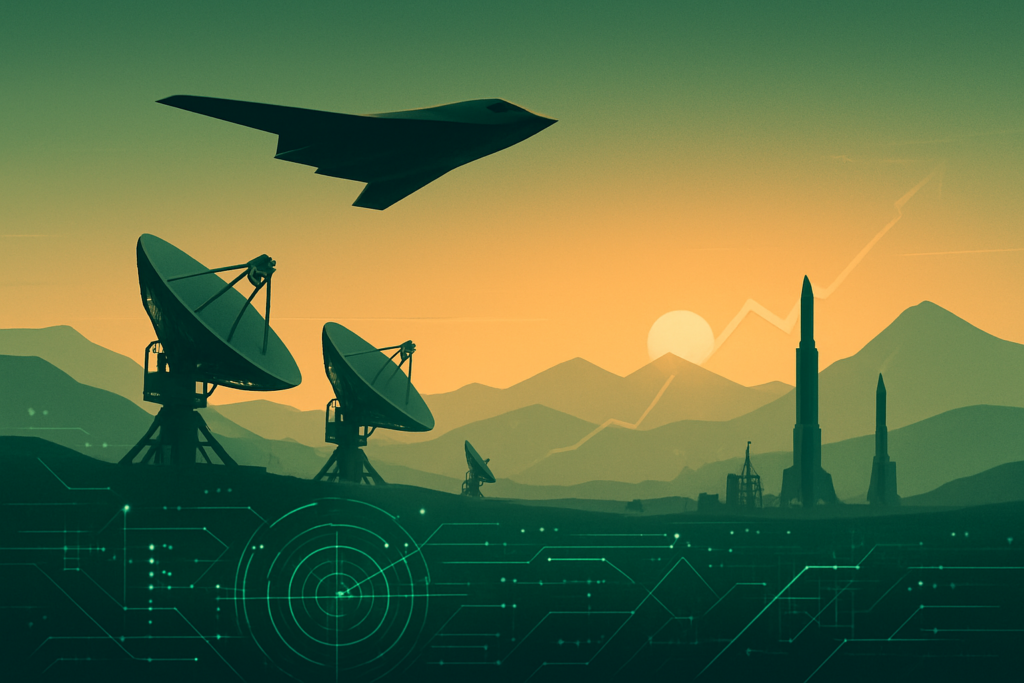
As of March 9, 2026, Northrop Grumman Corporation (NYSE: NOC) stands as a foundational pillar of the United States’ national security architecture. In an era defined by the return of "Great Power Competition," Northrop Grumman has transitioned from a traditional defense contractor into a high-tech pioneer of the "Sixth Generation" of warfare. With its dual role in modernizing the nuclear triad and spearheading the militarization of space, the company has become a focal point for investors seeking exposure to long-term, government-backed technological cycles. While the defense sector often moves in lockstep with geopolitical tensions, Northrop Grumman’s current relevance is driven by specific, multi-decade franchises—most notably the B-21 Raider stealth bomber—and its aggressive pivot toward digital engineering under a unified leadership vision.
Historical Background
The lineage of Northrop Grumman is a story of two aviation giants. Jack Northrop, a visionary obsessed with the "flying wing" design, founded Northrop Aircraft in 1939. His designs were decades ahead of their time, eventually manifesting in the B-2 Spirit stealth bomber. Parallel to this, Grumman Aerospace, founded in 1929, became the primary provider of carrier-based aircraft for the U.S. Navy and the builder of the Apollo Lunar Module.
The two entities merged in 1994, creating a defense behemoth capable of competing with the likes of Lockheed Martin and Boeing. Over the following three decades, the company strategically shed non-core businesses and doubled down on high-end electronics and space. A transformative milestone occurred in 2018 with the $9.2 billion acquisition of Orbital ATK. This move integrated solid rocket motor production and satellite manufacturing into Northrop’s portfolio, positioning the company as the lead contractor for the next generation of Intercontinental Ballistic Missiles (ICBMs) and a critical partner for NASA’s Artemis missions.
Business Model
Northrop Grumman operates through four primary segments, each aligned with high-priority Pentagon modernization goals:
- Aeronautics Systems: The crown jewel of the company, housing the B-21 Raider, the E-2D Advanced Hawkeye, and high-altitude autonomous systems like the Global Hawk and MQ-4C Triton.
- Defense Systems: Focuses on the "Sentinel" (LGM-35A) ICBM program, tactical missiles, and large-scale ammunition production. This segment is currently the lead on the U.S. nuclear modernization effort.
- Mission Systems: Provides the "brains" of modern platforms, including advanced sensors, cyber solutions, and electronic warfare suites. It is a major subcontractor for the F-35 Lightning II program (NYSE: LMT).
- Space Systems: Specializes in satellites, human spaceflight components, and launch vehicles. Following the Orbital ATK merger, this segment has seen the fastest growth, driven by both military and civilian space contracts.
The company’s customer base is overwhelmingly the U.S. Department of Defense (DoD) and intelligence agencies, though international sales to NATO allies and Pacific partners have surged to nearly 15% of total revenue.
Stock Performance Overview
Over the last decade, NOC has been a standout performer in the aerospace and defense (A&D) sector.
- 10-Year Horizon: Investors who bought in 2016 have seen substantial capital appreciation, with the stock significantly outperforming the S&P 500 during the late 2010s as the U.S. shifted focus to near-peer threats.
- 5-Year Horizon: Performance was characterized by volatility during the early 2020s due to supply chain disruptions but recovered sharply as the B-21 Raider moved into flight testing and global defense budgets surged following the 2022 invasion of Ukraine.
- 1-Year Horizon: As of March 2026, the stock is trading near all-time highs, hovering around $756. This recent rally is attributed to the U.S. Air Force’s 2026 decision to accelerate B-21 production capacity and a reduction in investor fears regarding the Sentinel program’s cost overruns.
Financial Performance
Northrop Grumman’s 2025 fiscal year demonstrated financial resilience despite inflationary pressures.
- Revenue: 2025 sales hit $42.0 billion, a steady climb from $41.0 billion in 2024.
- Earnings: Net earnings for 2025 were $4.2 billion, or $29.08 per share.
- Operating Margins: Margins remained healthy at 10.8%, though they were slightly dampened by a $477 million loss provision related to the low-rate initial production (LRIP) of the B-21.
- Backlog: The company enters 2026 with a massive $95.7 billion backlog—nearly 2.3 years of revenue.
- 2026 Guidance: Management expects 2026 revenue to land between $43.5 billion and $44.0 billion, with free cash flow projected to reach $3.5 billion as production efficiencies improve.
Leadership and Management
Since 2019, Kathy Warden has served as Chairman, CEO, and President. Warden is widely regarded as one of the most effective leaders in the defense industry, recognized for her "Digital-First" strategy. Under her tenure, Northrop has aggressively adopted "Digital Twin" technology, which allows for the virtual testing of aircraft and missiles before a single piece of metal is cut. This approach was credited with the B-21 Raider’s relatively smooth transition from design to flight.
Warden’s strategy also emphasizes shareholder returns; the company has a consistent track record of returning nearly 100% of free cash flow to investors through dividends and aggressive share buybacks, which has bolstered institutional confidence during periods of program uncertainty.
Products, Services, and Innovations
Innovation at Northrop Grumman is currently centered on three technological "moats":
- Stealth and Digital Engineering: The B-21 Raider is the world’s first digital aircraft, designed to be upgraded via software updates rather than hardware overhauls.
- Solid Rocket Motors (SRM): Through its Space Systems segment, Northrop is the world's leading producer of SRMs, which power everything from the SLS moon rocket to the Sentinel ICBM.
- Advanced Sensing: The company’s APG-81 and APG-83 AESA radars are industry benchmarks, providing the superior "eyes and ears" for the F-35 and F-16 fleets globally.
Competitive Landscape
Northrop Grumman competes in a "Big Five" oligopoly alongside Lockheed Martin (NYSE: LMT), RTX Corporation (NYSE: RTX), General Dynamics (NYSE: GD), and Boeing (NYSE: BA).
- Strengths: Northrop holds a virtual monopoly on the ground-based leg of the nuclear triad (Sentinel) and a unique lead in flying-wing stealth technology.
- Weaknesses: Compared to Lockheed Martin, Northrop lacks a high-volume "cash cow" comparable to the F-35 fighter jet, though the B-21 is expected to fill this role over the next decade.
- Differentiation: Northrop’s focus on the "space-to-ground" kill chain—integrating satellite data directly with bombers and missiles—gives it a technological edge in the emerging Joint All-Domain Command and Control (JADC2) market.
Industry and Market Trends
The defense sector in 2026 is governed by three macro trends:
- The Nuclear Renaissance: The U.S. is currently engaged in its first full-scale nuclear modernization since the Cold War, a multi-decade project that secures Northrop's revenue for 20+ years.
- Space Militarization: The shift of the Space Force from an auxiliary service to a primary combatant command has increased the demand for Northrop’s rapid-launch capabilities and jam-resistant satellites.
- Supply Chain Localization: To mitigate risks from China, Northrop has spent the last two years "friend-shoring" its supply chain, particularly in microelectronics and rare earth materials.
Risks and Challenges
Despite its strong position, Northrop Grumman faces significant hurdles:
- The Sentinel Breach: In 2024, the Sentinel ICBM program suffered a Nunn-McCurdy Act breach due to an 80% cost overrun (now totaling $141 billion). While the program was recertified in 2025, the risk of future budget caps or political opposition to ICBM funding remains a "sword of Damocles" over the Defense Systems segment.
- Fixed-Price Contracts: Like its peers, Northrop is burdened by legacy fixed-price contracts signed before the post-pandemic inflationary spike. These contracts can lead to "earnings "leaks" if production costs exceed pre-set prices.
- Labor Shortages: The need for specialized engineers with high-level security clearances remains a bottleneck for accelerating the B-21 and Space programs.
Opportunities and Catalysts
- B-21 Production Ramp: The U.S. Air Force signaled in early 2026 that it may increase its total B-21 buy from 100 aircraft to as many as 150. Any official contract expansion would be a major upside catalyst for the stock.
- Hypersonics: Northrop is a lead developer of scramjet engines for hypersonic missiles. A successful flight test of a production-ready hypersonic weapon in late 2026 could unlock billions in new procurement funding.
- International Sales: Growing demand in Poland, Germany, and Japan for Integrated Air and Missile Defense (IAMD) systems provides a high-margin growth lever outside of the U.S. DoD budget.
Investor Sentiment and Analyst Coverage
Wall Street sentiment on NOC as of March 2026 is "Moderate Buy." Analysts favor the company’s visibility into long-term cash flows due to its involvement in the nuclear triad. Institutional ownership remains high at over 80%, with major positions held by Vanguard, BlackRock, and State Street. Retail sentiment is generally positive, viewing NOC as a "defensive" stock that provides a hedge against geopolitical instability. Some analysts, however, remain cautious about the capital expenditure required to scale B-21 production, which may temporarily limit dividend growth.
Regulatory, Policy, and Geopolitical Factors
The regulatory environment is favorable but complex. The 2026 National Defense Authorization Act (NDAA) reflected a bipartisan consensus to sustain high levels of defense spending, specifically targeting Pacific deterrence. However, Northrop must navigate strict ITAR (International Traffic in Arms Regulations) which can slow international deals. Geopolitically, the company is a direct beneficiary of increased NATO spending and the AUKUS pact (Australia, UK, US), which has opened new doors for undersea and autonomous technology exports.
Conclusion
Northrop Grumman enters the second half of the 2020s as an indispensable asset to Western security. The company has successfully navigated the transition from legacy systems to the digital era, exemplified by the B-21 Raider. While the Sentinel program’s cost overruns and the inherent risks of fixed-price development contracts require close monitoring, the company’s record $95.7 billion backlog and its dominant position in space and stealth provide a formidable economic moat. For investors, Northrop Grumman represents a play on long-cycle technological superiority, offering a blend of stability and high-tech growth in an increasingly volatile world.
This content is intended for informational purposes only and is not financial advice.