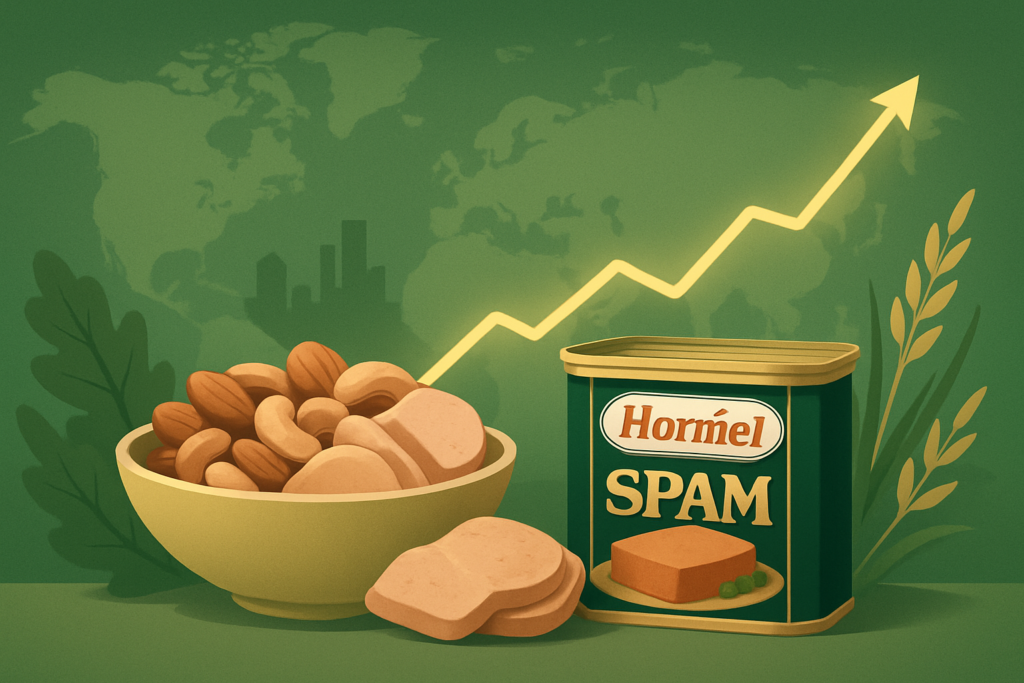
As of March 9, 2026, Hormel Foods Corporation (NYSE: HRL) finds itself at a critical juncture in its 135-year history. Known globally for its iconic SPAM® brand and its status as a "Dividend King," the Austin, Minnesota-based company is currently navigating a period of profound structural transformation. Following a multi-year stretch of equity underperformance and significant macroeconomic headwinds—ranging from persistent avian influenza to inflationary pressures on consumer wallets—Hormel is aggressively pivoting away from its legacy as a commodity meatpacker toward a future as a global, high-margin, "brand-first" food company. This feature explores the company’s current strategic overhaul, financial health, and the competitive hurdles it must overcome to regain its former status as a staple of defensive investment portfolios.
Historical Background
Founded in 1891 by George A. Hormel, the company began as a small retail meat shop in Austin, Minnesota. George’s focus on quality and efficiency allowed the company to survive the volatility of the late 19th-century meat market. The most significant early milestone occurred in 1926 with the introduction of the world's first canned ham, followed by the 1937 launch of SPAM®, a product that would become a global cultural icon and a logistical staple for Allied forces during World War II.
Over the decades, Hormel transformed through strategic diversification. The 1960s and 70s saw the company move into more specialized protein products, while the late 20th century marked its entry into the "better-for-you" and organic markets with the acquisition of Applegate Farms in 2015. Perhaps the most transformative moment in recent history was the 2021 acquisition of the Planters® snacking business for $3.35 billion, the largest in the company's history, signaling a definitive shift into the high-growth snacking category.
Business Model
Hormel’s business model is centered on "value-added" protein and snacking products. Unlike traditional meatpackers who are heavily exposed to the volatility of live animal prices, Hormel focuses on processing those raw materials into branded goods that command premium pricing and customer loyalty.
In early 2026, the company operates through three primary reporting segments:
- Retail (62% of Revenue): This segment includes household names like Planters®, SPAM®, Jennie-O®, Applegate®, and Hormel® Chili. It focuses on the consumer-packaged goods (CPG) market through grocery stores and mass merchandisers.
- Foodservice (32% of Revenue): Hormel is a dominant player in providing high-quality protein solutions to restaurants, hospitals, and educational institutions. This segment has historically offered higher margins than retail due to the technical requirements of large-scale kitchen prep.
- International (6% of Revenue): This segment represents the company’s expansion into global markets, particularly China and Brazil, through both exports and local manufacturing facilities.
Stock Performance Overview
The last decade has been a tale of two eras for HRL investors. Between 2014 and 2019, Hormel was a darling of the defensive sector, prized for its low volatility and consistent dividend growth. However, the period from 2021 to 2025 proved exceptionally difficult.
As of March 9, 2026, the stock’s performance metrics reflect these challenges:
- 1-Year Performance: Down approximately 15%, as the market reacted to leadership transitions and a $234 million impairment charge related to international investments in late 2025.
- 5-Year Performance: Down roughly 45%. The stock has struggled to recover from post-pandemic highs, significantly trailing the S&P 500 during a period of rapid tech-led growth.
- 10-Year Performance: Down nearly 30% in total return terms.
Currently trading near $24.42, the stock is testing multi-year lows, though value-oriented investors are beginning to eye the dividend yield, which has climbed significantly as the price compressed.
Financial Performance
In its most recent quarterly filings (Q1 2026), Hormel reported net sales of $3.03 billion, showing a modest organic growth rate of 2%. While revenue has stabilized, profitability remains the primary concern for analysts.
- Margins: Adjusted operating margins sit at approximately 8.2%. This is a recovery from the sub-6% levels seen in late 2025 but remains below the company's historical double-digit norms.
- Debt Profile: Despite the massive Planters acquisition, Hormel maintains a relatively conservative balance sheet with $2.9 billion in long-term debt and a Debt-to-Equity ratio of 0.36.
- Dividends: Hormel remains a "Dividend King," having increased its annual dividend for 60 consecutive years. Management has reiterated its commitment to the dividend, though payout ratios have become uncomfortably high (near 80-85% of earnings) in recent quarters.
Leadership and Management
Hormel is currently in a transitional leadership phase. In late 2025, long-time CEO Jim Snee retired, moving into a Strategic Advisor role until March 2027. Taking the helm as Interim CEO is Jeffrey M. Ettinger, who previously served as CEO from 2005 to 2016. Ettinger’s return is seen as a "steady hand" approach while the Board searches for a permanent successor.
Working alongside Ettinger is John Ghingo, the President of Hormel Foods, who is widely seen as the architect of the "Transform & Modernize" initiative. This program aims to generate $250 million in annual savings by 2026 through supply chain optimization and portfolio simplification. The leadership team’s reputation for governance remains high, though pressure is mounting from institutional investors for a more aggressive growth strategy.
Products, Services, and Innovations
Innovation at Hormel is currently focused on two pillars: Convenience and Protein-Plus.
- Planters® Revitalization: Hormel is moving Planters beyond simple nut jars into "snack kits" that include protein pairings, targeting the on-the-go consumer.
- Jennie-O® Pivot: In early 2026, Hormel finalized the sale of its commodity "whole-bird" turkey business. The brand now focuses exclusively on high-margin ground turkey, deli meats, and pre-marinated products.
- R&D Pipeline: The company is investing heavily in "nutrient-dense" mini-snacks and portion-controlled formats designed to appeal to the growing population of consumers using GLP-1 weight-loss medications, who prioritize high protein in smaller volumes.
Competitive Landscape
Hormel operates in a hyper-competitive environment dominated by global giants:
- Tyson Foods (NYSE: TSN): Tyson is the primary rival in the protein space. While Tyson has a larger scale, it is also more exposed to the volatile commodity cycles of chicken and beef.
- Conagra Brands (NYSE: CAG) & Kraft Heinz (NASDAQ: KHC): These peers compete with Hormel in the shelf-stable and refrigerated aisles. Hormel’s edge has traditionally been its specialized focus on protein, whereas Conagra and Kraft Heinz have much broader, and sometimes more diluted, portfolios.
- Private Label: Perhaps the greatest competitor in 2026 is the rise of grocery store house brands (e.g., Kirkland, Great Value). As inflation pinched consumer budgets, Hormel’s premium brands like Applegate faced significant pressure from these lower-cost alternatives.
Industry and Market Trends
The "Protein-Plus" trend is the defining theme of 2026. Consumers are increasingly seeking protein in every meal occasion, from breakfast bars to midnight snacks. However, the industry is also grappling with "Input Volatility." In 2025 and early 2026, pork cutout and beef costs rose between 10% and 25%, making it difficult for food processors to maintain margins without alienating price-sensitive shoppers.
Additionally, the "Transform & Modernize" trend is sweeping the sector. Like Hormel, many legacy food companies are shedding their commodity-heavy divisions to focus on "leaner" portfolios that can withstand the logistical disruptions that have become a hallmark of the 2020s.
Risks and Challenges
Hormel faces three primary risks that have weighed on its valuation:
- Avian Influenza (HPAI): The Jennie-O turkey business has been plagued by recurring outbreaks of avian flu, which caused massive supply gaps and increased costs through late 2025.
- The "GLP-1 Threat": While Hormel is pivoting its products to fit, there is a broader market fear that weight-loss drugs will lead to a secular decline in overall calorie consumption, particularly in the snacking and processed meat categories.
- Consumer Trading Down: If the macro economy remains sluggish, the shift toward private-label products may become a permanent behavioral change, eroding the "brand equity" that Hormel has spent a century building.
Opportunities and Catalysts
Despite the headwinds, several catalysts could spark a recovery:
- International Growth: Hormel’s expansion in China, specifically a new meat snacking facility in Jiaxing, is expected to reach full capacity by mid-2026.
- Cost Savings realization: If the "Transform & Modernize" program hits its $250 million savings target, it could provide an immediate 100-200 basis point boost to operating margins.
- M&A Potential: With a conservative debt level, Hormel is well-positioned to acquire smaller, high-growth "insurgent" brands in the health and wellness space, similar to its acquisition of Justin’s or Applegate.
Investor Sentiment and Analyst Coverage
As of early 2026, Wall Street sentiment is best described as "cautiously optimistic." The consensus rating is a Hold/Moderate Buy, with an average price target of $27.50.
- Institutional Moves: Hedge fund activity has been mixed, with some value-oriented funds increasing positions to capture the 4.5%+ dividend yield, while growth-oriented institutional investors remain on the sidelines.
- Retail Chatter: On retail platforms, Hormel is often discussed as a "forgotten" Dividend King, with retail investors debating whether the stock is a "value trap" or a "generational buying opportunity."
Regulatory, Policy, and Geopolitical Factors
Geopolitics play a significant role in Hormel’s international ambitions. In China, new 2026 regulations have tightened oversight on "ghost kitchens" and influencer (KOL) marketing, forcing Hormel to adjust its digital advertising strategy. In Brazil, the company’s Ceratti brand has faced "credit stress" within the regional agricultural sector, which has seen rising defaults in 2025.
Domestically, U.S. food safety regulations regarding "Forever Chemicals" (PFAS) in packaging are a looming concern, requiring Hormel to invest in new, compliant packaging materials across its entire retail portfolio by 2027.
Conclusion
Hormel Foods (NYSE: HRL) is a company in the midst of a necessary, albeit painful, evolution. It is no longer just a purveyor of canned meat; it is a snacking and protein powerhouse attempting to find its footing in a post-inflationary, health-conscious world. For investors, the decision to hold HRL rests on a belief in the "Transform & Modernize" strategy and the company's ability to protect its brand margins against private-label encroachment. While the stock has been a laggard for years, its "Dividend King" status and specialized focus on the "Protein-Plus" trend provide a floor for the valuation. Investors should watch for the announcement of a permanent CEO and the margin performance in the upcoming Q2 and Q3 reports as the primary indicators of a potential turnaround.
This content is intended for informational purposes only and is not financial advice.