
Retail traders are apparently missing out on the upside opportunity in Chevron (CVX) and other integrated oil giants. With a raging inferno in the Middle East, the obvious potential bottleneck is the Strait of Hormuz. As multiple pundits on the internet have asserted, if Iran blockades this critical waterway, several economic powerhouses could be brought to their knees.
It’s the kind of narrative that fuels the doom-and-gloom, buy-gold-or-else ideologies. I have to say it’s quite compelling stuff. At the same time, there’s a decent chance that it’s overplayed.
To make a long story short, the integrated oil giants don’t necessarily share a directly positive correlation with fossil fuel prices — and much of this underlying drag stems from the refining side. While rising fuel prices can be a cynical positive for supermajors, a more relevant statistic is the crack spread. This ratio is the difference between the price of crude oil and the prices of petroleum products (such as gasoline) refined from it.
To be sure, the current crack spread is roughly about $37, which is historically very high. That’s not surprising given the spike in refined fuel prices across the nation due to the Iran conflict. However, industry data indicates that the crack spread has been declining daily by around $7.66. In other words, the refining margins are compressing following the initial geopolitical shock.
Where it gets a little problematic for something like CVX stock is the latest headline. Earlier on Monday, equities closed higher after President Donald Trump stated that the Iran war is “pretty much” complete. If I may be blunt, it’s difficult to take these words seriously considering the haphazard messaging behind the military campaign.
Nevertheless, if the market believes some semblance of stability will enter the region, betting heavily on CVX stock may not be the most prudent course of action. Sure enough, it also seems that the smart money is pensive on integrated oil.
When Talking About CVX Stock, Just Follow the (Smart) Money
It’s one thing to give an opinion about an investment idea; it’s quite another when you’re basing the analysis on the activities of the most sophisticated participants in the room. The central motif behind screeners like options flow — which focuses exclusively on big block transactions likely placed by institutional investors — is that you can ride the coattails of power brokers.
On Monday, net trade sentiment in the derivatives market (for big block trades) fell to roughly $2.5 million below parity. Granted, most of the day’s bearish trades centered on credit-based calls. However, sentiment may be turning as smart money traders may be pivoting away from directionally bullish wagers.
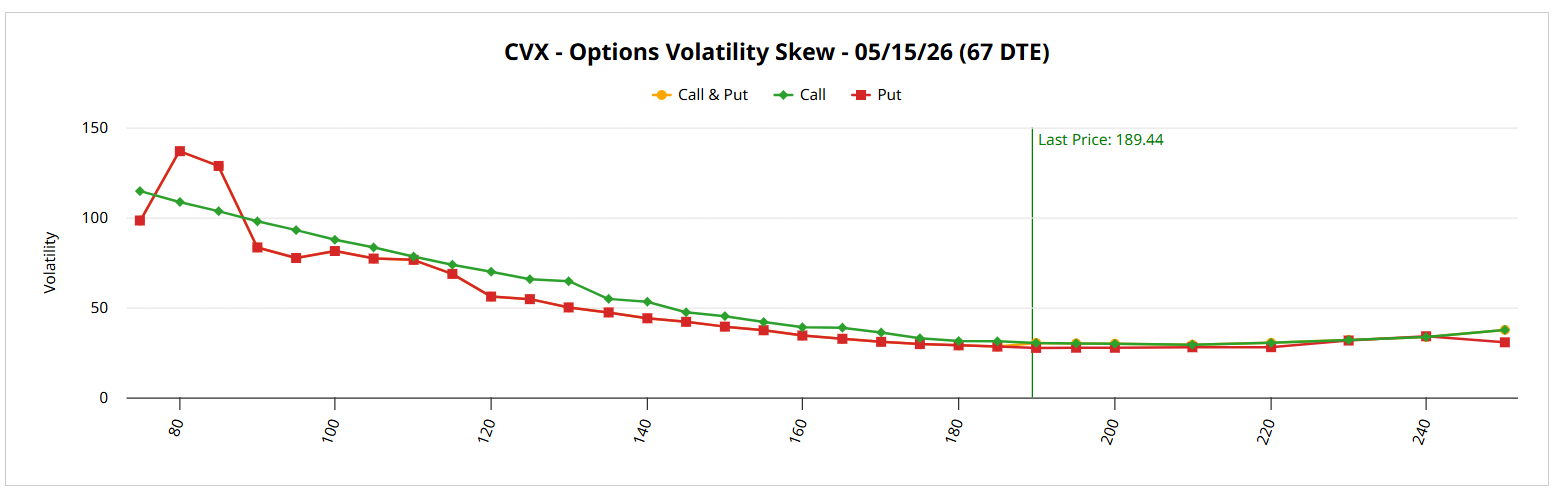
Indeed, the pensiveness becomes even more obvious when looking at the volatility skew for the May 15 expiration date. Definitionally, the skew identifies implied volatility (IV) — or a stock’s potential range of motion — across the strike price spectrum of a given options chain.
Again, in the case of the May 15 date, the curvature of the skew rises conspicuously at the left-hand boundaries (toward the lowest strike prices). This setup suggests that the net priority is mitigation of downside tail risk. What makes this bias all the more evident is that toward the right-hand boundaries, the curvature is relatively flat.
Using options-focused lexicon, we would say that smart money traders are not positioned for upside convexity. In other words, those traders who are still engaged in CVX stock are aiming not to lose rather than to run up the score.
That being said, the lack of demand for calls could mean that bullish strategies may be discounted on a volatility basis. However, what I’m concerned about is the potential lack of breadth. According to Barchart’s gamma exposure by strike screener, there’s heavy gamma clustering around the $200 strike price.
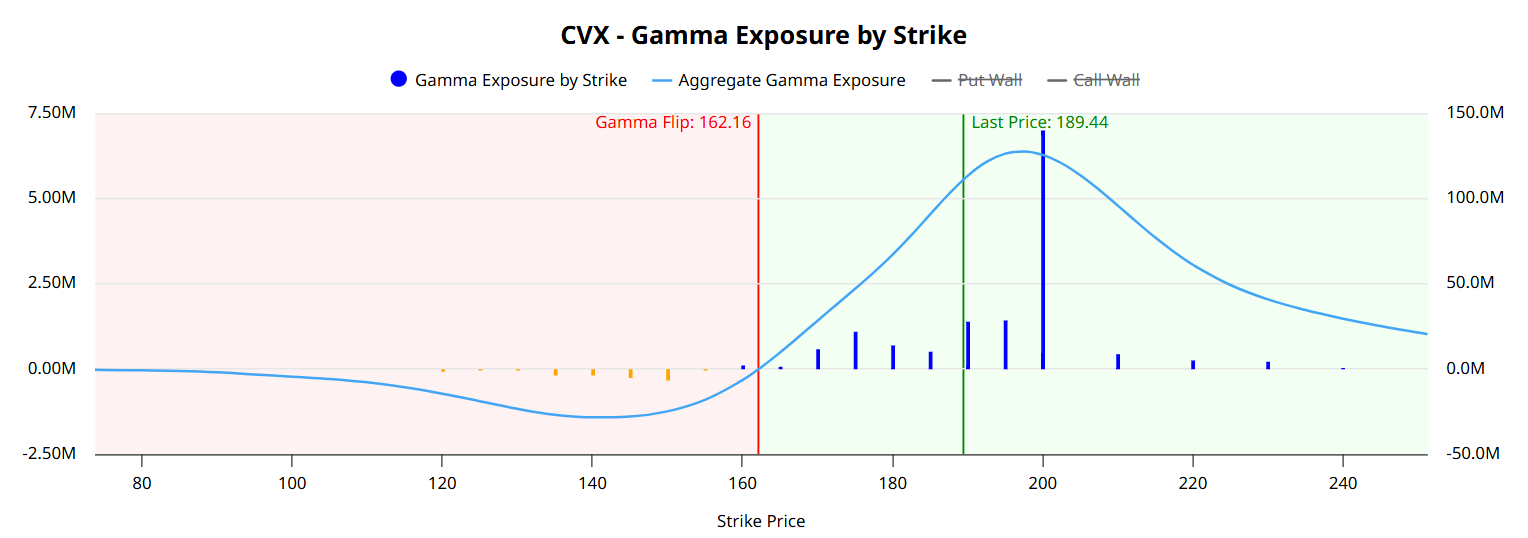
Basically, if CVX stock rises to that point, dealers could begin selling shares of the oil giant to remain delta-neutral. At less than 6% higher from the current spot, this gap doesn’t seem big enough to justify a heavy long exposure.
Taking a Skeptical View of Chevron Stock
Looking at the Expected Move calculator, the forward dispersion for the May 15 expiration date is given as landing between $172.99 and $205.89. Here too, I have reservations about the bullish narrative for Chevron stock. While the realistic upside target is close to $206, dealers will be tempted to balance their books prior to this theoretical benchmark.
With the crack spread falling daily, I’m not sure if optimism at this moment is the right call.
For those who are extremely aggressive, I believe there may be a rational case for the 185/180 bear put spread expiring May 15. Should CVX stock fall below the $180 strike at expiration, the maximum payout would be over 108%.
On the date of publication, Josh Enomoto did not have (either directly or indirectly) positions in any of the securities mentioned in this article. All information and data in this article is solely for informational purposes. For more information please view the Barchart Disclosure Policy here.
More news from Barchart