In a landmark moment for the synthetic media landscape, London-based AI powerhouse Synthesia has reached a staggering $4 billion valuation following a $200 million Series E funding round. Announced on January 26, 2026, the round was led by Google Ventures (NASDAQ: GOOGL), with significant participation from NVentures, the venture capital arm of NVIDIA (NASDAQ: NVDA), alongside long-time backers Accel and Kleiner Perkins. This milestone is not merely a reflection of the company’s capital-raising prowess but a signal of a fundamental shift in how the world’s largest corporations communicate, train, and distribute knowledge.
The valuation comes on the heels of Synthesia crossing $150 million in Annual Recurring Revenue (ARR), a feat fueled by its near-total saturation of the corporate world; currently, over 90% of Fortune 100 companies—including giants like Microsoft (NASDAQ: MSFT), SAP (NYSE: SAP), and Xerox (NASDAQ: XRX)—have integrated Synthesia’s AI avatars into their daily operations. By transforming the static, expensive process of video production into a scalable, software-driven workflow, Synthesia has moved synthetic media from a "cool experiment" to a mission-critical enterprise utility.
The Technical Leap: From Broadcast Video to Interactive Agents
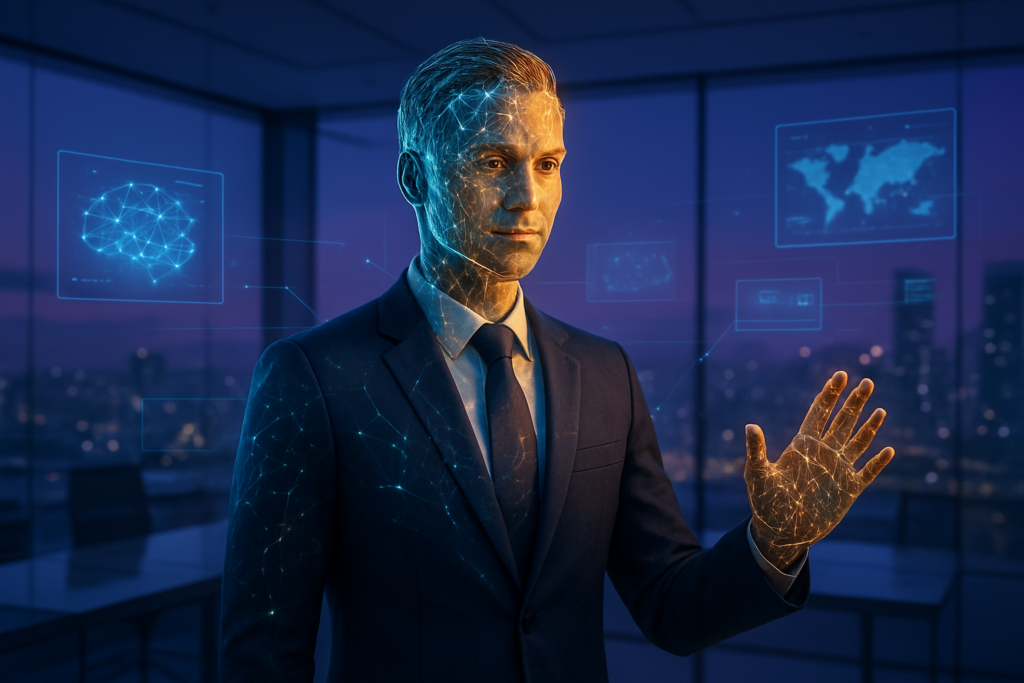
At the heart of Synthesia’s dominance is its recent transition from "broadcast video"—where a user creates a one-way message—to "interactive video agents." With the launch of Synthesia 3.0 in late 2025, the company introduced avatars that do not just speak but also listen and respond. Built on the proprietary EXPRESS-1 model, these avatars now feature full-body control, allowing for naturalistic hand gestures and postural shifts that synchronize with the emotional weight of the dialogue. Unlike the "talking heads" of 2023, these 2026 models possess a level of physical nuance that makes them indistinguishable from human presenters in 8K Ultra HD resolution.
Technical specifications of the platform have expanded to support over 140 languages with perfect lip-syncing, a feature that has become indispensable for global enterprises like Heineken (OTCMKTS:HEINY) and Merck (NYSE: MRK). The platform’s new "Prompt-to-Avatar" capability allows users to generate entire custom environments and brand-aligned digital twins using simple natural language. This shift toward "agentic" AI means these avatars can now be integrated into internal knowledge bases, acting as real-time subject matter experts. An employee can now "video chat" with an AI version of their CEO to ask specific questions about company policy, with the avatar retrieving and explaining the information in seconds.
A Crowded Frontier: Competitive Dynamics in Synthetic Media
While Synthesia maintains a firm grip on the enterprise "operating system" for video, it faces a diversifying competitive field. Adobe (NASDAQ: ADBE) has positioned its Firefly Video model as the "commercially safe" alternative, leveraging its massive library of licensed stock footage to offer IP-indemnified content that appeals to risk-averse marketing agencies. Meanwhile, OpenAI’s Sora 2 has pushed the boundaries of cinematic storytelling, offering 25-second clips with high-fidelity narrative depth that challenge traditional film production.
However, Synthesia’s strategic advantage lies in its workflow integration rather than just its pixels. While HeyGen has captured the high-growth "personalization" market for sales outreach, and Hour One remains a favorite for luxury brands requiring "studio-grade" micro-expressions, Synthesia has become the default for scale. The company famously rejected a $3 billion acquisition offer from Adobe in mid-2025, a move that analysts say preserved its ability to define the "interactive knowledge layer" without being subsumed into a broader creative suite. This independence has allowed them to focus on the boring-but-essential "plumbing" of enterprise tech: SOC2 compliance, localized data residency, and seamless integration with platforms like Zoom (NASDAQ: ZM).
The Trust Layer: Ethics and the Global AI Landscape
As synthetic media becomes ubiquitous, the conversation around safety and deepfakes has reached a fever pitch. To combat the rise of "Deepfake-as-a-Service," Synthesia has taken a leadership role in the Coalition for Content Provenance and Authenticity (C2PA). Every video produced on the platform now carries "Durable Content Credentials"—invisible, cryptographic watermarks that survive compression, editing, and even screenshotting. This "nutrition label" for AI content is a key component of the company’s compliance with the EU AI Act, which mandates transparency for all professional synthetic media by August 2026.
Beyond technical watermarking, Synthesia has pioneered "Biometric Consent" standards. This prevents the unauthorized creation of digital twins by requiring a time-stamped, live video of a human subject providing explicit permission before their likeness can be synthesized. This move has been praised by the AI research community for creating a "trust gap" between professional enterprise tools and the unregulated "black market" deepfake generators. By positioning themselves as the "adult in the room," Synthesia is betting that corporate legal departments will prioritize safety and provenance over the raw creative power offered by less restricted competitors.
The Horizon: 3D Avatars and Agentic Gridlock
Looking toward the end of 2026 and into 2027, the focus is expected to shift from 2D video outputs to fully realized 3D spatial avatars. These entities will live not just on screens, but in augmented reality environments and VR training simulations. Experts predict that the next challenge will be "Agentic Gridlock"—a phenomenon where various AI agents from different platforms struggle to interoperate. Synthesia is already working on cross-platform orchestration layers that allow a Synthesia video agent to interact directly with a Salesforce (NYSE: CRM) data agent to provide live, visual business intelligence reports.
Near-term developments will likely include real-time "emotion-sensing," where an avatar can adjust its tone and body language based on the facial expressions or sentiment of the human it is talking to. While this raises new psychological and ethical questions about the "uncanny valley" and emotional manipulation, the demand for personalized, high-fidelity human-computer interfaces shows no signs of slowing. The ultimate goal, according to Synthesia’s leadership, is to make the "video" part of their product invisible, leaving only a seamless, intelligent interface between human knowledge and digital execution.
Conclusion: A New Chapter in Human-AI Interaction
Synthesia’s $4 billion valuation is a testament to the fact that video is no longer a static asset to be produced; it is a dynamic interface to be managed. By successfully pivoting from a novelty tool to an enterprise-grade "interactive knowledge layer," the company has set a new standard for how AI can be deployed at scale. The significance of this moment in AI history lies in the normalization of synthetic humans as a primary way we interact with information, moving away from the text-heavy interfaces of the early 2020s.
As we move through 2026, the industry will be watching closely to see how Synthesia manages the delicate balance between rapid innovation and the rigorous safety standards required by the global regulatory environment. With its Series E funding secured and a massive lead in the Fortune 100, Synthesia is no longer just a startup to watch—it is the architect of a new era of digital communication. The long-term impact will be measured not just in dollars, but in the permanent transformation of how we learn, work, and connect in an AI-mediated world.
This content is intended for informational purposes only and represents analysis of current AI developments.
TokenRing AI delivers enterprise-grade solutions for multi-agent AI workflow orchestration, AI-powered development tools, and seamless remote collaboration platforms.
For more information, visit https://www.tokenring.ai/.