
Looking back on semiconductors stocks’ Q1 earnings, we examine this quarter’s best and worst performers, including Western Digital (NASDAQ: WDC) and its peers.
The semiconductor industry is driven by cyclical demand for advanced electronic products like smartphones, PCs, servers, and data storage. While analog chips serve as the building blocks of most electronic goods and equipment, processors (CPUs) and graphics chips serve as their brains. The growth of data and technologies like artificial intelligence, 5G, the Internet of Things, and smart cars are creating the next wave of secular growth for the industry.
The 41 semiconductors stocks we track reported a very strong Q1. As a group, revenues beat analysts’ consensus estimates by 2.6% while next quarter’s revenue guidance was 6.3% above.
Luckily, semiconductors stocks have performed well with share prices up 28.2% on average since the latest earnings results.
Western Digital (NASDAQ: WDC)
Founded in 1970 by a Motorola employee, Western Digital (NASDAQ: WDC) is a leading producer of hard disk drives, SSDs and flash memory.
Western Digital reported revenues of $3.34 billion, up 45.5% year on year. This print exceeded analysts’ expectations by 2.5%. Overall, it was an exceptional quarter for the company with a beat of analysts’ EPS and operating income estimates.
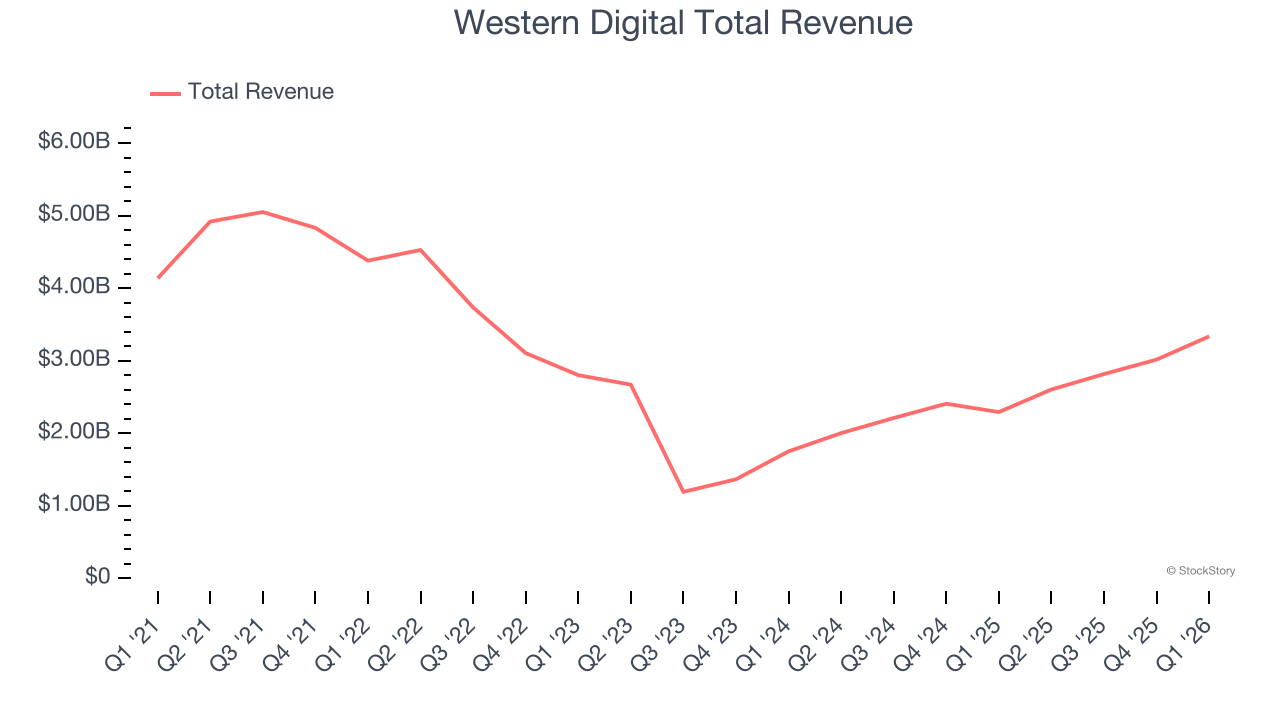
Interestingly, the stock is up 69.7% since reporting and currently trades at $737.25.
Best Q1: Texas Instruments (NASDAQ: TXN)
Headquartered in Dallas, Texas since the 1950s, Texas Instruments (NASDAQ: TXN) is the world’s largest producer of analog semiconductors.
Texas Instruments reported revenues of $4.83 billion, up 18.6% year on year, outperforming analysts’ expectations by 6.6%. The business had a stunning quarter with a beat of analysts’ EPS and operating income estimates.
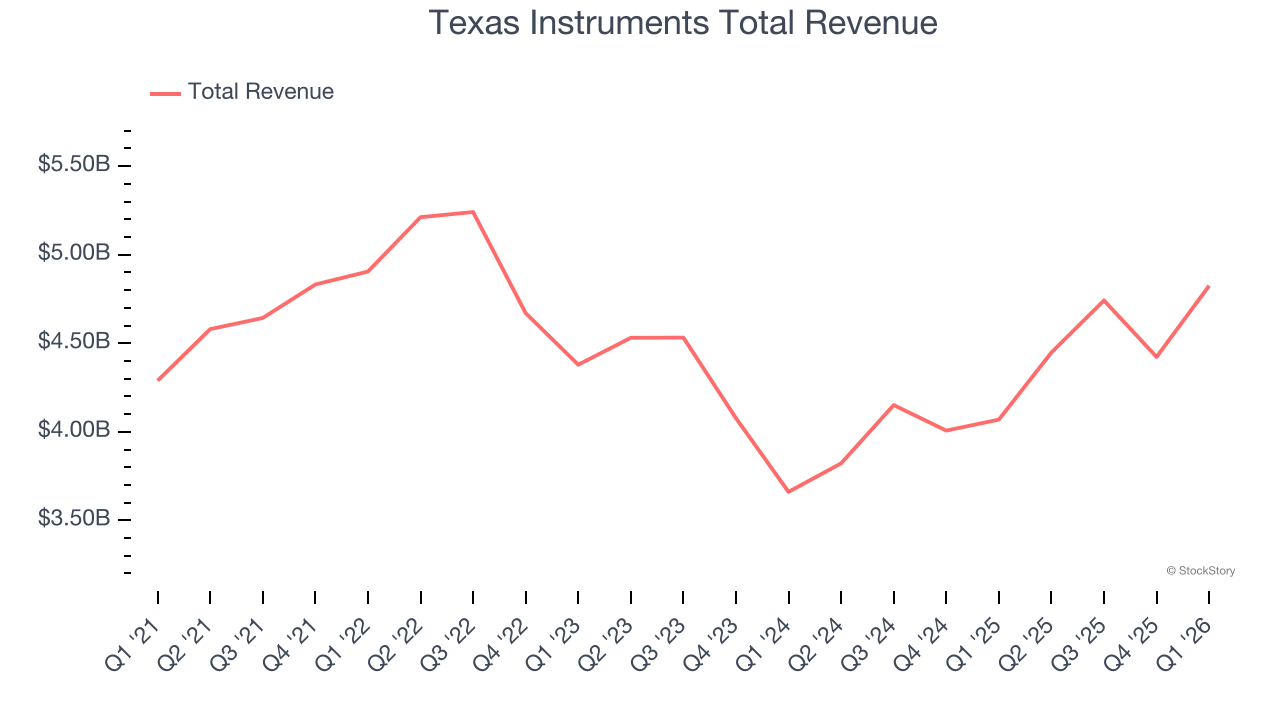
The market seems happy with the results as the stock is up 28.5% since reporting. It currently trades at $303.75.
Is now the time to buy Texas Instruments? Access our full analysis of the earnings results here, it’s free.
Slowest Q1: Universal Display (NASDAQ: OLED)
Serving major consumer electronics manufacturers, Universal Display (NASDAQ: OLED) is a provider of organic light emitting diode (OLED) technologies used in display and lighting applications.
Universal Display reported revenues of $142.2 million, down 14.5% year on year, falling short of analysts’ expectations by 11%. It was a disappointing quarter as it posted full-year revenue guidance missing analysts’ expectations.
Universal Display delivered the weakest performance against analyst estimates and slowest revenue growth in the group. As expected, the stock is down 2.9% since the results and currently trades at $84.58.
Read our full analysis of Universal Display’s results here.
Amtech (NASDAQ: ASYS)
Focusing on the silicon carbide and power semiconductor sectors, Amtech Systems (NASDAQ: ASYS) produces the machinery and related chemicals needed for manufacturing semiconductors.
Amtech reported revenues of $20.47 million, up 31.4% year on year. This result beat analysts’ expectations by 5%. It was a stunning quarter as it also produced a beat of analysts’ EPS and operating income estimates.
The stock is up 20.6% since reporting and currently trades at $21.96.
Read our full, actionable report on Amtech here, it’s free.
Lam Research (NASDAQ: LRCX)
Founded in 1980 by David Lam, the man who pioneered semiconductor etching technology, Lam Research (NASDAQ: LRCX) is one of the leading providers of wafer fabrication equipment used to make semiconductors.
Lam Research reported revenues of $5.84 billion, up 23.8% year on year. This number surpassed analysts’ expectations by 1.7%. Overall, it was an exceptional quarter as it also recorded revenue guidance for next quarter exceeding analysts’ expectations and a beat of analysts’ EPS estimates.
The stock is up 44.2% since reporting and currently trades at $383.00.
Read our full, actionable report on Lam Research here, it’s free.
Market Update
Late in 2025 into early 2026, there was hand-wringing around artificial intelligence. For software companies, the fear was that AI would erode pricing power and compress margins as new tools made it easier to replicate what once required expensive enterprise platforms. Crypto investors had their own version of the same anxiety: if AI agents could trade, allocate capital, and manage wallets autonomously, what exactly was the long-term value of today’s crypto infrastructure?
These concerns triggered a noticeable rotation away from these sectors and into safer havens. But markets rarely dwell on one narrative for long. Spring 2026 came, and the focus shifted abruptly from technological disruption to geopolitical risk. The US’ conflict with Iran became the dominant driver of market psychology, and when geopolitics takes center stage, the script changes quickly. Investors stop debating growth rates and start worrying about oil supply, inflation, and global stability.
Want to invest in winners with rock-solid fundamentals? Check out our Top 5 Growth Stocks and add them to your watchlist. These companies are poised for growth regardless of the political or macroeconomic climate.
StockStory’s analyst team — all seasoned professional investors — uses quantitative analysis and automation to deliver market-beating insights faster and with higher quality.