
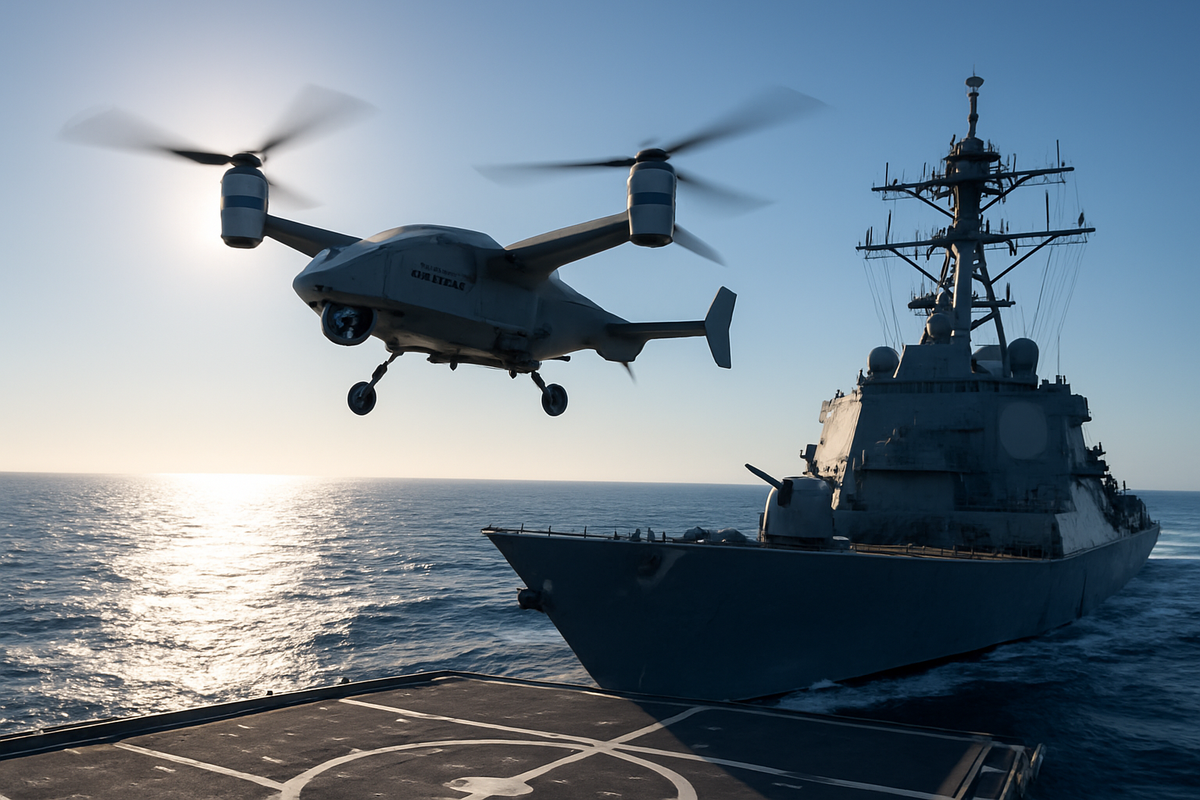
In a definitive move to modernize maritime surveillance, the U.S. Navy has selected AeroVironment, Inc. (NASDAQ: AVAV) as a primary provider for its expanded Intelligence, Surveillance, and Reconnaissance (ISR) services program. Announced on April 1, 2026, the selection integrates AeroVironment into a prestigious pool of contractors tasked with providing "ISR-as-a-Service" across global naval theaters. This move signifies a pivotal shift in defense procurement, prioritizing the delivery of actionable data over the mere acquisition of hardware.
The immediate implications for the market are substantial. By moving to a Contractor-Owned, Contractor-Operated (COCO) model, the Navy is effectively outsourcing the logistical and technical risks of unmanned aviation while ensuring it remains at the cutting edge of sensor technology. For AeroVironment, this contract serves as a massive validation of its JUMP 20-X vertical take-off and landing (VTOL) platform, positioning the company as a dominant force in the medium-altitude, high-endurance segment of the defense market.
The JUMP 20-X Takes Flight
The contract, issued by the Naval Air Systems Command (NAVAIR) Program Executive Office for Unmanned Aviation and Strike Weapons (PMA-263), establishes a Multiple-Award Contract (MAC) framework. Under this agreement, AeroVironment will compete for individual delivery orders to provide "turnkey" ISR support. Unlike traditional procurement where the military owns and maintains the aircraft, AeroVironment will be responsible for the entire ecosystem: the aircraft, flight crews, maintenance, and the real-time delivery of imagery and sensor data to warfighters on the ground and at sea.
The centerpiece of this award is the JUMP 20-X, an advanced iteration of the Group 3 VTOL system. Capable of over 13 hours of continuous flight and possessing a range of 115 miles, the JUMP 20-X solves a critical naval bottleneck: launch and recovery. Traditional unmanned systems often require bulky catapults and recovery nets, which are difficult to operate on the constrained decks of guided-missile destroyers or Littoral Combat Ships. The JUMP 20-X’s VTOL capability allows it to operate like a helicopter, expanding the Navy's eyes and ears to virtually any vessel in the fleet.
Initial industry reactions have been overwhelmingly positive, with Wall Street analysts noting the stability this provides to AeroVironment’s revenue. Firms like BTIG have reiterated "Buy" ratings for (NASDAQ: AVAV), citing a price target of $330. The expansion of the vendor pool from two incumbents to four—now including AeroVironment and the privately held Shield AI—demonstrates the Navy’s desire for technical diversity and more aggressive innovation cycles.
Winners and Losers in the ISR Arms Race
The primary winner in this announcement is undoubtedly AeroVironment. While the company has long dominated the small, hand-launched drone market with its Raven and Puma systems, this contract solidifies its successful pivot into "Group 3" operations—larger, more capable aircraft that command higher margins. This win is a direct fruit of the company’s acquisition of Arcturus UAV, proving that the integration of that technology has successfully met the Navy's stringent requirements.
On the other side of the ledger, long-time incumbents like The Boeing Company (NYSE: BA), through its subsidiary Insitu, and Textron Inc. (NYSE: TXT) now face a more crowded and competitive field. For years, Insitu’s ScanEagle and Textron’s Aerosonde were the go-to platforms for naval ISR. The introduction of AeroVironment and Shield AI into the pool suggests that the Navy is looking for more than just reliability; it is looking for the "payload-first" flexibility offered by newer VTOL designs. While Boeing and Textron remain key players, they will now have to fight harder for individual task orders that were once nearly guaranteed.
Sensor and payload specialists like L3Harris Technologies, Inc. (NYSE: LHX) also stand to benefit. Because the COCO model incentivizes contractors to provide the best possible data to the Navy, companies like AeroVironment are more likely to integrate third-party, high-end sensors rapidly. This creates a secondary market for advanced infrared, signals intelligence (SIGINT), and AI-enabled computer vision payloads that can be "plugged and played" into the JUMP 20-X architecture.
A Broader Shift: The "Payload-Centric" Defense Era
This contract is a milestone in the broader trend of "decoupling" software and sensor technology from the physical airframe. In the past, the defense industry was plagued by "vendor lock," where a specific aircraft could only use specific proprietary sensors. The 2026 Navy ISR contract validates a modular approach where the airframe is treated as a utility—a "truck" in the sky—while the value lies in the payload.
Historically, this mirrors the transition seen in the commercial satellite industry, where companies like Northrop Grumman Corporation (NYSE: NOC) and others shifted toward providing data services rather than just selling hardware. By adopting the COCO model, the Navy can refresh its technological capabilities every few months rather than every few years, avoiding the technical obsolescence that often haunts multi-decade procurement programs.
Furthermore, the emphasis on VTOL technology marks the end of the "catapult era" for mid-sized naval drones. As maritime tensions rise in the Indo-Pacific and other regions, the ability to launch sophisticated surveillance from small, agile ships is becoming a strategic necessity. This event sets a precedent that will likely be followed by allied navies in the UK, Australia, and Japan, potentially creating a massive export market for the validated JUMP 20-X technology.
The Horizon: AI Integration and Fleet Expansion
Looking ahead, the short-term focus will be on the execution of the first delivery orders. Investors should monitor how many "mission days" AeroVironment is actually awarded relative to its competitors. The long-term potential, however, lies in the integration of Artificial Intelligence at the "edge." As the JUMP 20-X platforms begin their 24/7 rotations, the sheer volume of data will require on-board AI to filter and identify threats in real-time, reducing the bandwidth needed to beam information back to the fleet.
Strategic pivots are already appearing on the horizon. Competitors who rely on runway-dependent or catapult-launched systems will likely need to accelerate their own VTOL development or risk being phased out of maritime ISR altogether. We may also see AeroVironment leverage this Navy success to bid for similar "ISR-as-a-Service" contracts with the U.S. Coast Guard and international border security agencies, further diversifying their portfolio away from traditional combat-zone dependence.
Final Thoughts: A New Standard for Naval Surveillance
The selection of AeroVironment for the Navy’s ISR services contract is more than just a business win; it is a signal that the era of "unmanned-as-a-service" has arrived. By validating the JUMP 20-X and its payload-centric philosophy, the Navy has provided a roadmap for how modern militaries can stay ahead of the technological curve while managing costs.
For investors, the key takeaways are clear: (NASDAQ: AVAV) has successfully graduated into a higher tier of defense contracting, offering recurring service revenue that is often more resilient than one-time hardware sales. Moving forward, the market should watch for the announcement of specific task orders and the potential integration of new AI payloads. As of April 2026, AeroVironment has not just sold a drone; it has secured a vital role in the infrastructure of national security, proving that in the modern theater of war, the data is just as important as the wings that carry it.
This content is intended for informational purposes only and is not financial advice.