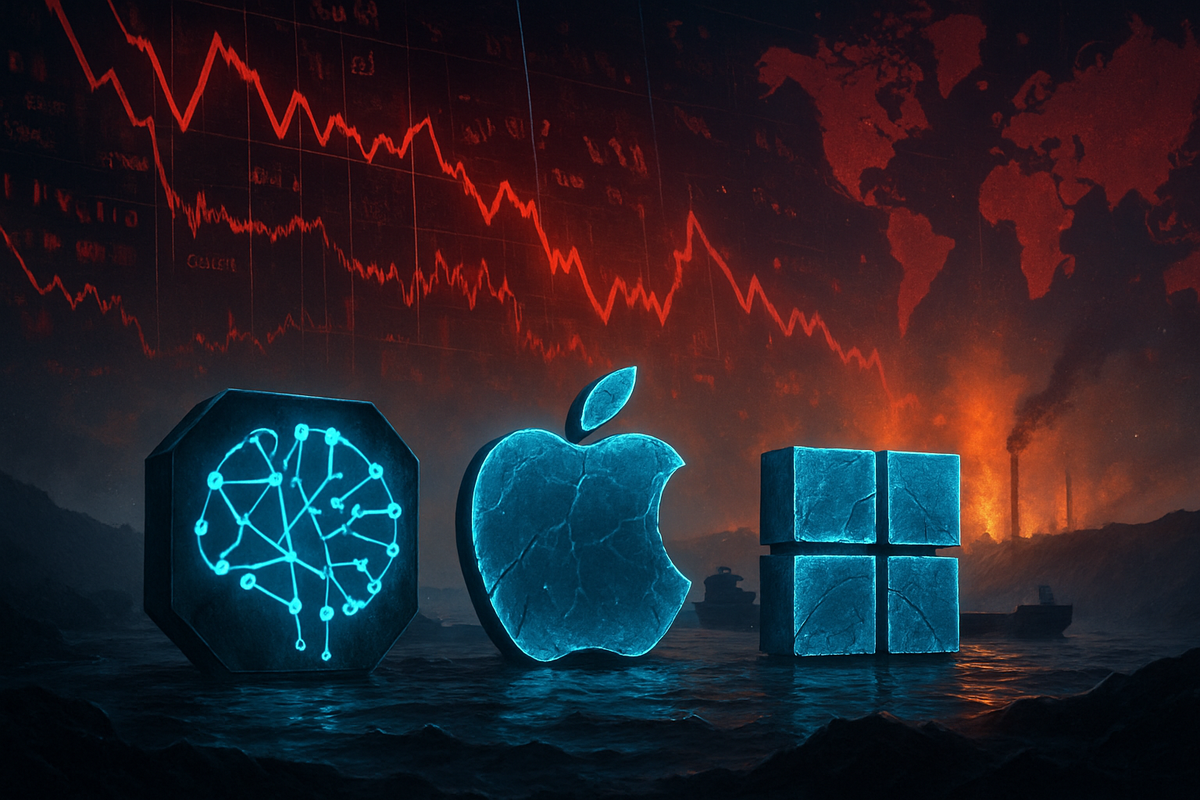
As of March 9, 2026, the U.S. stock market is standing at a precarious crossroads, with a brief early-March rebound already beginning to evaporate under the heat of geopolitical friction and soaring energy costs. After the S&P 500 hit a historic 7,000-point milestone in January, the recent "broad reset" has left investors clinging to the stability of the world's most valuable companies. All eyes are now turning toward the upcoming calendar Q1 2026 earnings for Apple Inc. (NASDAQ: AAPL) and Microsoft Corp. (NASDAQ: MSFT), which are increasingly viewed as the final line of defense against a deeper market correction.
The stakes for these reports have never been higher. With the CBOE Volatility Index (VIX) spiking above 30 for the first time in nearly a year and Brent crude oil hovering near $120 per barrel due to escalating conflict in the Middle East, the ability of Big Tech to maintain growth is being questioned. These upcoming financial disclosures will not just reveal the health of two companies; they will serve as a critical referendum on whether the "AI-driven supercycle" can survive a world of $100+ oil and fractured global trade routes.
The Road to the Q1 Reckoning: A Timeline of Volatility
The path to this moment began in late 2025, a period marked by explosive growth but mounting underlying tension. Apple entered 2026 following a record-breaking holiday quarter where it generated $143.8 billion in revenue, fueled by the iPhone 17 "supercycle" and a surprising 38% surge in Greater China sales. Microsoft similarly reported a blockbuster end to 2025, with Cloud revenue surpassing $50 billion in a single quarter for the first time. However, the optimism of the New Year was short-lived as "exogenous shocks" began to rattle the foundation of the global economy in February 2026.
The defining event of the current quarter has been the military escalation involving Iran, which has sent shockwaves through the technology supply chain. Coordinated strikes in late February led to the closure of the Strait of Hormuz, trapping nearly 170 container ships and severely impacting the flow of critical minerals used in semiconductor fabrication. This geopolitical crisis has forced Apple and Microsoft to navigate a "double-edged sword" of high consumer demand for AI products and a collapsing logistics network. While a strong jobs report on March 4 briefly sparked a relief rally, those gains were erased by March 9 as the market refocused on the "Energy Shock" and its implications for corporate margins.
Winners and Losers: The Big Tech Divergence
In this high-volatility environment, a clear divergence is emerging between those who can absorb rising costs and those who cannot. Apple (NASDAQ: AAPL) appears to be leveraging its massive $25 billion quarterly buyback program as a buffer, positioning itself as a "defensive growth" play. By accelerating its production shift to India and Vietnam, Apple has mitigated some of the sting from persistent U.S. import tariffs. However, the company remains vulnerable to supply constraints on advanced 3nm chips, a bottleneck that could cap its upside if the conflict in the Middle East continues to disrupt global air cargo.
Microsoft (NASDAQ: MSFT), meanwhile, faces a different set of pressures. While its Azure cloud growth remains robust at roughly 39%, the company is under intense scrutiny for its massive capital expenditures, which are projected to reach $125 billion for the full fiscal year 2026. Investors are beginning to demand more immediate returns on the "Copilot" AI integration, especially as margins face slight compression from rising electricity costs for data centers. Other potential losers in this scenario include hardware-dependent firms like Dell Technologies (NYSE: DELL) and HP Inc. (NYSE: HPQ), which lack the software-driven "sticky" revenue of Microsoft and the premium pricing power of Apple to offset the 18% drop in global cargo capacity.
Anchors in a Storm: Broader Industry Significance
The significance of these upcoming earnings extends far beyond the tech sector. Today, technology companies account for approximately 50% of the S&P 500’s total weighting, making the index hyper-sensitive to any guidance revisions from its largest members. Apple and Microsoft are no longer just stocks; they are the "anchors" of the American retirement system and institutional portfolios. If these two giants provide cautious outlooks due to the "Iran War" or trade chokepoints, the ripple effects could trigger a mass rotation out of equities and into safe-haven assets like the U.S. dollar and gold.
Historically, this moment draws comparisons to the "tariff meltdown" of April 2025, yet the current situation is complicated by the AI arms race. Unlike the 2025 dip, companies are now locked in a high-stakes competition for compute power. This has created a "flight to quality" where investors are abandoning speculative startups in favor of the "Magnificent" incumbents. Regulatory pressures also loom; as Apple partners with Alphabet Inc. (NASDAQ: GOOGL) for Gemini AI integration, antitrust authorities in both the U.S. and EU are watching closely to ensure that the current market volatility doesn't become an excuse for further industry consolidation.
What Comes Next: Strategic Pivots and Scenarios
Looking forward, the remainder of 2026 will likely be defined by "resilience over growth." Apple and Microsoft are expected to pivot their messaging toward supply chain sovereignty and energy efficiency. For Apple, this may mean a faster-than-anticipated transition to proprietary modem chips to reduce reliance on external vendors. For Microsoft, the focus will likely shift to "AI at the Edge," reducing the dependency on energy-hungry centralized data centers that are currently being taxed by the global energy crisis.
Market analysts are preparing for two primary scenarios. In the "Bullish Pivot," Apple and Microsoft beat expectations and provide guidance that suggests they have successfully rerouted their supply chains around the Strait of Hormuz, potentially stabilizing the S&P 500 above the 6,800 level. In the "Bearish Correction," management teams cite the energy shock and logistical delays as reasons for a significant downward revision in Q2 and Q3 guidance. This could lead to a breach of the 6,500 level on the S&P 500, officially ending the post-2024 bull run and entering a period of prolonged stagnation.
The Investor Outlook: A Final Assessment
The upcoming Q1 2026 earnings cycle represents a "moment of truth" for the global economy. The key takeaway for investors is that the era of "easy growth" has been replaced by a "resilience premium." While Apple and Microsoft have the balance sheets to survive the current turmoil, their high valuations (forward P/E ratios of 30x–33x) leave very little room for error. The market is no longer just looking at bottom-line numbers; it is looking for a roadmap through a world of geopolitical fragmentation.
In the coming months, investors should closely watch the VIX and Brent crude prices as leading indicators for tech sentiment. If energy prices remain at these elevated levels, even the most advanced AI software will struggle to maintain the margin expansion that fueled the 2025 rally. As we move deeper into March, the performance of AAPL and MSFT will determine whether the U.S. stock market can find its footing or if the 2026 rebound was merely a "dead cat bounce" in an increasingly volatile decade.
This content is intended for informational purposes only and is not financial advice.