
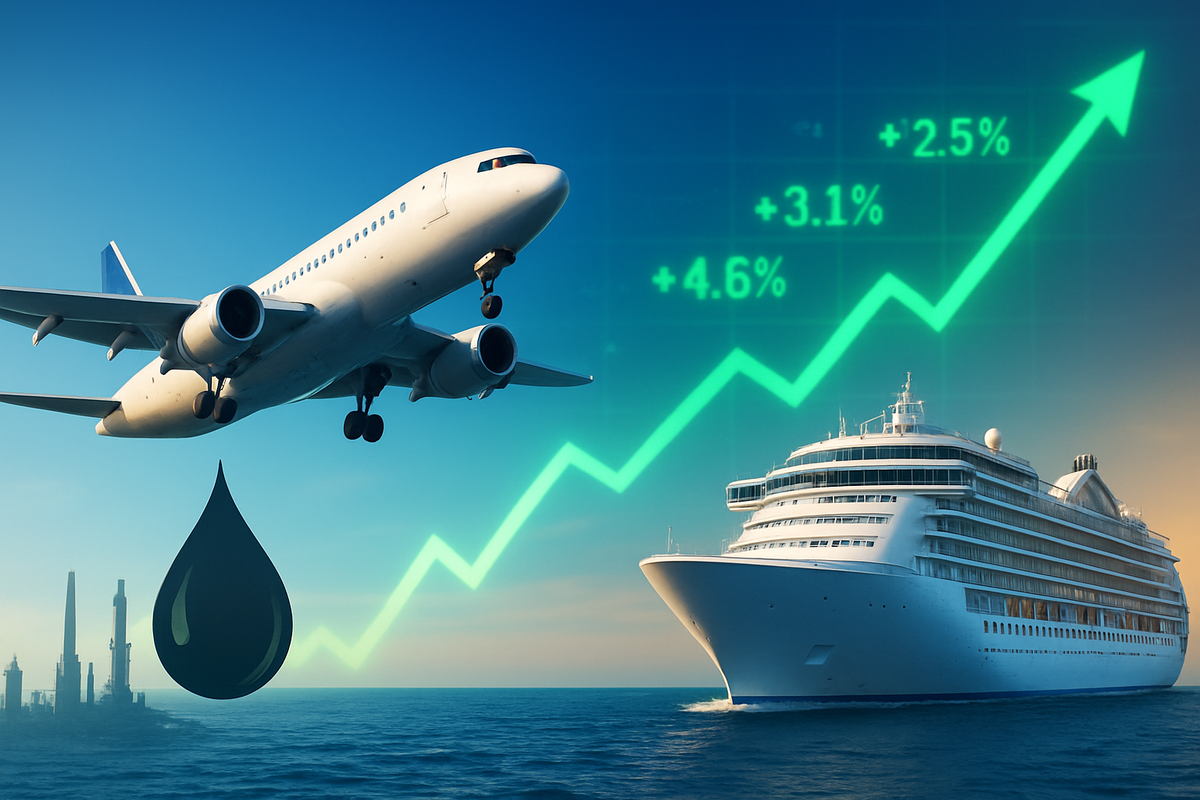
CHICAGO/NEW YORK — March 23, 2026 — Wall Street witnessed a massive relief rally in the travel and transportation sectors today as global oil prices plummeted, easing fears of a prolonged inflationary squeeze on the world’s largest carriers. In a dramatic reversal of the month’s earlier price spikes, Brent crude fell over 10% to settle near $100 per barrel, providing an immediate catalyst for a surge in airline and cruise line equities.
The sharp decline in fuel costs—often the single largest operating expense for travel companies—sent shares of United Airlines (NASDAQ: UAL) climbing 4.5%, while American Airlines (NASDAQ: AAL) notched a gain of 4.9%. The most aggressive movement, however, was seen in the cruise sector, where Norwegian Cruise Line Holdings (NYSE: NCLH) saw its stock price jump by a staggering 7.9% as investors bet on a significant margin expansion for the upcoming summer season.
A Breakthrough in Global Energy Markets
The sudden retreat in oil prices follows a period of extreme volatility that began in late February 2026. Geopolitical tensions in the Middle East had previously pushed Brent crude toward the $120 mark, threatening to derail the global travel recovery. However, the market shifted gears today following reports of a diplomatic breakthrough and a pause in regional hostilities. This cooling of "war premiums" was further accelerated by a coordinated release of 400 million barrels from the International Energy Agency’s (IEA) strategic reserves, a move designed to stabilize global supply.
Beneath the geopolitical surface, market fundamentals have been leaning toward a surplus for much of early 2026. Increasing U.S. shale production, which remains near record levels of 13.6 million barrels per day, combined with a structural decline in Chinese oil demand due to rapid electric vehicle adoption, has created a "global glut" scenario. For airline and cruise executives, today’s price drop represents a return to a more manageable cost environment after weeks of "crisis-mode" planning and capacity adjustments.
Carriers Recalibrate for High-Margin Growth
The immediate impact of lower fuel prices on corporate balance sheets is profound. For United Airlines (NASDAQ: UAL), which had recently warned of an $11 billion increase in annual fuel expenses if oil remained near its peak, the pullback offers a vital reprieve. CEO Scott Kirby had previously announced a 5% capacity cut to protect margins; today's market reaction suggests that some of those conservative measures may be rolled back if energy prices continue to trend downward.
Similarly, American Airlines (NASDAQ: AAL) reported a $400 million hit to its first-quarter expenses just weeks ago. The nearly 5% jump in its stock reflects investor confidence that the airline's "capacity discipline" strategy—which involves focusing on high-demand hubs and delaying less profitable route expansions—will now yield even higher profit margins. In the cruise sector, Norwegian Cruise Line Holdings (NYSE: NCLH) remains particularly sensitive to fuel fluctuations, with analysts estimating that every 10% shift in fuel prices impacts the company's net income by roughly $90 million. The 7.9% surge in NCLH shares underscores the market's belief that the company can now better navigate its heavy debt-servicing requirements while capitalizing on record-breaking passenger volumes.
Broader Industry Significance and Structural Shifts
Today’s rally is not just a reaction to a single day of trading; it highlights a broader industry trend where travel demand remains "price inelastic." Despite the price spikes earlier this month, booking volumes for the summer of 2026 have hit record highs, with the cruise industry alone expected to host 37.7 million passengers globally this year. The drop in oil prices allows these companies to capture more of that consumer spending as profit rather than surrendering it to fuel surcharges and operational overhead.
Furthermore, this event mirrors historical precedents such as the 2014-2015 oil price collapse, which sparked a multi-year bull market for the airline industry. However, the 2026 landscape is different due to the industry's increased focus on sustainability and fuel efficiency. Competitors like Delta Air Lines (NYSE: DAL), which operates its own refinery to hedge against such volatility, are seeing their competitive advantage challenged when prices drop across the board, as unhedged or less-hedged peers like United and American see more dramatic upside in their stock performance during a sell-off in crude.
Navigating the Path Forward
Looking toward the remainder of 2026, the primary challenge for the travel sector will be managing volatility. While the current "relief rally" is a welcome sign for investors, the threat of renewed geopolitical instability remains a wild card. Analysts expect major carriers to double down on hedging strategies and fuel-efficient fleet renewals to insulate themselves from future shocks. We may also see a strategic pivot toward more aggressive marketing for the summer season, as airlines and cruise lines look to lock in bookings while fuel costs are favorable.
In the short term, the market will be watching for Q1 earnings calls in April, where executives are expected to provide updated guidance based on these lower energy prices. If the "Year of the Glut" thesis holds true and oil stabilizes below $90, the travel sector could be entering its most profitable cycle since the pre-pandemic era. However, any breakdown in diplomatic talks or further supply chain disruptions could quickly reverse today's gains, requiring a more defensive posture from investors.
Summary and Market Outlook
The March 23 rally serves as a powerful reminder of how closely the travel industry’s fortunes are tied to the energy complex. The gains seen in United Airlines, American Airlines, and Norwegian Cruise Line Holdings represent a collective sigh of relief from a market that had been pricing in a worst-case scenario for fuel expenses. As oil prices return to levels supported by supply-demand fundamentals rather than fear, the focus shifts back to the underlying strength of the consumer.
For investors, the coming months will require a close eye on both the Brent crude ticker and regional geopolitical developments. The key takeaway from today's session is that the travel sector remains incredibly resilient, capable of rapid recovery when the heavy weight of energy costs is lifted. As we move into the peak summer travel season, the ability of these companies to maintain pricing power while enjoying lower input costs will be the primary driver of shareholder value.
This content is intended for informational purposes only and is not financial advice.