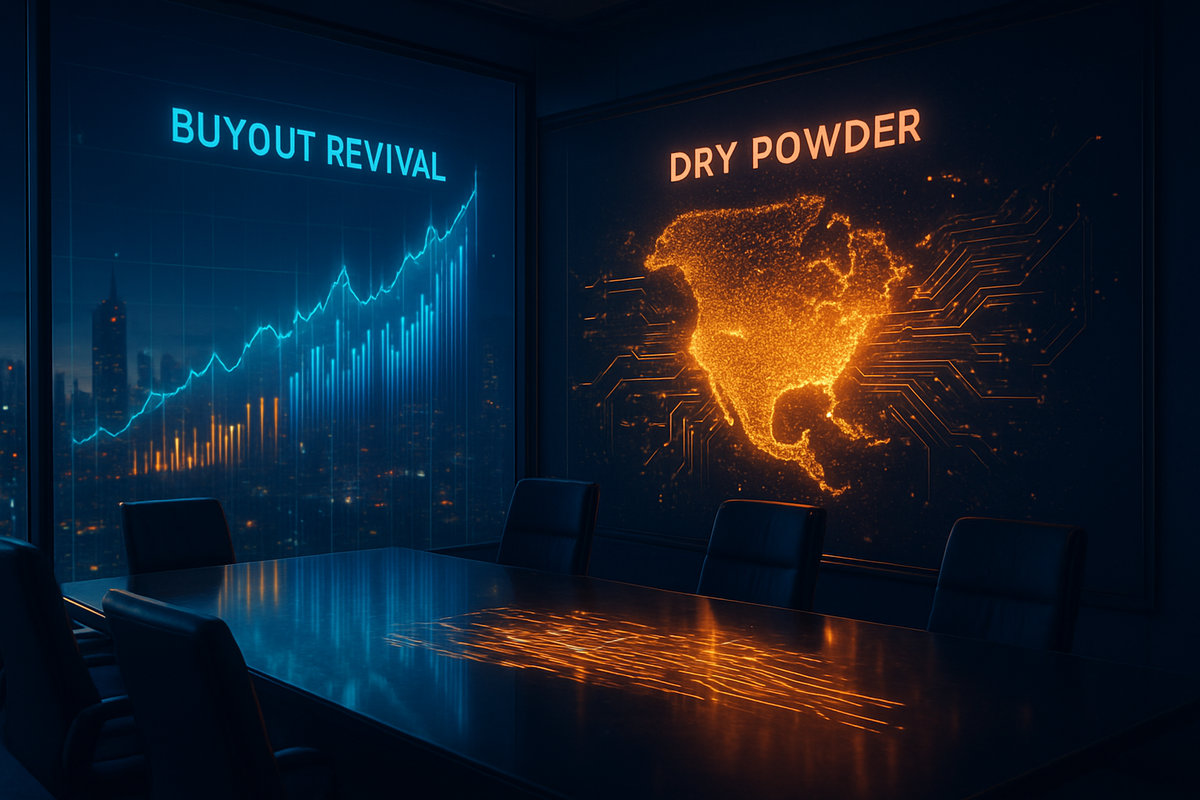
As of March 18, 2026, the North American financial landscape is witnessing an unprecedented surge in private equity (PE) activity, marking what analysts have dubbed the "Buyout Revival." After nearly two years of deal-making stagnation caused by high interest rates and valuation gaps, the floodgates have officially opened. Over the past twelve months, more than 30 management and sponsor-led buyouts exceeding the $1 billion threshold have been finalized, signaling a massive shift in how public companies are valued and restructured.
This resurgence is driven by a staggering "capital overhang"—a record $4.63 trillion in total private market dry powder, with over $1.1 trillion specifically earmarked for private equity buyouts. As general partners (GPs) face mounting pressure to deploy aging capital before investment periods expire, the market has entered a high-velocity phase. The immediate implications are clear: a shrinking public equity market as multi-billion dollar giants are delisted, and a concentrated effort by private sponsors to overhaul these entities through aggressive AI integration and operational streamlining.
The Great Delisting: Megadeals and the 2025 Boom
The timeline leading to this revival began in late 2024, as the Federal Reserve’s pivot toward interest rate stabilization—now settled in a predictable 3.5% to 3.75% range—provided the visibility necessary for large-scale leveraged buyouts (LBOs). Throughout 2025, the "bid-ask spread" that had previously paralyzed the market finally narrowed. Sellers, once clinging to 2021-era valuations, and buyers, wary of high debt costs, found common ground as public market volatility moderated.
Key players have wasted no time in executing some of the largest transactions in history. The crown jewel of this era is the staggering $56.6 billion take-private of Electronic Arts (formerly NASDAQ: EA) by a consortium led by Silver Lake. Close behind was the $23.7 billion acquisition of Walgreens Boots Alliance (formerly NASDAQ: WBA) by Sycamore Partners, aimed at a fundamental operational pivot to healthcare services. Other landmark deals include Apollo Global Management (NYSE: APO) acquiring Air Lease (formerly NYSE: AL) for $28.2 billion and Blackstone (NYSE: BX) further cementing its dominance in AI infrastructure with the $40 billion Aligned Data Centers partnership.
Industry reaction has been a mix of awe and strategic recalibration. Market participants note that North America has become the global engine for this growth, accounting for nearly 80% of the increase in total global deal value in 2025. The shift isn't just about quantity but scale; for the first time in history, U.S. private equity deal value has captured more than 50% of all North American M&A activity, effectively overshadowing traditional corporate-led acquisitions.
Winners and Losers in the New Private Order
The primary winners in this "Buyout Revival" are the "Mega-Managers"—firms like Blackstone (NYSE: BX), KKR & Co. Inc. (NYSE: KKR), and Apollo Global Management (NYSE: APO). These entities have successfully leveraged their massive dry powder reserves and expanded private credit arms to fund their own buyouts, bypassing traditional bank syndication when necessary. For instance, Carlyle Group (NASDAQ: CG) recently demonstrated the strength of this cycle by realizing $18 billion for its investors, anchored by the record-breaking $7 billion IPO of Medline, the largest sponsor-backed IPO to date.
Investment banks have also seen a dramatic reversal in fortune. After a lean 2023, firms like Goldman Sachs Group Inc. (NYSE: GS) and Morgan Stanley (NYSE: MS) are reporting record advisory fees from these multi-billion dollar take-privates. The "winners" also include public shareholders of undervalued companies, who are receiving significant premiums—often between 30% and 50%—as sponsors race to secure "real assets" in digital infrastructure and energy sectors.
Conversely, the "losers" may be the public markets themselves and smaller retail investors who are losing access to high-quality companies. As dominant players in sectors like gaming, retail, and logistics are taken private, the public market is increasingly skewed toward a handful of "Magnificent" tech giants, reducing diversification for the average 401(k) holder. Additionally, mid-market PE firms that lack the scale to compete for megadeals are finding themselves squeezed out by the aggressive deployment of capital from the top-tier managers who can afford the high-grade infrastructure required for the AI era.
A Structural Shift: The ‘Buy Complexity, Sell Clarity’ Era
The significance of the 2025–2026 buyout surge lies in its underlying strategy: "Buy Complexity, Sell Clarity." Sponsors are no longer just looking for undervalued cash flows; they are targeting public companies with complex, bloated structures that can be radically simplified using artificial intelligence. This trend has seen roughly 25% of all deal value concentrated in technology and AI-enabled infrastructure. The ripple effect is profound: as private equity-backed firms become more efficient through proprietary AI tools, their public competitors face increasing pressure to keep pace or risk becoming the next take-private target.
Historically, this era draws comparisons to the LBO boom of the late 1980s or the mid-2000s. However, the current revival is distinct due to the role of private credit. In previous cycles, a freeze in the high-yield bond market could stall buyouts. Today, the $1.7 trillion private credit market provides a permanent, flexible capital source that keeps the buyout engine running regardless of public debt market sentiment. This has created a "shadow" financial system that is largely insulated from traditional banking regulations.
Regulatory scrutiny is, unsurprisingly, on the rise. Both U.S. and European antitrust regulators have expressed concerns over "roll-up" strategies where PE firms acquire multiple smaller competitors to build a dominant market player. However, the sheer speed of the 2025 revival has often outpaced the ability of policy makers to intervene, especially as many of these deals are framed as necessary "recapitalizations" for struggling retail or energy infrastructure sectors.
The Road Ahead: From Deployment to Divestment
Looking forward, the short-term focus for these PE giants will remain on capital deployment. With nearly 50% of current dry powder residing in funds that are between two and five years old, the "use it or lose it" pressure on fund managers will likely sustain this high level of activity through at least the end of 2026. We can expect more "mega-MBOs" in sectors that have yet to be fully disrupted by AI, such as traditional manufacturing and localized logistics.
The long-term challenge will be the "Exit Bridge." As firms take these $10 billion+ companies private today, they must eventually find a way to exit. This could lead to a massive wave of IPOs in 2028 and 2029. If the public markets remain receptive—as they were for the Medline IPO—the cycle will continue. However, if the "exit door" narrows, the industry could face a liquidity crunch. Strategic pivots are already occurring; many firms are opting for "GP-led secondaries," where they sell assets from one of their funds to another to provide liquidity to investors while maintaining control of the asset.
Market opportunities will emerge for those who can provide the physical infrastructure—power and data—required by these newly privatized entities. For investors, the challenge will be identifying which remaining public companies are "buyout bait" based on their free cash flow and structural complexity.
Wrapping Up: A New Era of Private Dominance
The "Buyout Revival" of 2026 represents a fundamental maturation of the private equity industry. With over 30 billion-dollar management buyouts in a single year and record-shattering dry powder levels, the sector has moved from the periphery to the very center of the North American economy. The trend of sponsor-led take-privates is not merely a cyclical rebound; it is a structural shift toward a market where a significant portion of corporate value is created behind closed doors, away from the quarterly scrutiny of public earnings calls.
As we move through the remainder of 2026, the key takeaways for investors are clear: monitor the "capital overhang" and the health of the private credit markets. The dominance of firms like Blackstone (NYSE: BX) and KKR (NYSE: KKR) is unlikely to wane as long as interest rates remain stable and the AI supercycle continues to demand massive capital investments.
Investors should watch for the next wave of "AI infrastructure" deals and pay close attention to the narrowing gap between private and public valuations. While the "Buyout Revival" has brought immense liquidity and premium exits for some, it also marks a new era where the most transformative corporate restructurings are happening in the private sphere, leaving public investors to navigate a leaner, more concentrated market.
This content is intended for informational purposes only and is not financial advice.