
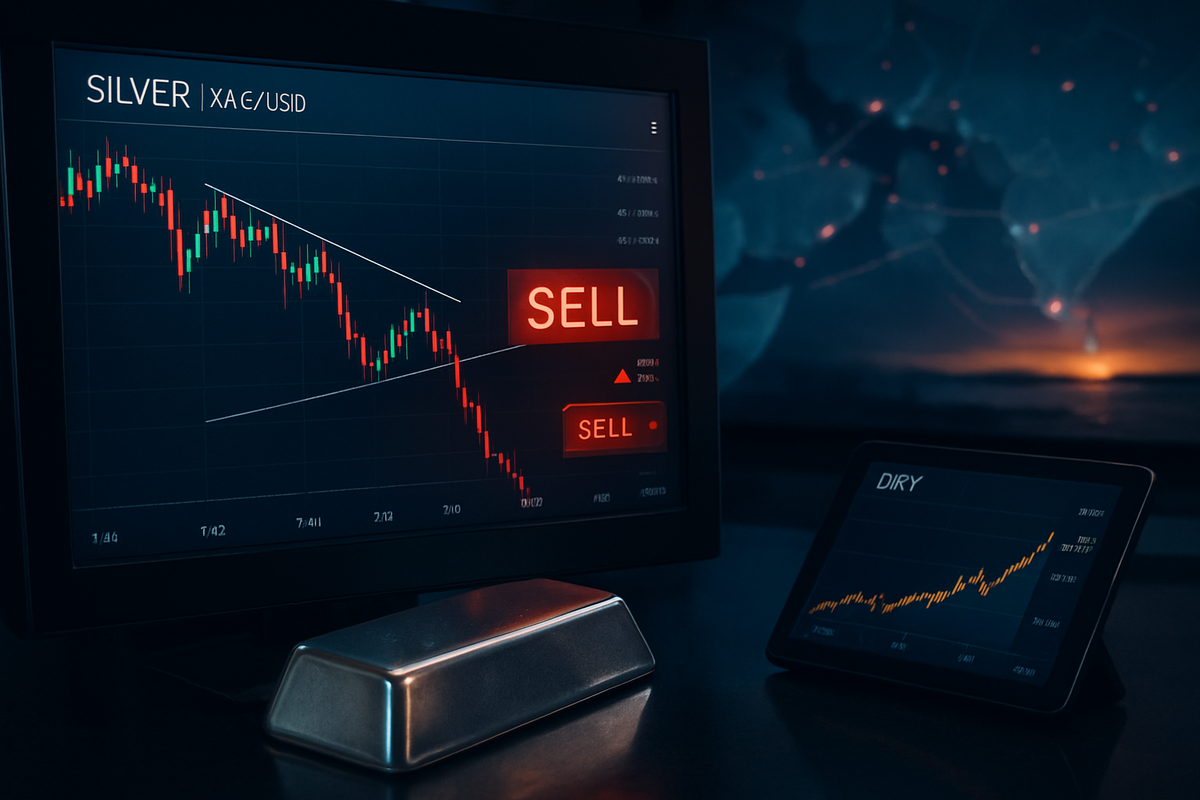
The silver (XAG/USD) market is experiencing a period of intense turbulence as of March 16, 2026, following a dramatic escalation in Middle Eastern hostilities and a significant technical failure on the price charts. After reaching historic highs earlier this year, the "white metal" has seen its momentum stall, characterized by a sharp rejection of a long-standing triangle formation that has left traders questioning the sustainability of the current bull run.
While geopolitical instability typically fuels a flight to precious metals, the current conflict—centered around a major military engagement with Iran—has produced a complex market reaction. Heavy institutional positioning and a surprising pivot toward the U.S. Dollar as the primary safe haven have created a "sell-the-news" environment for silver, leading to a sharp correction from its January peaks.
Operation Epic Fury and the Strait of Hormuz Crisis
The current volatility traces its roots back to February 28, 2026, when a joint military operation led by the United States and Israel, dubbed "Operation Epic Fury," launched massive precision strikes against Iranian infrastructure. The sudden escalation, which reportedly resulted in a leadership vacuum in Tehran, prompted an immediate retaliatory blockade of the Strait of Hormuz. By mid-March, the blockade had effectively throttled global energy shipments, sending oil prices toward the $120 mark and sparking fears of a global stagflationary shock.
Technically, silver entered this crisis already overextended. After hitting a staggering $121 per ounce in late January 2026, the market began forming a massive consolidation triangle. On March 12, 2026, as silver attempted to break above the $90–$92 resistance level, it encountered a wave of institutional selling. This "triangle rejection" was confirmed on the daily charts, signaling that the bulls had lost their grip. By today, March 16, silver has dipped below the psychological $80 support level, trading near $79.70 as the market adjusts to the reality of a prolonged regional war.
The role of "Managed Money" has been pivotal in this price action. Large hedge funds, which had built record-long positions during the initial 2025 rally, began aggressive profit-taking as the technical rejection materialized. Despite the ongoing maritime denial in the Persian Gulf and the expansion of the conflict into the 2026 Lebanon War, silver has struggled to reclaim its safe-haven status, as investors prioritize the liquidity and stability of the Greenback.
Mining Giants Face a Volatility Litmus Test
The secondary impact of this price correction is being felt across the silver mining sector. Pan American Silver Corp (NYSE: PAAS) has remained a focal point for investors; despite the market downturn, the company’s strategic acquisition of the Juanicipio mine has kept its All-In Sustaining Costs (AISC) near $15 per ounce. This robust margin allows PAAS to remain highly profitable even at $80 silver, though its stock price has mirrored the metal’s recent volatility, dropping roughly 12% since the March 12 technical rejection.
Conversely, First Majestic Silver Corp (NYSE: AG) has faced a more grueling path. Known for its "silver torque"—a high sensitivity to the spot price—First Majestic saw its shares soar during the January peak but has since faced a steep pullback. Trading at a high forward-earnings multiple, AG remains a favorite for aggressive speculators, but the current technical breakdown in XAG/USD has led to significant de-risking among its retail base.
For those seeking a more defensive play, Wheaton Precious Metals Corp (NYSE: WPM) has emerged as a relative winner in terms of stability. As a streaming company, Wheaton is insulated from the direct operational risks and inflationary pressures hitting traditional miners. With a market capitalization nearing $60 billion, WPM has acted as a stabilizer for the Global X Silver Miners ETF (NYSEARCA: SIL), providing exposure to silver's upside without the same level of downside risk seen in the pure-play miners during this technical correction.
A Paradigm Shift in Safe-Haven Dynamics
The current market environment represents a significant departure from historical precedents. In previous conflicts, such as the 2022 invasion of Ukraine or the 2020 pandemic, silver often moved in lockstep with gold as a primary hedge. However, in March 2026, the "Iran War" has highlighted a growing preference for "cash-king" strategies. The U.S. Dollar Index (DXY) has surged alongside oil, creating a headwind that even the most bullish silver technicals could not overcome.
Furthermore, the "physical-paper divergence" has returned to the forefront. While paper silver prices on the COMEX have fallen due to technical rejections and fund liquidation, the physical market is in a state of rare backwardation. The maritime blockade in the Middle East has disrupted the flow of industrial silver, leading to a premium on spot metal. This suggests that while the "paper" price is being pushed down by speculators, the fundamental supply-demand balance remains dangerously tight, echoing the "Silver Squeeze" narratives of years past but on a much larger institutional scale.
The regulatory response has also been swift. The Commodity Futures Trading Commission (CFTC) has reportedly increased margin requirements for silver futures in mid-March to curb the extreme volatility. This move has further pressured the iShares Silver Trust (NYSEARCA: SLV), as the cost of carry for large positions becomes increasingly prohibitive for retail and institutional players alike.
Looking Ahead: Support Levels and Strategic Pivots
In the short term, all eyes are on the $75 "line in the sand." Technical analysts suggest that if silver can hold this level—which corresponds to the 2025 "cup-and-handle" breakout point—the long-term bullish structure remains intact. However, a failure to hold $75 could trigger a cascade of sell orders, potentially driving the price back toward the $60–$65 range as the market fully "cleanses" the heavy positioning of early 2026.
Long-term, the strategic pivot for investors will likely involve a focus on industrial demand versus speculative fervor. As the 2026 Iran War potentially drags into a war of attrition, the demand for silver in military technology, satellite communications, and energy-independent infrastructure will likely grow. This provides a fundamental floor for the market that technical rejections cannot permanently dismantle. Investors should watch for a "falling wedge" pattern to develop over the next several weeks, which could signal the end of this corrective phase.
Summary of the March 2026 Silver Correction
The mid-March correction in silver serves as a stark reminder that geopolitical risk does not always translate into immediate price gains. The combination of a technical "triangle rejection," heavy institutional profit-taking, and a resurgent U.S. Dollar has created a perfect storm for XAG/USD. While mining leaders like Pan American Silver Corp (NYSE: PAAS) and Wheaton Precious Metals Corp (NYSE: WPM) maintain strong fundamentals, the broader market is currently in a state of "exhaustion."
Moving forward, the market will likely remain tethered to developments in the Strait of Hormuz and the persistence of the Iranian blockade. Investors should maintain a cautious stance, watching for a stabilization in technical indicators like the RSI and a cooling of the extreme backwardation currently seen in spot markets. The next two months will be critical in determining whether this is a healthy correction in a secular bull market or the beginning of a more prolonged downturn driven by shifting global safe-haven preferences.
This content is intended for informational purposes only and is not financial advice.