
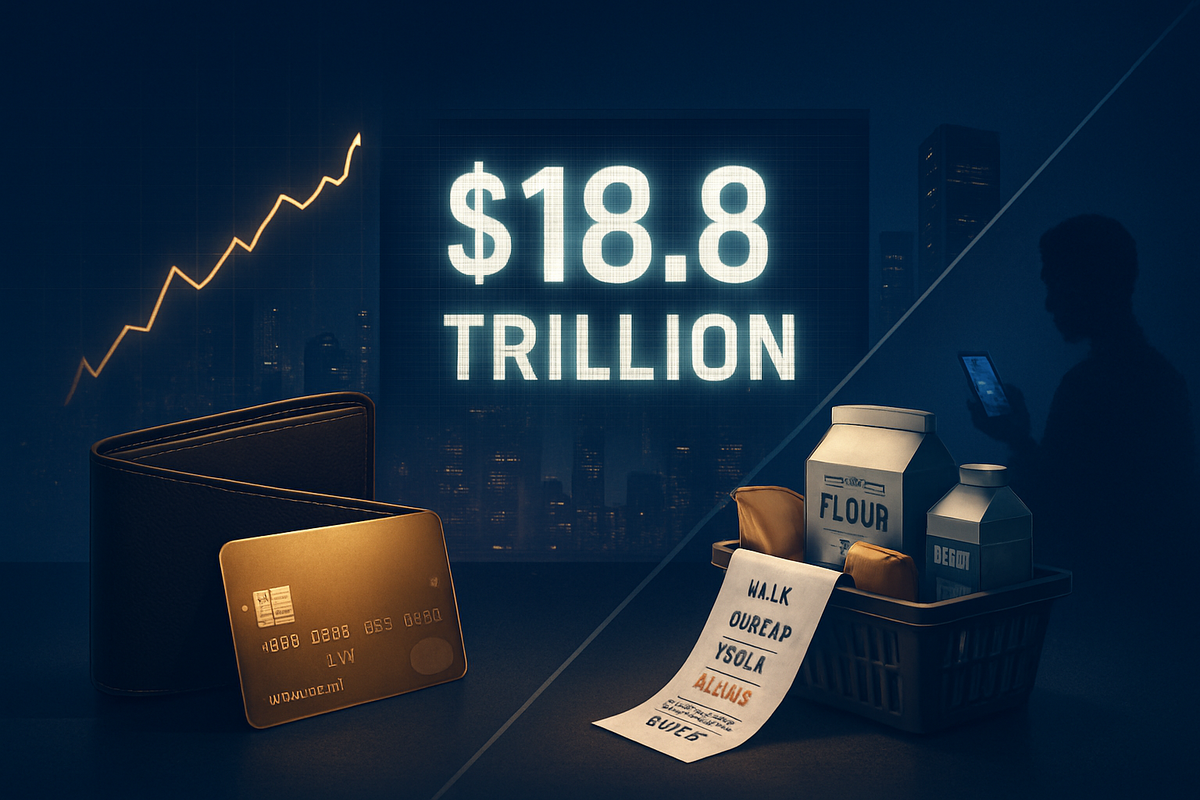
As of March 13, 2026, the American consumer is walking a precarious tightrope. Total US household debt has climbed to a staggering record of $18.8 trillion, according to the latest quarterly data, driven by a combination of sticky inflation and the compounding weight of high interest rates. While the Federal Reserve has paused its aggressive tightening cycle, holding the benchmark rate at 3.50% to 3.75%, the "higher-for-longer" environment has fundamentally reshaped how households manage their balance sheets. Credit card balances alone have surged to $1.28 trillion, though a recent plateau in delinquency rates suggests that consumers are beginning to prioritize "intentional spending" over the impulse-driven consumption of previous years.
The immediate implications of this debt load are being felt across the retail and financial sectors. Lower-income households are increasingly stretched, leading to a "K-shaped" recovery where affluent consumers continue to spend on luxury and travel while others trade down to private-label goods at discount retailers. For the broader market, this shift marks the end of the post-pandemic "revenge spending" era, replaced by a defensive posture that emphasizes essential goods and debt management. As the Federal Reserve adopts a "wait-and-see" approach this month, the market is bracing for a year where consumer resilience—once the engine of the US economy—faces its toughest test since the 2008 financial crisis.
The $18.8 Trillion Milestone: A Timeline of Consumer Strain
The road to today’s record debt levels began in earnest during the inflation spikes of 2023 and 2024. While price growth moderated throughout 2025, settling near 2.7%, the cumulative effect of three years of elevated costs has exhausted the "excess savings" built up during the pandemic. By Q4 2025, the personal savings rate had dipped to a modest 4.8%, forcing many households to rely on revolving credit to bridge the gap between stagnant wages and the rising cost of living. This culminated in the February 2026 report from the New York Fed, which confirmed that aggregate debt had jumped from $17.5 trillion in late 2024 to the current $18.8 trillion.
Key stakeholders, including major lenders and the Federal Open Market Committee (FOMC), have closely monitored the serious delinquency rate for bankcards, which currently sits at 2.98%. While this is a significant rise from the pandemic lows of 1.5%, it remains well below the catastrophic 5-7% levels seen during the Great Recession. This "plateau effect" is largely credited to tighter underwriting standards implemented by banks in early 2025. However, the pressure remains acute for Gen Z and Millennial borrowers, who have been disproportionately affected by the resumption of student loan payments and the elimination of the Biden-era SAVE plan, which was replaced by the more restrictive Repayment Assistance Plan (RAP) in early 2026.
Market reactions to these trends have been mixed. During the mid-March 2026 FOMC meeting, Fed Chair Jerome Powell indicated that while the "inflation battle" is nearing its conclusion, the labor market’s recent cooling—with unemployment ticking up to 4.5%—prevents further aggressive rate cuts. This neutral stance has left investors in a holding pattern, as they weigh the benefits of stable interest rates against the risks of a potential late-cycle slowdown.
Winners and Losers in the New Credit Reality
In this environment, financial institutions with premium portfolios are emerging as the primary winners. American Express (NYSE: AXP) reported record annual revenue of $72.2 billion for 2025, benefiting from a customer base that remains largely insulated from credit stress. Their luxury retail and travel spending segments grew by 15% and 8% respectively, proving that the top tier of the "K-shaped" economy is still thriving. Similarly, JPMorgan Chase (NYSE: JPM) has demonstrated dominance, reporting a 7% year-over-year increase in net interest income to $25.1 billion, despite aggressively raising its loan loss provisions to $4.7 billion to account for its recent acquisition of the Apple Card portfolio.
Conversely, lenders with higher exposure to subprime or middle-market consumers are facing headwinds. Capital One (NYSE: COF) saw its loan loss provisions jump significantly to $4.1 billion in late 2025, reflecting rising concerns over its core credit card loans. The company’s ongoing integration of Discover Financial (NYSE: DFS) has added another layer of complexity, as analysts scrutinize the combined entity’s ability to manage defaults in a slowing economy. Bank of America (NYSE: BAC) has managed to remain more stable, with average deposits growing for ten consecutive quarters, yet it too faces the challenge of narrowing net interest margins as the Fed holds rates steady.
In the retail sector, Walmart (NYSE: WMT) is the clear standout, capturing market share from all income brackets as even households earning over $100,000 "trade down" to save on groceries. Walmart’s revenue hit $190.7 billion in its most recent quarter, bolstered by a 24% surge in e-commerce. On the other hand, Target (NYSE: TGT) continues to struggle with softness in discretionary categories like apparel and home goods. While Target beat late-2025 estimates, its growth trajectory remains fragile compared to Walmart’s essential-heavy business model.
Regulatory Reversals and Bipartisan Pressures
The current credit landscape is also being reshaped by a dramatic shift in the regulatory environment. In a major blow to consumer advocacy groups, the Biden-era CFPB rule that sought to cap credit card late fees at $8 was vacated in April 2025. By March 2026, large issuers like Citigroup (NYSE: C) and Wells Fargo (NYSE: WFC) have returned to charging "safe harbor" fees as high as $43 for repeat violations. This reversal has added hundreds of millions of dollars back into the fee-income streams of major banks, though it has also sparked a populist backlash in Washington.
A rare bipartisan coalition, led by figures as ideologically diverse as Senators Bernie Sanders and Josh Hawley, is currently pushing the "10% Credit Card Interest Rate Cap Act." The bill proposes a hard national ceiling on credit card APRs, a move that the American Bankers Association warns would "devastate" credit access for millions of Americans. While the bill’s passage remains uncertain, the political pressure has already forced some lenders to voluntarily cap rates for certain "at-risk" segments to avoid more heavy-handed legislation.
Furthermore, the implementation of the Homebuyers Privacy Protection Act (HPPA) on March 5, 2026, has brought relief to mortgage seekers. The law effectively bans credit bureaus like Equifax (NYSE: EFX) and TransUnion (NYSE: TRU) from selling "mortgage trigger leads," ending the barrage of unsolicited calls that previously followed a credit pull. This shift highlights a broader trend toward data privacy that could eventually impact how credit is marketed and sold across the entire industry.
The 2026 Outlook: A Pivot to Private Credit
Looking ahead to the remainder of 2026, the short-term focus will remain on the Federal Reserve’s next move. If unemployment continues to climb toward 5%, the Fed may be forced to abandon its neutral stance and resume rate cuts to prevent a "hard landing." However, the "sticky" nature of service-sector inflation remains a significant hurdle. In response to this uncertainty, we are seeing a massive strategic pivot toward "Private Credit." Non-bank lenders are now projected to reach $4 trillion in assets under management by 2028, as they increasingly fill the void left by traditional banks that are pulling back under the shadow of the "Basel III Endgame" capital requirements.
The long-term challenge for the market will be managing the "debt maturity wall" facing many households and small businesses. As low-rate loans from the 2020-2021 era expire, they are being refinanced at significantly higher levels, further squeezing disposable income. For investors, the opportunity lies in companies that can offer efficiency and value—fintech firms that use AI for more accurate credit scoring or retailers that provide essential goods at scale. The primary risk remains a systemic increase in defaults if the labor market softens more rapidly than expected.
Summary and Investor Takeaways
The US consumer credit story in early 2026 is one of resilience under pressure. While $18.8 trillion in debt is a daunting figure, the stabilization of delinquency rates and the shift toward intentional spending suggest that the "crash" many feared in 2024 has been avoided—at least for now. However, the divide between the "haves" and "have-nots" is widening, creating a bifurcated market that requires careful navigation.
Investors should keep a close eye on three key indicators in the coming months:
- The Personal Savings Rate: If this continues to trend below 5%, the ceiling for consumer spending will remain low.
- Bank Loan Loss Provisions: Continued increases from JPM or COF would signal that the "plateau" in delinquencies may be temporary.
- Legislative Progress on Rate Caps: Any movement on the 10% APR cap would cause significant volatility in the financial sector.
Ultimately, the 2026 economy is characterized by a "new normal" of higher costs and more disciplined credit usage. While the record debt levels are a headline-grabbing figure, the real story is the subtle shift in how the American consumer is learning to live within the constraints of a high-interest world.
This content is intended for informational purposes only and is not financial advice