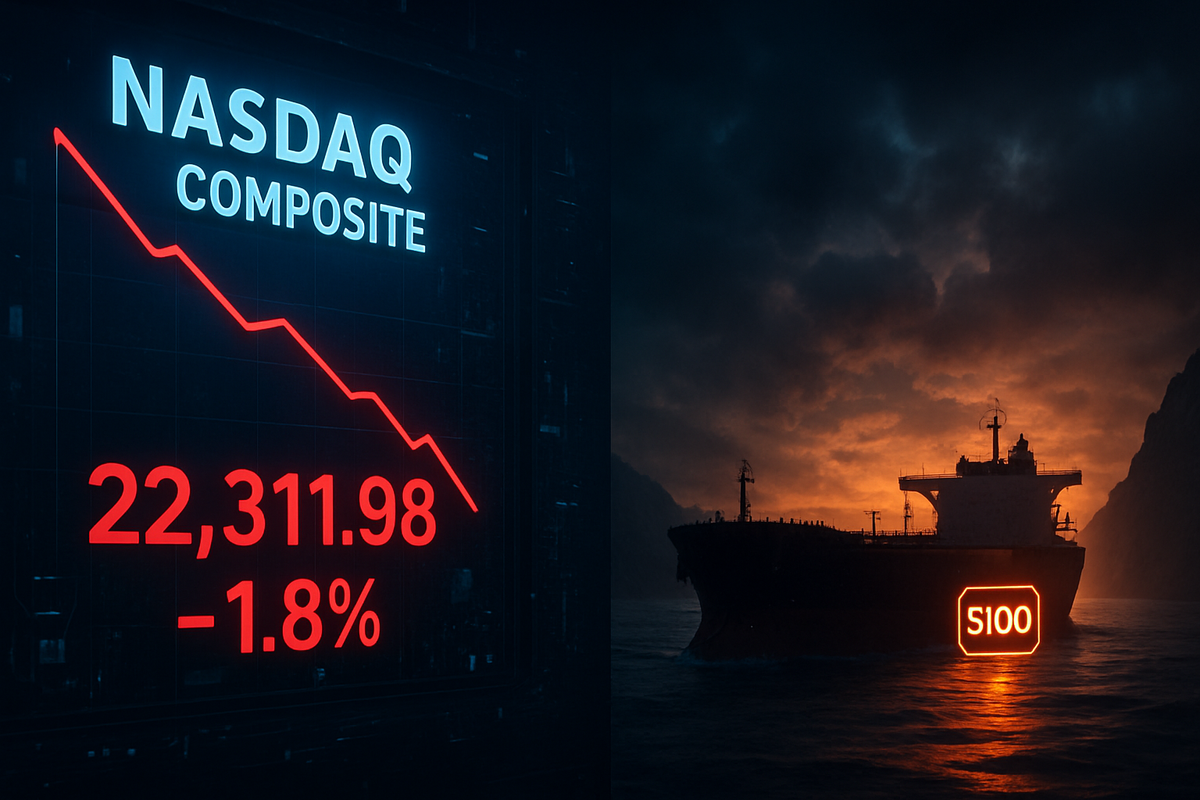
The tech-heavy Nasdaq Composite (IXIC) suffered its most devastating session of the year on Friday, March 13, 2026, as a toxic combination of surging energy costs and escalating geopolitical conflict sent investors fleeing for safety. The index plunged 1.8%, shedding more than 400 points to close at 22,311.98, marking its lowest finish of 2026. The sell-off wiped out billions in market capitalization from the world’s largest technology firms, ending a week of extreme volatility that has effectively erased the gains seen during the early-year rally.
The immediate implications of this slide are profound, as the "inflation trade" returns with a vengeance. With energy prices breaching key psychological levels, the market is quickly repricing its expectations for Federal Reserve policy, with many traders now abandoning hopes for interest rate cuts in the first half of the year. For technology giants that rely on low-cost capital and high consumer discretionary spending, the sudden shift to a high-cost, high-risk environment has created a "perfect storm" that is forcing a major recalibration of growth forecasts across the sector.
The Geopolitical Catalyst: Oil and the Strait of Hormuz
The day’s market carnage was driven primarily by a dramatic spike in crude oil prices, which saw Brent crude settle above $100 per barrel for the first time since 2022. The catalyst was the intensification of the "Iran War," a conflict that escalated earlier this week following U.S. and Israeli precision strikes on Iranian nuclear facilities. In a retaliatory move that sent shockwaves through global energy markets, Tehran announced the closure of the Strait of Hormuz—the world’s most critical maritime oil chokepoint—vowing to block the 20% of global oil supply that traverses the narrow waterway.
The timeline leading up to this Friday’s collapse began in late February when diplomatic efforts in Vienna finally disintegrated, leading to a "geopolitical risk premium" that had been steadily building for weeks. By the time markets opened on March 13, the premium had reached an estimated $18 per barrel. Despite an emergency announcement from the International Energy Agency (IEA) to release 400 million barrels from global reserves—including 172 million from the U.S. Strategic Petroleum Reserve—investors remained unconvinced that supply could be stabilized. The CBOE Volatility Index (VIX), often referred to as Wall Street's "fear gauge," spiked 12.6% to 27.29, its highest level in nearly two years.
Winners and Losers: The "Mag 7" Under Siege
The pain was felt most acutely among the "Magnificent Seven" technology stocks. Nvidia (NASDAQ: NVDA), the poster child for the artificial intelligence boom, saw its stock drop 3.2% as investors questioned whether the massive capital expenditures required for AI infrastructure could be sustained in an environment of surging electricity and operational costs. Microsoft (NASDAQ: MSFT) also faced significant pressure, with its shares now down more than 15% year-to-date, as the broader software sector grapples with an "AI-driven sell-off" fueled by fears that the technology's monetization is not keeping pace with its valuation.
Amazon (NASDAQ: AMZN) was particularly hard-hit, falling 2.5% as the market digested the impact of $100 oil on its massive logistics and delivery network. Even Apple (NASDAQ: AAPL), traditionally viewed as a safe haven within the tech space, saw its shares tumble toward the $255 mark as concerns over global supply chain stability and dampened consumer sentiment in Asia weighed on the stock. Conversely, the only bright spots in the market were found in the Energy Select Sector SPDR Fund (NYSE: XLE), which surged as oil majors reaped the benefits of the price spike, and safe-haven assets like gold and the U.S. Dollar.
A Fundamental Shift in Industry Trends
This market event marks a significant departure from the optimism that defined 2025. For the past year, the prevailing narrative was "AI at any cost," with the Nasdaq reaching record highs on the back of generative AI breakthroughs. However, today’s 1.8% plummet suggests that macro-economic realities—specifically energy security and inflation—have once again overtaken tech idealism. The situation echoes the "Stagflation" scares of the mid-1970s and the 2022 energy crisis, where supply-side shocks forced a painful re-rating of high-growth assets.
The ripple effects are already being felt by mid-cap tech firms and startups, which are seeing their paths to profitability elongated by rising cloud computing costs—a direct result of higher energy prices for data centers. Regulatory focus is also expected to shift; as energy costs become a national security priority, the intensive power demands of AI training models may face new scrutiny from policymakers concerned about grid stability and carbon mandates during a period of scarcity.
What Comes Next: Strategic Pivots and Market Resilience
In the short term, analysts expect continued volatility as the "Iran War" enters a new, more unpredictable phase. The central question for the market is whether the IEA’s reserve release will be enough to bridge the gap if the Strait of Hormuz remains closed for months rather than weeks. Companies like Alphabet (NASDAQ: GOOGL) and Meta (NASDAQ: META) may be forced to pivot their messaging toward "efficiency and cost-containment" rather than "growth and moonshots" during the upcoming Q1 earnings season to soothe jittery shareholders.
Strategic adaptations are already underway; some of the larger tech firms may accelerate their investments in proprietary renewable energy sources—such as small modular nuclear reactors (SMRs)—to decouple their operations from the volatile oil and gas markets. While the current scenario is dire, it may also present a "valuation reset" that allows disciplined investors to enter high-quality tech names at prices not seen in years, provided the geopolitical situation does not spiral into a wider global conflict.
Summary and Outlook for Investors
The Nasdaq’s 1.8% drop to 22,311.98 is more than just a bad day of trading; it is a signal that the era of "easy growth" for Big Tech is facing its most significant challenge since the pandemic. The intersection of a major energy shock and a high-stakes geopolitical confrontation has effectively neutralized the tailwinds of the AI revolution for the time being. Investors are now operating in a "risk-off" environment where capital preservation and energy-sector exposure are taking precedence over speculative tech bets.
Moving forward, the market will be hyper-focused on two key metrics: the daily movement of Brent crude and the weekly reports on inflation expectations. If oil remains above $100, the Nasdaq could see further testing of its support levels, possibly falling toward the 21,500 range. For the tech sector to rebound, a clear path to de-escalation in the Middle East is required, alongside evidence that the "AI productivity miracle" can deliver tangible cost savings that offset the rising price of energy. For now, caution remains the watchword on Wall Street.
This content is intended for informational purposes only and is not financial advice.