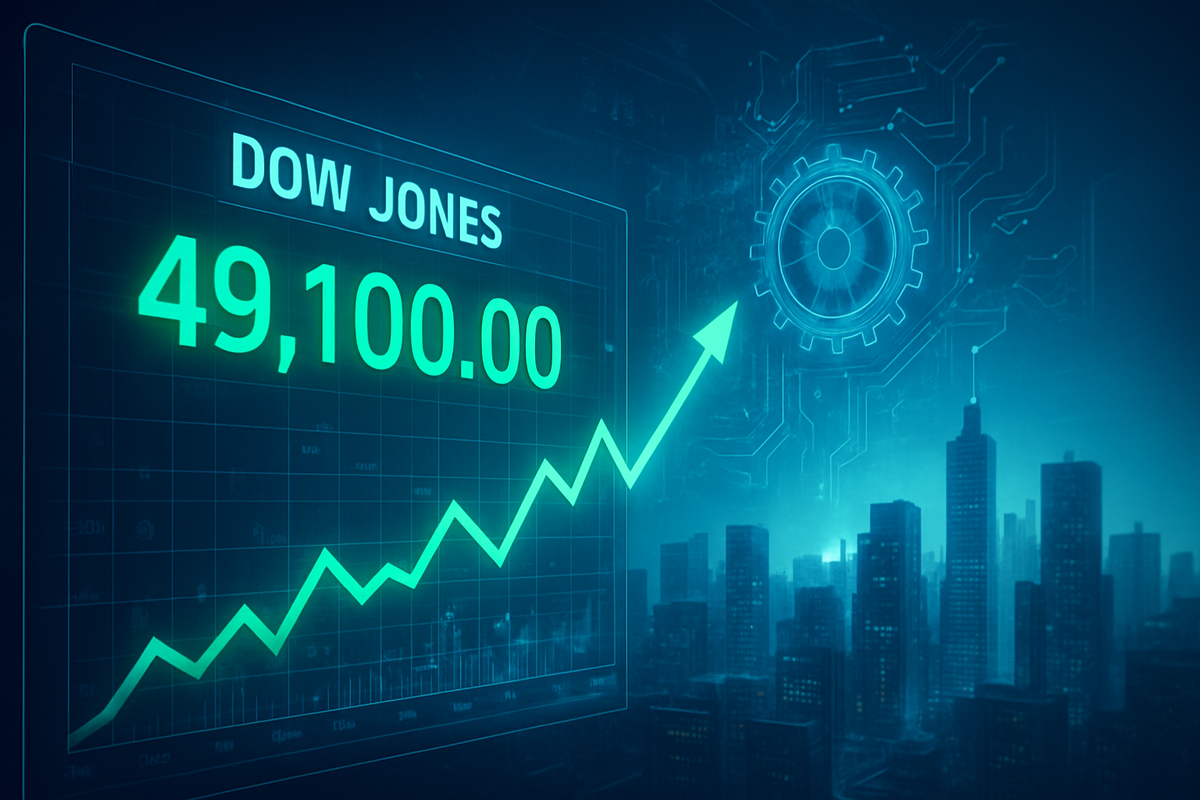
The Dow Jones Industrial Average surged to a historic close of 49,100 on Monday, January 5, 2026, marking a triumphant start to the new year for Wall Street. This milestone represents a significant psychological breakthrough, placing the 130-year-old index within striking distance of the once-unthinkable 50,000 mark. The rally was fueled by a potent mix of continued Federal Reserve monetary easing, a geopolitical shift in energy markets, and the deepening integration of artificial intelligence into the nation's industrial backbone.
As the closing bell rang, the index sat at its highest point in history, capping a multi-year bull run that has defied skeptics of the "soft landing" narrative. For investors, the jump to 49,100 signals more than just a round number; it reflects a fundamental re-rating of the American economy as it transitions from a high-interest-rate environment to a period of tech-driven productivity gains.
The Road to 49,100: A Timeline of Resilience
The journey to 49,100 began in earnest during the late months of 2024, after the Federal Reserve initiated its first rate cuts in September of that year. Throughout 2025, the Dow experienced what many analysts described as a "melt-up" phase, achieving over 50 record closes in a single calendar year. After crossing the 45,000 threshold in August 2025 following the Jackson Hole Economic Symposium, the index accelerated its pace, gaining momentum from a string of better-than-expected corporate earnings and a cooling inflation profile that allowed for a total of six rate cuts by the end of 2025.
The final push to 49,100 was catalyzed by a dramatic shift in the geopolitical landscape during the first week of January 2026. News of a major U.S.-led operation in Venezuela, resulting in the capture of Nicolás Maduro, sparked a flurry of activity in the energy and industrial sectors. Markets reacted with optimism to the potential for normalized oil exports from the region, which could lower long-term energy costs for U.S. manufacturers. This geopolitical "shock" acted as a tailwind for blue-chip stocks that had already been buoyed by a strong holiday retail season and a "Santa Claus rally" that refused to quit.
Key stakeholders, including institutional fund managers and retail investors, have increasingly rotated capital into the Dow’s 30 components, seeking stability and dividends alongside growth. The initial market reaction to Monday's close was one of exuberant relief, as the index successfully broke through a heavy resistance level that had stalled progress in late December. Trading volumes were significantly higher than the five-day average, indicating a broad-based participation in the rally rather than a narrow tech-led surge.
Winners and Losers in the New High-Water Mark
The primary beneficiaries of this historic rise have been the industrial and financial giants that anchor the index. Caterpillar Inc. (NYSE: CAT) has emerged as a standout performer, benefiting from a massive domestic infrastructure build-out and the deployment of AI-driven autonomous machinery. Similarly, Goldman Sachs Group Inc. (NYSE: GS) and JPMorgan Chase & Co. (NYSE: JPM) have seen their valuations soar as a revitalized mergers and acquisitions (M&A) market and lower borrowing costs boosted their investment banking and lending divisions.
On the technology front, International Business Machines Corp. (NYSE: IBM) and Microsoft Corp. (NASDAQ: MSFT) have been instrumental in the Dow's ascent. These firms have successfully moved beyond the "hype" phase of artificial intelligence, delivering tangible software-as-a-service (SaaS) and cloud infrastructure tools that have optimized the operations of their fellow Dow components. Salesforce Inc. (NYSE: CRM) also contributed significantly, as its AI-integrated CRM platforms became standard for enterprises looking to navigate a softening labor market with higher efficiency.
However, the rally has not been a "rising tide that lifts all boats." UnitedHealth Group Inc. (NYSE: UNH) has faced headwinds as the 2026 regulatory landscape grew more complex, with intensified scrutiny on Medicare Advantage payments and pharmacy benefit managers. While the broader market celebrated, healthcare stocks within the Dow have lagged, struggling with rising operational costs and the threat of legislative reforms. Similarly, some consumer staples like The Procter & Gamble Company (NYSE: PG) have seen more modest gains as investors prioritize high-growth cyclical stocks over defensive plays in a "risk-on" environment.
A Structural Shift: The Re-Industrialization of America
The Dow’s climb to 49,100 is a testament to the "re-industrialization" of the United States, a trend that has gained massive traction over the last 18 months. Unlike the tech-heavy Nasdaq-100, which dominated the early 2020s, the current market leadership is more balanced. The integration of AI into physical industries—often called "Industrial AI"—has allowed legacy companies to achieve productivity margins previously reserved for software firms. This shift has narrowed the valuation gap between "Old Economy" and "New Economy" stocks.
Historically, such milestones often follow periods of significant monetary policy pivots. Comparisons are already being drawn to the late 1990s and the mid-2010s, where prolonged periods of low or falling rates preceded extended bull markets. However, the current environment is unique due to the speed of technological adoption. Regulatory and policy implications are also at the forefront, as the administration’s decision to delay certain tariffs in late 2025 provided a crucial "breathing room" for global manufacturers listed on the index, such as Apple Inc. (NASDAQ: AAPL).
Furthermore, the "soft landing" engineered by the Federal Reserve appears to have been successful, at least for now. By bringing the federal funds rate down to the 3.5%–3.75% range by the start of 2026, the central bank has managed to curb inflation without triggering a deep recession. This has restored confidence in the Dow as a reliable barometer for the health of the American middle class and the broader global economy.
The Path to 50,000: What Lies Ahead
Looking forward, the immediate question for investors is whether the Dow can maintain its velocity to breach the 50,000 mark before the end of the first quarter. Short-term scenarios suggest a period of consolidation as the market digests the recent gains. Technical analysts warn that the 49,000–49,500 range could see increased volatility as some investors look to "take chips off the table" after a 14% return in 2025.
Strategic pivots will be required for companies as they navigate a potential softening in the labor market. With unemployment hovering around 4.5% as of early 2026, the focus will shift from "growth at all costs" to "margin preservation." Market opportunities may emerge in mid-cap stocks that provide the specialized components for the AI infrastructure that Dow giants are currently building. However, the challenge remains "sticky" inflation; if the consumer price index fails to stay near the 2% target, the Fed may be forced to pause its rate-cutting cycle, which could dampen the current enthusiasm.
Potential scenarios for the remainder of 2026 range from a "melt-up" toward 52,000 if corporate earnings continue to surprise to the upside, to a "sideways grind" if geopolitical tensions in South America or Eastern Europe escalate. Investors will be closely watching the Fed’s next meeting in February for clues on whether the projected two additional rate cuts for 2026 remain on the table.
Conclusion: A New Era for the Blue-Chip Index
The Dow’s achievement of 49,100 is a landmark moment that underscores the enduring strength of the American corporate sector. The key takeaways from this milestone are the successful rotation into cyclical stocks, the tangible impact of AI on industrial productivity, and the market's resilience in the face of geopolitical shifts. Moving forward, the market appears poised for further gains, though the "easy money" of the initial rate-cut phase may be transitioning into a more selective, earnings-driven environment.
Investors should remain vigilant, focusing on quality companies with strong balance sheets and the ability to leverage new technologies. While the 50,000 mark is within reach, the coming months will likely test the market's resolve through labor data and central bank commentary. For now, the 49,100 milestone stands as a symbol of a robust, evolving economy that has managed to navigate the complexities of a post-pandemic world with remarkable agility.
This content is intended for informational purposes only and is not financial advice.