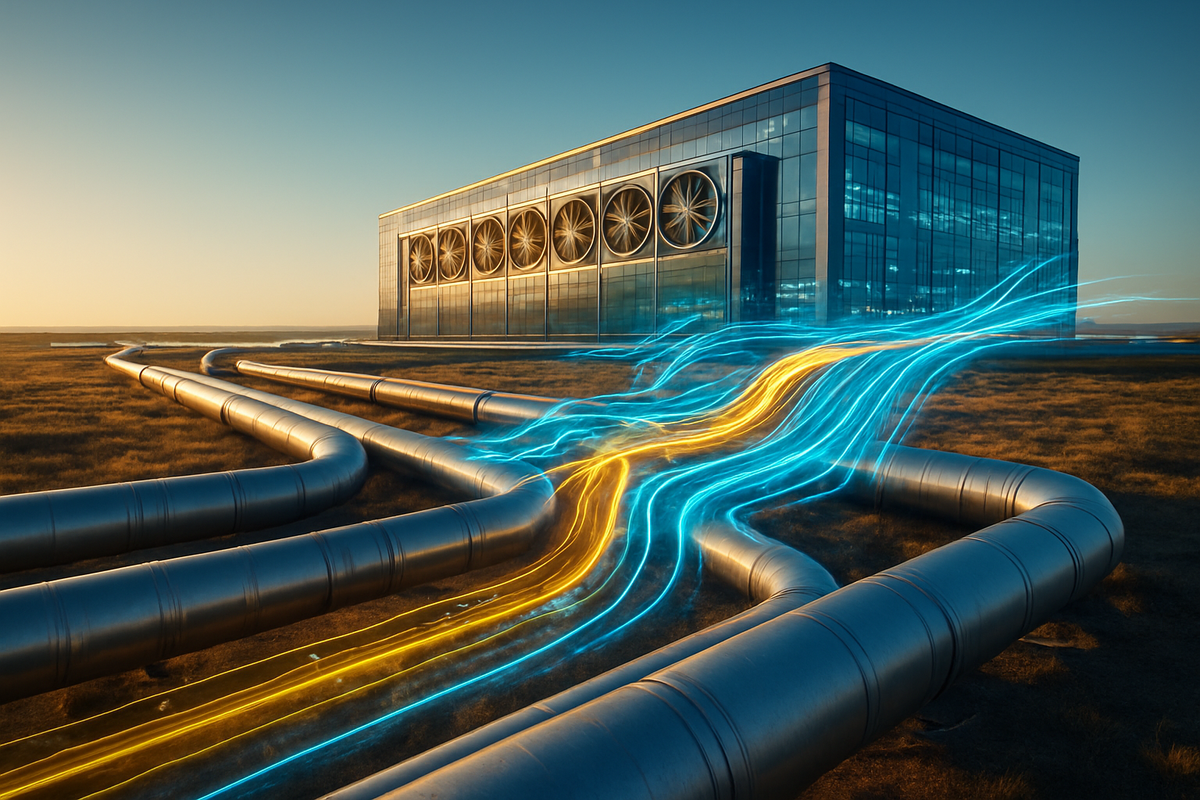
The United States energy sector has entered a transformative "harvest" phase in early 2026, marking a structural shift from heavy capital investment to aggressive cash-flow generation and operational optimization. As of January 13, 2026, the midstream industry—the massive network of pipelines, storage facilities, and processing plants—is no longer viewed merely as a cyclical bet on commodity prices. Instead, it has emerged as the essential backbone of the global artificial intelligence (AI) revolution, providing the critical natural gas infrastructure required to power a new generation of hyperscale data centers.
This resurgence is underpinned by a dramatic reversal in the federal regulatory landscape that began in early 2025. The convergence of a "U.S. Energy Dominance" policy mandate and an insatiable demand for 24/7 baseload power has created a perfect storm for investors. For the first time in over a decade, the midstream sector is seeing a massive expansion in domestic load growth, driven by "Behind the Meter" (BTM) solutions and a streamlined permitting process that has unblocked billions of dollars in stalled infrastructure projects.
A Year of Policy Revolution and Infrastructure Acceleration
The current momentum is the direct result of a sequence of landmark events that unfolded throughout 2025. On his first day in office in January 2025, President Trump issued Executive Order 14154, titled "Unleashing American Energy," which fundamentally altered the federal government's approach to energy oversight. This was followed by a National Energy Emergency declaration that reclassified critical energy infrastructure as a matter of national security, effectively shielding many pipeline projects from the "death by a thousand cuts" litigation that characterized the previous five years.
The most significant legislative milestone occurred on July 4, 2025, with the signing of the "One Big Beautiful Bill Act" (OBBBA). This sweeping legislation established strict "shot-clocks" for environmental reviews under the National Environmental Policy Act (NEPA) and ended the pause on Liquefied Natural Gas (LNG) export approvals. Furthermore, the Federal Energy Regulatory Commission (FERC) took decisive action in mid-2025 by rescinding Order No. 871. This move allowed developers to begin construction on approved projects immediately, even if legal rehearing requests were pending, removing a major hurdle for capacity expansions.
Industry reaction has been swift and overwhelmingly positive. Since the passage of the OBBBA, capital has flowed back into the sector at a record pace, with the Alerian Midstream Index outperforming the broader S&P 500 by over 15% in the last twelve months. Key stakeholders, ranging from traditional energy executives to Big Tech "hyperscalers," are now collaborating on integrated energy solutions that were unthinkable just two years ago. The timeline has shifted from long-term planning to immediate execution, as data center developers race to secure gas-fired power before the grid reaches its breaking point.
Navigating the 2026 Winners: From Pipelines to Power
The companies best positioned to win in this new environment are those with expansive existing footprints in the Southeast and the Permian Basin. Kinder Morgan (NYSE: KMI) has emerged as a primary beneficiary, currently pursuing over 5 billion cubic feet per day (Bcf/d) in new opportunities. KMI recently green-lit the $455 million Gulf Coast Express expansion, specifically designed to funnel Permian gas to the tech hubs of Texas and the Gulf Coast. Their focus on the "last mile" of energy delivery to data centers has made them a favorite among institutional investors seeking stable, AI-leveraged yields.
The Williams Companies (NYSE: WMB) has taken a different but equally lucrative path by dominating the "Behind the Meter" space. By building dedicated natural gas-fired power plants directly on-site at data center locations, Williams is bypassing the bottlenecked electrical grid entirely. CEO Alan Armstrong recently noted that the company is "overwhelmed" by requests from tech giants for these dedicated energy hubs. The successful advancement of the once-stalled Northeast Supply Enhancement (NESE) project in late 2025 has further solidified WMB’s control over the critical mid-Atlantic energy corridor.
Meanwhile, Enterprise Products Partners (NYSE: EPD) represents the "harvest" strategy at its finest. After years of heavy spending, EPD is entering 2026 with a significant reduction in capital expenditures, projected to drop from $4.5 billion in 2025 to just $2.3 billion this year. This pivot is expected to result in record-breaking free cash flow, much of which is being directed toward aggressive dividend hikes and share buybacks. Conversely, smaller players who failed to consolidate or lack proximity to the emerging data center clusters in Virginia, Ohio, and Texas may struggle to find their footing in an increasingly localized demand market.
The AI Power Grab and the Broader Industry Shift
The wider significance of this shift cannot be overstated. By the end of 2026, natural gas demand for AI data centers is projected to hit 2.5 Bcf/d, more than double the levels seen in 2024. This trend highlights a broader realization within the tech industry: wind, solar, and battery storage alone cannot provide the high-density, constant power required for generative AI at scale. As a result, natural gas is being re-branded as "essential tech infrastructure." This shift has fundamentally changed the ESG (Environmental, Social, and Governance) conversation, as energy reliability now takes precedence over rapid decarbonization.
The ripple effects are felt across the entire energy value chain. ONEOK (NYSE: OKE), following its massive acquisitions in 2024 and 2025, is now leveraging an integrated natural gas and liquids network to debottleneck the Permian Basin. This provides a reliable fuel source not just for domestic power, but for the revitalized LNG export market. The end of the LNG permitting pause has created a permanent demand floor for companies like Energy Transfer (NYSE: ET), which recently confirmed multiple 20-year "take-or-pay" contracts with both international buyers and domestic data center operators.
Historically, the midstream sector was plagued by high debt and unpredictable regulatory shifts. However, in 2026, the sector maintains some of the cleanest balance sheets in decades, with average debt-to-EBITDA ratios falling below 3.5x. This financial resilience, combined with the "national security" status of energy projects, has turned the sector into a safe-haven for capital. The precedent being set today mirrors the mid-20th-century build-out of the interstate highway system—a foundational infrastructure expansion that will support American economic growth for the next several decades.
Strategic Pivots and the Road Ahead
Looking toward the latter half of 2026 and beyond, the midstream sector is preparing for a period of "optimization through technology." Short-term opportunities lie in the rapid deployment of compression expansions, which allow companies to squeeze more capacity out of existing pipes without the need for extensive new trenching. Long-term, however, the industry is eyeing the integration of hydrogen and carbon capture and storage (CCS). The extension of Section 45Q tax credits in the 2025 OBBBA has made CCS a viable side-business for companies with existing pipeline rights-of-way.
The potential for strategic pivots is high, as midstream firms begin to look more like diversified energy utilities. Investors should expect more mergers and acquisitions as larger firms seek to acquire "ready-to-build" data center hookups. A potential challenge remains the volatility of natural gas prices, though the prevalence of long-term, fee-based contracts in the midstream space largely mitigates this risk for infrastructure owners compared to upstream producers. The primary scenario for the next 24 months is one of steady, infrastructure-led growth, shielded by a favorable federal government and fueled by the silicon of Silicon Valley.
Final Assessment: A Resilient Market Moving Forward
The US Energy and Midstream sector has successfully transitioned into a new era of relevance. The key takeaways for 2026 are clear: the AI revolution is a power revolution, and natural gas is its primary fuel. The combination of the "One Big Beautiful Bill Act," FERC streamlining, and a massive pivot toward "Behind the Meter" power solutions has de-risked the sector to a degree not seen in a generation. For investors, the appeal lies in the rare combination of high, sustainable yields and genuine growth prospects driven by the tech sector's needs.
As we move forward in 2026, the market will likely reward those companies with the largest footprints in the Permian and the Mid-Atlantic. Investors should keep a close watch on quarterly capital allocation updates from leaders like Enterprise Products Partners and Kinder Morgan. The lasting impact of 2025’s regulatory shifts will be a faster, more responsive energy sector that is capable of keeping pace with the rapid evolution of the digital economy. In the coming months, the focus will remain on project execution and the continued signing of long-term power agreements with the world's largest technology firms.
This content is intended for informational purposes only and is not financial advice.