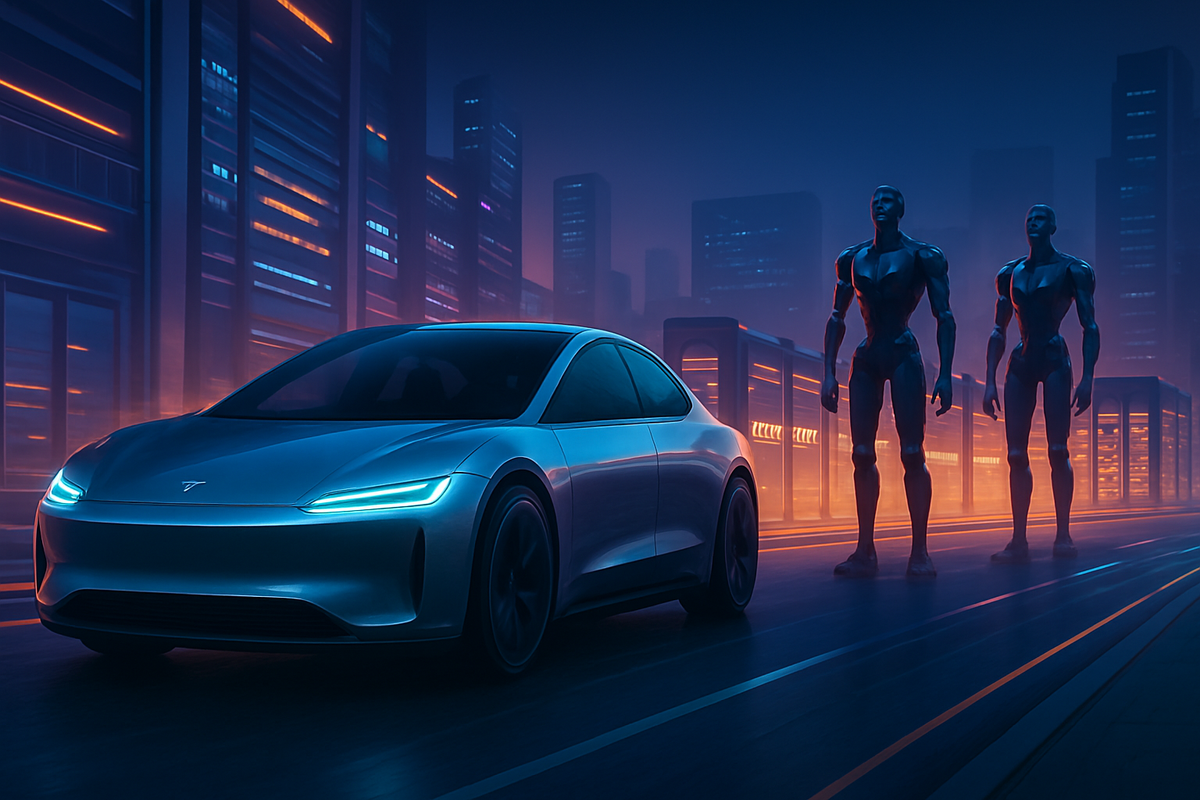
As the final trading bell of 2025 approaches, Tesla, Inc. (NASDAQ: TSLA) stands at a historic crossroads, capping off a year that redefined its identity from a high-growth electric vehicle manufacturer to a diversified artificial intelligence and robotics powerhouse. Despite facing a second consecutive year of declining vehicle deliveries—estimated to have dropped roughly 8% to 1.64 million units—the company’s stock has defied traditional automotive metrics, reaching a record intraday high of $498.83 in late December. This paradoxical performance reflects a market that is increasingly valuing Elon Musk’s empire not on the number of cars it puts on the road, but on the perceived "AI moat" generated by its autonomous software and humanoid robotics programs.
The immediate implications of this shift are profound for both retail and institutional investors. While Tesla’s valuation has surged to over $1.6 trillion, the company has officially ceded its crown as the world’s top-selling EV brand to Chinese rival BYD Company Limited (OTC: BYDDY). This transition marks the end of the "hyper-growth" era for Tesla’s automotive segment and the beginning of a high-stakes gamble on the future of autonomy. As the $7,500 federal EV tax credit vanished in September 2025 under a new regulatory regime, Tesla’s ability to maintain its premium valuation now rests almost entirely on its ability to monetize Full Self-Driving (FSD) and its burgeoning energy storage business.
The Great Pivot: From Automaker to AI Powerhouse
The story of Tesla in 2025 is one of strategic delays and technical breakthroughs. The year began with high hopes for "Project Redwood," the long-awaited $25,000 affordable vehicle intended to revitalize volume growth. However, by mid-year, management confirmed that mass production of the Model 2 had been pushed to the second half of 2026, leaving a product gap that competitors were quick to exploit. To counter the narrative of stagnation, Tesla pivoted its focus to the "Cybercab." In December 2025, the company achieved a major milestone by testing driverless prototypes on public roads in Austin, Texas, without safety drivers, signaling that the vision of a dedicated robotaxi fleet is nearing commercial reality.
Timeline-wise, the release of FSD v14 in the fourth quarter proved to be the stock's primary catalyst. Analysts noted a six-fold improvement in miles between interventions, bringing the software closer to "near-human" safety levels. This technical progress was mirrored in Tesla’s factories, where several thousand "Optimus" humanoid robots were deployed to handle repetitive assembly tasks by year-end. Key stakeholders, including long-term bulls at Wedbush and Morgan Stanley (NYSE: MS), have championed these developments as proof that Tesla is successfully decoupling its stock price from the cyclical nature of the global auto market.
Initial market reactions to these milestones have been polarized. While tech-focused investors cheered the "Cybercab" progress, traditional automotive analysts pointed to the "hollowed out" delivery numbers in Q4. The repeal of federal subsidies in September 2025 led to a massive "pull-forward" of sales into the third quarter, leaving the final months of the year looking remarkably lean. This volatility has become the new normal for Tesla, as the company navigates the "valley of death" between its legacy car business and its future as an AI service provider.
The Shift in the EV Hierarchy: Winners and Losers
The competitive landscape of 2025 has produced clear winners and losers, with BYD (OTC: BYDDY) emerging as the undisputed volume leader. By leveraging a vertically integrated supply chain and a dominant position in the LFP battery market, BYD captured nearly 20% of the global BEV market this year. Their ability to undercut Tesla’s pricing by as much as 50% in European and Southeast Asian markets has forced a re-evaluation of Tesla’s global dominance. While Tesla remains the profit leader per vehicle, BYD’s scale has made it the primary beneficiary of the global shift toward affordable electrification.
On the other side of the spectrum, smaller EV startups like Lucid Group, Inc. (NASDAQ: LCID) and Rivian Automotive, Inc. (NASDAQ: RIVN) have faced a brutal 2025. Lucid’s stock hit all-time lows in December after the company slashed production guidance for its Gravity SUV and continued to struggle with high cash burn. Rivian, despite breaking ground on its new Georgia facility, has seen its margins squeezed by the end of federal tax credits and rising component costs. For these players, the "Tesla-lite" strategy is no longer enough to satisfy investors who are now demanding a clear path to profitability in a post-subsidy world.
In a surprising twist, the "winner" of Tesla’s internal portfolio has been its Energy division. Tesla Energy emerged as a critical profit engine in 2025, with gross margins exceeding 30%. The deployment of a record 12.5 GWh of storage in Q3 alone demonstrated that the utility-scale Megapack business is no longer a side project. This segment now contributes nearly a quarter of the company's total profit, providing a vital cushion as automotive margins face pressure from Chinese competition and the loss of US regulatory credits.
The Musk Factor and the Regulatory Reset
The broader significance of Tesla’s 2025 performance cannot be divorced from the political landscape. Following the 2024 US election, Elon Musk’s high-profile involvement in the Department of Government Efficiency (DOGE) has created a unique set of challenges and opportunities. While his proximity to power has fueled hopes for a streamlined federal framework for autonomous vehicles, it has also led to "brand damage" among certain consumer segments. Analysts observed a 23% drop in Tesla’s US sales in November 2025, attributed in part to political polarization surrounding Musk’s public persona.
Regulatory shifts have also reshaped the industry's trajectory. The rollback of Biden-era fuel-efficiency standards has eased the pressure on legacy automakers like Ford Motor Company (NYSE: F) and General Motors (NYSE: GM) to transition quickly to electric fleets. This "regulatory reset" has slowed the overall pace of EV adoption in the US, making Tesla’s dominance of the remaining market even more critical. Historically, this mirrors the "trough of disillusionment" seen in other disruptive technologies, where initial hype is replaced by a grueling period of consolidation and infrastructure building.
Furthermore, the global expansion of FSD into markets like China and the UAE in early 2025 has set a precedent for how AI-driven software can be exported as a high-margin service. However, European regulators remain the "wild card" heading into 2026, with stringent data privacy and safety requirements posing a significant hurdle for Tesla’s vision-only approach. The ripple effects are being felt across the semiconductor industry as well, with Nvidia Corporation (NASDAQ: NVDA) continuing to benefit from the massive compute requirements needed to train Tesla’s neural networks.
The 2026 Horizon: Strategic Pivots and Scenarios
Looking ahead to 2026, Tesla faces a "make-or-break" year for its hardware roadmap. The primary challenge will be the successful volume ramp of the $25,000 Model 2. If Tesla can hit its mid-2026 production targets, it could reclaim significant market share and prove that it can compete with BYD on price. However, any further delays would likely lead to a painful re-rating of the stock as investors lose patience with the "affordable car" narrative.
The second major pivot involves the commercialization of Optimus. With several thousand units already working internally, the second half of 2026 is slated for the first external shipments of "Optimus Gen 2." This could open up an entirely new revenue stream in industrial automation, potentially dwarfing the automotive business in the long term. Strategic adaptations will also be required in the Robotaxi segment, as Tesla must move from "testing" to "revenue-generating" miles in cities beyond Austin and Phoenix to justify its current valuation.
Final Verdict: An Investor's Guide to the New Tesla
As 2025 draws to a close, the key takeaway for investors is that Tesla is no longer a "car company" in the traditional sense. It has become a venture capital fund for AI and robotics, wrapped in a profitable energy and automotive shell. The stock’s 21% gain this year, despite falling deliveries, proves that the market is willing to pay a "Musk Premium" for the optionality of future technologies. However, this premium comes with extreme volatility and a reliance on a regulatory environment that is increasingly tied to the CEO’s personal and political ventures.
Moving forward, the market will be watching three critical metrics: the ramp-up of the Model 2, the expansion of the Robotaxi testing footprint, and the continued margin growth of the Energy division. Investors should remain cautious of the "delivery hollow" expected in early 2026 following the end of US subsidies, but the long-term thesis remains tied to the success of FSD v14 and beyond. Tesla remains the ultimate "show me" story; in 2025, it showed the world its future, but in 2026, it must prove that future can be scaled.
This content is intended for informational purposes only and is not financial advice.