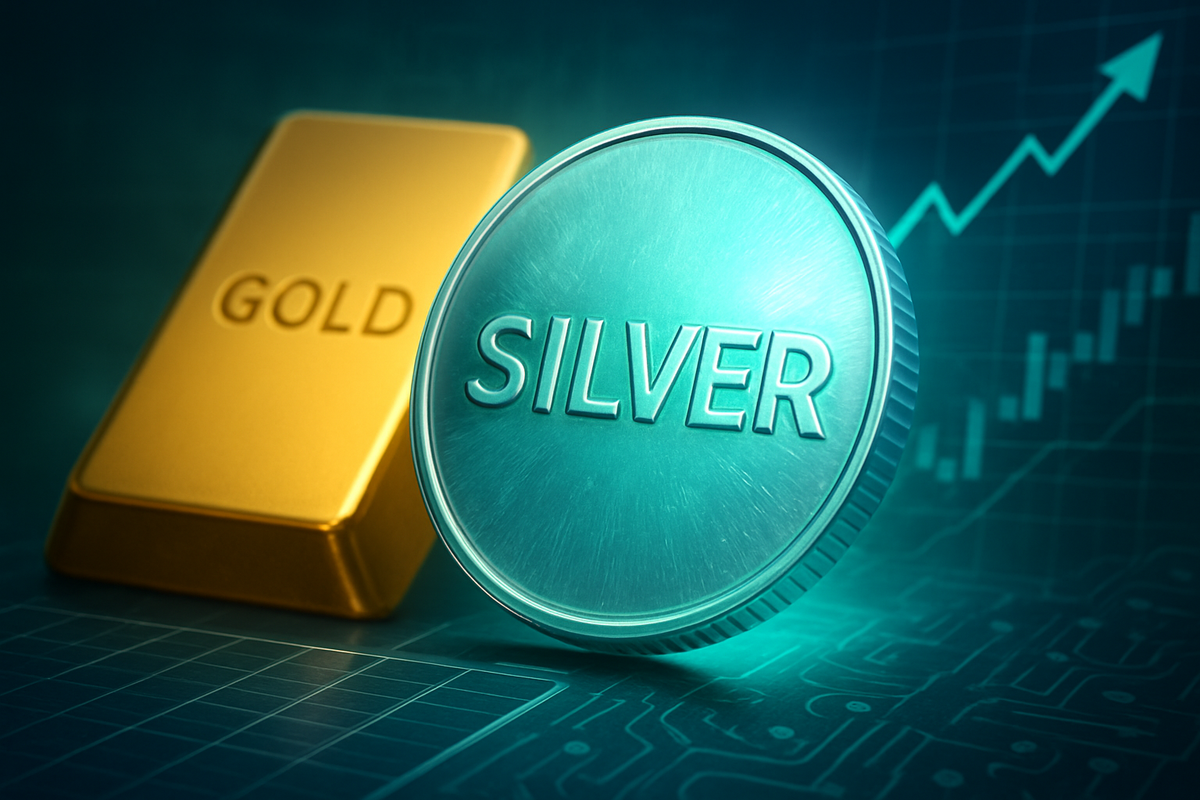
The precious metals market is currently witnessing a fascinating and potentially paradigm-shifting phenomenon: silver (XAG) appears to be increasingly decoupling from its traditional big brother, gold (XAU). For decades, the price movements of silver have largely mirrored those of gold, albeit with higher volatility. However, recent trends, particularly throughout 2025, suggest a significant divergence, with silver dramatically outperforming gold and carving out its own bullish narrative. This shift has profound implications for investors, potentially redefining strategies in the precious metals space and highlighting silver's unique position at the intersection of investment and industrial demand.
This emerging decoupling is more than just a fleeting market anomaly; it represents a fundamental re-evaluation of silver's intrinsic value and its distinct demand drivers. While gold continues to shine as a safe-haven asset amidst geopolitical uncertainties and inflationary pressures, silver's rally is increasingly underpinned by its critical role in the accelerating global green energy transition. The implications are immediate: a renewed focus on silver as a standalone investment, a re-evaluation of the historically significant gold-to-silver ratio, and a potential recalibration of portfolios for those seeking exposure to both traditional precious metal attributes and the burgeoning industrial demand for critical minerals.
Silver's Meteoric Rise and the Narrowing Ratio
The story of silver's decoupling is best told through its blistering ascent throughout 2025. While gold posted a robust 60.7% gain for the year, reaching new all-time highs of $4,381.58 per troy ounce in October and hovering around $4,193.70 to $4,256 by early December 2025, silver's performance has been nothing short of spectacular. The white metal surged past the $50 per ounce mark in October, hitting new all-time highs near $56.40, and even exceeding $57.30 in late November before reaching an impressive $58.85 per ounce in December 2025. This translates to an astounding 103% return for silver in 2025, significantly outperforming gold and most other asset classes.
The timeline leading up to this moment reveals a sustained period of silver outperformance. After peaking around 120:1 to 125:1 during the early COVID-19 market crash in 2020, the gold-to-silver ratio, which indicates how many ounces of silver are needed to buy one ounce of gold, has been in a consistent rebalancing phase. In mid-2025, the ratio fluctuated between 75:1 and 85:1. By early November 2025, it was approximately 80:1 to 83:1, but a critical milestone was reached by December 1, 2025, when the ratio dropped to 74.6x – its lowest reading since May 29, 2024. This sustained compression of the ratio is the clearest indicator of silver's independent strength and its ongoing decoupling.
Key players and stakeholders involved in this market dynamic include institutional investors recognizing silver's industrial demand, retail investors drawn to its relative affordability and higher percentage gains potential, and major mining companies. Initial market reactions have been overwhelmingly bullish for silver, with analysts widely predicting a continued upward trajectory. The primary driver behind silver's independent surge is its dual nature as both a monetary metal and a critical industrial commodity. Demand from green technologies, particularly solar panels and electric vehicles, has surged, creating significant supply deficits. This industrial demand, less pronounced for gold, provides a unique and powerful tailwind for silver, fundamentally altering its price discovery mechanism.
The current market environment, characterized by expectations of US Federal Reserve interest rate cuts throughout 2025, also provides a supportive backdrop for both precious metals by reducing the opportunity cost of holding non-yielding assets. However, silver's additional catalyst from industrial demand, coupled with tight physical supply and critically low inventories in key trading hubs, has allowed it to chart a more aggressive course, solidifying the narrative of a genuine decoupling.
Corporate Fortunes in Flux: Winners and Losers in a Decoupled Market
A sustained decoupling of silver from gold, particularly with silver's pronounced outperformance, is poised to reshape the financial landscape for public companies across the precious metals industry. Companies with significant exposure to silver, whether through primary mining operations, streaming agreements, or dedicated exchange-traded funds, stand to gain substantially, while gold-centric entities might see their relative performance lag. This shift necessitates a re-evaluation of investment strategies and corporate priorities.
Primary silver mining companies are undoubtedly the most direct beneficiaries. Entities like First Majestic Silver (NYSE: AG), which derives a substantial portion of its revenue from silver, would experience a significant boost to their profitability and cash flow. With operational costs often relatively fixed, a sharp increase in silver prices leads to amplified profit margins, a phenomenon known as operational leverage. Similarly, Hecla Mining Company (NYSE: HL), the largest primary silver producer in the United States and Canada, and Pan American Silver Corp. (NASDAQ: PAAS), a major player with extensive reserves across the Americas, are poised for substantial gains. Pan American Silver, for instance, has already seen its stock hit 52-week highs in December 2025, fueled by record silver prices and strong quarterly results, underscoring the immediate positive impact. These companies are likely to increase exploration budgets, expand existing operations, strengthen their balance sheets, and potentially engage in strategic mergers and acquisitions to consolidate silver assets.
Conversely, major gold mining companies, where silver is often a by-product, might find themselves as relative underperformers. While they will still benefit from rising gold prices, their stock performance is likely to be overshadowed by the more explosive gains of dedicated silver miners. Giants like Newmont Corporation (NYSE: NEM), the world's largest gold miner, and Barrick Gold (NYSE: ABX) (or TSX: ABX), a leading global gold and copper producer, will continue to see their core profitability driven by gold. Their strategic focus will likely remain gold-centric, although they might re-evaluate the economics of projects with significant silver by-product potential if silver's price surge makes them more attractive. For investors, physical gold ETFs like SPDR Gold Shares (NYSE Arca: GLD) would reflect gold's price movements, but would likely underperform silver-focused ETFs such as iShares Silver Trust (NYSE Arca: SLV) or silver mining ETFs like Global X Silver Miners ETF (NYSE Arca: SIL), which are direct beneficiaries of the silver rally.
Precious metals streaming and royalty companies, such as Wheaton Precious Metals Corp. (NYSE: WPM), with diversified exposure to both gold and silver streams, stand to benefit significantly from higher silver prices, especially given their fixed-price purchase agreements. Wheaton, with approximately 39% of its revenue from silver, would see an increase in its silver stream revenue, contributing to overall profitability and stock appreciation. Refining companies, while less directly exposed to commodity prices, could see increased processing volumes as higher silver prices stimulate the recycling of silver scrap from industrial applications and jewelry, leading to moderate positive impacts. This dynamic underscores a clear shift in investor preference and capital allocation within the precious metals sector, favoring assets with direct and substantial exposure to silver's burgeoning industrial demand.
A New Era for Precious Metals: Wider Significance and Shifting Paradigms
The ongoing decoupling of silver from gold in late 2024 and throughout 2025 marks a pivotal moment in the precious metals market, signaling a deeper shift in underlying market dynamics and investor perception. This divergence is not merely a short-term anomaly but reflects fundamental changes in broader industry trends, with significant ripple effects across various sectors, potential policy implications, and echoes of historical market cycles.
At the heart of this shift is silver's burgeoning industrial demand, a trend that aligns perfectly with the global push towards a green economy. Silver's indispensable role in photovoltaics (solar panels), electric vehicles, 5G technology, and other critical electronics has propelled its industrial fabrication to record highs, projected to surpass 700 million ounces in 2025. This structural demand contrasts with gold's primary role as a monetary and safe-haven asset, which continues to be bolstered by geopolitical tensions, inflationary concerns, and robust central bank buying. The simultaneous existence of a structural supply deficit in silver, with mine output declining since 2016 and limited new projects, further exacerbates market tightness. The majority of silver is a byproduct of other metal mining, making its supply inelastic to its own price, thereby amplifying the impact of surging demand.
The ripple effects of this decoupling are far-reaching. For industrial users of silver, such as major electronics manufacturers (e.g., Apple (NASDAQ: AAPL), Samsung (KRX: 005930)) and solar panel producers (e.g., First Solar (NASDAQ: FSLR)), escalating silver prices mean increased input costs and potential supply chain vulnerabilities. This could spur innovation in "thrifting" (reducing silver content) or a more aggressive search for alternative materials and diversified supply sources. For investors, the decoupling underscores silver's unique dual nature, offering a distinct diversification opportunity and potentially greater upside potential given that the gold-to-silver ratio, even after its recent compression (around 79:1 in late 2025), remains above its long-term historical average (69:1) and geological average (15:1). This suggests that silver may still be undervalued relative to gold, offering a more accessible entry point for a broader range of investors.
From a regulatory and policy perspective, the U.S. government's designation of silver as a critical mineral in 2025 is a significant development. This could lead to strategic policies aimed at securing domestic supply, promoting exploration, and incentivizing recycling, potentially impacting global trade and supply chain dynamics. Furthermore, anticipated interest rate cuts by central banks throughout 2025 are expected to provide a supportive macroeconomic backdrop for all precious metals by reducing the opportunity cost of holding non-yielding assets. Historically, significant upward movements in silver prices have often followed periods where the gold-to-silver ratio reached a peak, as seen after the dot-com bust, the 2008 financial crisis, and the COVID-19 pandemic. Each of these periods saw substantial silver gains, mirroring the current trend. While silver is known for its higher volatility, its recent proportional decline during a market downturn in October 2025 was less severe than gold's, hinting at a potentially more resilient market structure driven by its strong underlying industrial fundamentals rather than purely speculative excess. This suggests that the current silver rally may be more sustainable, driven by tangible demand rather than just monetary policy or safe-haven flows.
The Road Ahead: Navigating a Decoupled Precious Metals Landscape
The evolving dynamics between silver and gold present a complex yet compelling outlook for the precious metals market, demanding strategic foresight from investors and companies alike. Both short-term and long-term possibilities suggest continued strength for precious metals, but with silver potentially charting a more aggressive course due to its unique industrial demand profile.
In the short term, leading up to late 2025, the "risk-off" sentiment prevalent globally, fueled by macroeconomic uncertainties and geopolitical tensions, is expected to continue benefiting both gold and silver as safe-haven assets. Gold, having already achieved its strongest annual performance in nearly 46 years with a 60.7% gain in 2025, is projected to maintain its robust trajectory, potentially presenting opportunities for accumulation on dips. However, silver's ascent has been even more dramatic, with a 94% gain over 11 months in 2025, driven by an insatiable industrial demand from the solar, electronics, and electric vehicle sectors, leading to a projected 206 million-ounce supply deficit for the year. This persistent deficit and industrial pull are expected to sustain silver's outperformance, further narrowing the gold-to-silver ratio.
Looking further ahead into 2026 and beyond, the long-term outlook for precious metals remains broadly bullish. Forecasts suggest gold could comfortably reach $4,500-$5,000+ per ounce by mid-to-end 2026, supported by persistent macroeconomic uncertainties and continued central bank accumulation. Silver's long-term projections are even more optimistic, with some experts predicting prices could double by the end of 2026, potentially reaching $100 per ounce or higher within a decade, fueled by its ongoing industrial demand and structural supply deficits. This sustained strength for both metals solidifies their positions as essential components of a resilient portfolio, offering diversification and a hedge against persistent inflation and geopolitical instability. This dynamic environment calls for agility, a keen understanding of both monetary and industrial drivers, and a readiness to adapt to evolving market conditions.
For investors, this environment necessitates a nuanced approach. While gold continues to offer stability and a hedge against systemic risk, silver, with its higher volatility and greater potential for percentage gains, becomes a compelling growth play for those with a higher risk appetite and a long-term horizon. Strategic diversification, tactical rebalancing, and disciplined allocations, potentially leveraging ETFs like iShares Silver Trust (NYSE Arca: SLV) for silver exposure and SPDR Gold Shares (NYSE Arca: GLD) for gold, will be crucial. Companies, especially those in mining, will need to adapt. Higher metal prices translate into increased revenues and stronger cash flows, incentivizing reinvestment in exploration, development, and mergers. Fabricators and industrial users of silver may face margin pressures, driving innovation in silver-lean technologies and prompting proactive hedging strategies to mitigate price volatility. The designation of silver as a critical mineral also opens doors for potential government incentives for domestic supply and recycling initiatives.
Conclusion: A New Dawn for Silver and a Resilient Precious Metals Market
The notable decoupling of silver from gold in late 2024 and throughout 2025 marks a pivotal moment in the precious metals market, signaling a profound recalibration of market priorities and a reinforced role for both metals in an increasingly volatile global economy. This shift is not merely a transient market phenomenon but reflects fundamental changes in demand drivers and investor perception.
The key takeaway is silver's remarkable emergence from gold's shadow. While gold (XAU) delivered a robust 60.7% gain in 2025, driven by its enduring safe-haven appeal amidst geopolitical tensions, inflation, and aggressive central bank buying, silver (XAG) staged a blistering ascent with a 103% return for the year, reaching new all-time highs near $58.85 per ounce by December 2025. This outperformance is largely attributed to silver's unique dual nature as both a monetary metal and a critical industrial commodity. Its surging demand from the green energy transition—particularly in solar panels and electric vehicles—and AI technologies has created significant structural supply deficits, distinguishing its trajectory from gold's more purely monetary role. The narrowing of the gold-to-silver ratio to around 74.6x by December 2025, its lowest since May 2024, vividly illustrates this divergence and silver's growing intrinsic value.
Moving forward, the market assessment for both gold and silver remains robustly bullish. Gold is projected to comfortably reach $4,500-$5,000+ per ounce by mid-to-end 2026, supported by persistent macroeconomic uncertainties and continued central bank accumulation. Silver's outlook is even more optimistic, with projections suggesting prices could potentially double by the end of 2026, reaching $100 per ounce or higher within a decade, fueled by its ongoing industrial demand and structural supply deficits. This sustained strength for both metals solidifies their positions as essential components of a resilient portfolio, offering diversification and a hedge against persistent inflation and geopolitical instability. The "flight to tangible assets," evidenced by capital shifting from volatile cryptocurrencies to precious metals, underscores a lasting impact on how investors seek to protect and grow wealth in uncertain times.
In the coming months, investors should closely monitor several key indicators. Continued vigilance on central bank monetary policies, particularly any further indications of interest rate cuts, will be crucial, as lower rates typically boost non-yielding assets. Persistent inflationary pressures and escalating geopolitical developments will also sustain demand for safe-haven assets. Furthermore, investors must pay close attention to industrial demand trends for silver, especially growth in green energy and AI sectors, and any shifts in the U.S. dollar's strength. Finally, tracking the gold-to-silver ratio's movement will provide ongoing insights into silver's relative strength and potential for further outperformance. A sustained decline towards historical averages (50:1 to 60:1) would signal continued bullish momentum for silver. The current market environment suggests that silver is not just catching up to gold, but actively forging its own powerful, fundamentally driven bull market.
This content is intended for informational purposes only and is not financial advice