
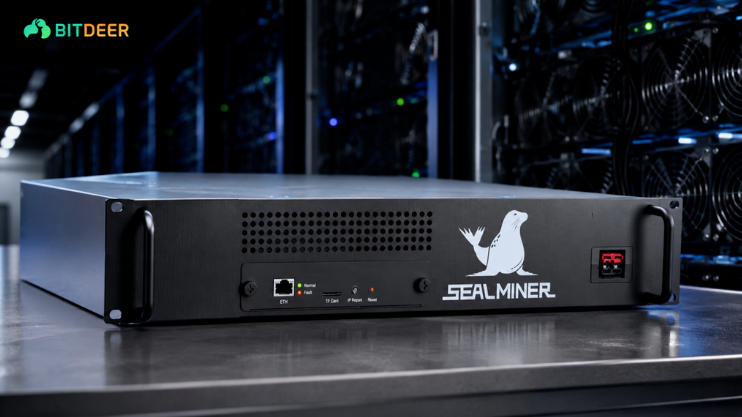
Litecoin has entered the part of its post-halving cycle, while Dogecoin merged mining is no longer a low-pressure bonus as Scrypt difficulty keeps climbing. For operators still relying on the 20 GH/s generation, the real question is no longer how many machines to add, but how long each megawatt can stay profitable. Bitdeer's recent release of the SEALMINER DL1 series has drawn attention from Scrypt miners looking for new options beyond the long-standing 20 GH/s hardware class.
Is the DL1 series simply adding more hashrate, or is it actually moving the cost curve? And when the power bill lands, does that efficiency gain still leave enough room above the shutdown price? With DL1 Air designed for air-cooled deployments and DL1 Hydro built for liquid-cooled, high-density facilities, the discussion quickly moves beyond headline performance.
That is also where the 180 J/GH benchmark becomes a practical concern. At scale, higher joules per gigahash raise the shutdown price because more electricity is consumed before revenue is produced. When difficulty or power costs rise, each MW supports fewer profitable gigahashes, net profit per power block declines, and operators have less room to absorb cooling, maintenance, and market volatility.
Smashing Industry Ceilings with Hard Data
Facility operators judge mining hardware by how much margin each joule can preserve. Moving beyond the 180 J/GH ceiling changes the cost baseline for large Scrypt mining sites.
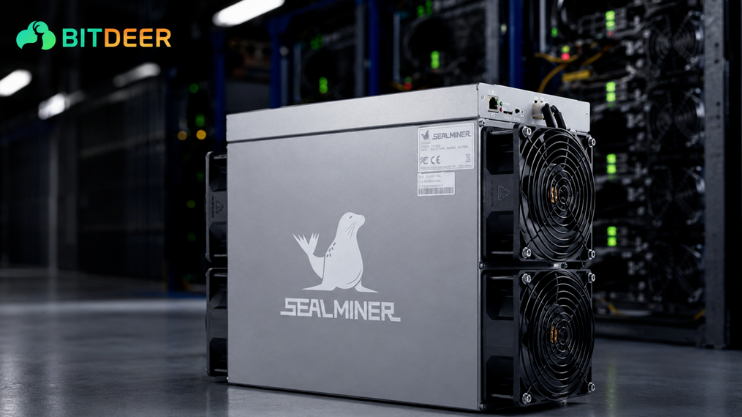
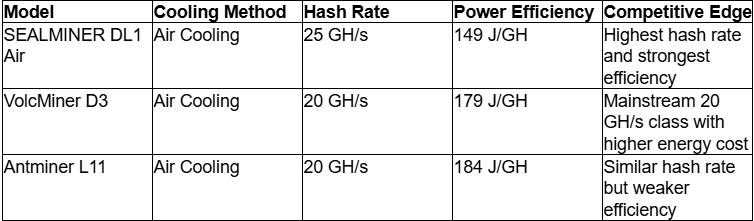
The SEALMINER DL1 Air delivers 25 GH/s at 149 J/GH in standard mode, breaking through the legacy 20 GH/s and 180 J/GH market ceiling to secure superior operating margins during volatile market cycles.
The air-cooled comparison below shows how DL1 Air performs against other major Scrypt mining models.
Table 1. Comparative Analysis: Scrypt Air-Cooling Efficiency & Hash Rate Metrics
Hydro Cooling Dominance
For liquid-cooled facilities, the SEALMINER DL1 Hydro strengthens the same economic logic. Its 42.5–55 GH/s operating range and 132–157 J/GH efficiency give operators higher per-machine output and more flexible deployment options than several competing hydro models.
Model: SEALMINER DL1 Hydro
- Operating Mode: Standard
- Hash Rate: 52.5 GH/s
- Power Efficiency: 149 J/GH
- Competitive Edge: Stronger output with flexible operation
Model: Antminer L11 Hydro (HU2)
- Operating Mode: Standard
- Hash Rate: 35 GH/s
- Power Efficiency: 165 J/GH
- Competitive Edge: Nearest hydro efficiency competitor
Model: VolcMiner D1 Hydro (30G)
- Operating Mode: Standard
- Hash Rate: 30.4 GH/s
- Power Efficiency: 250 J/GH
- Competitive Edge: Lower output with higher energy use
Model: ElphaPex DG Hydro 1
- Operating Mode: Standard
- Hash Rate: 20 GH/s
- Power Efficiency: 310 J/GH
- Competitive Edge: Lowest output in this group
For site managers, the comparison moves quickly from machine specifications to operating exposure. Matching DL1 Hydro's 52.5 GH/s normal-mode output would require about 2.6 conventional 20 GH/s units, increasing rack demand, cabling, network ports, switch capacity, and maintenance points.
The wider implication lies in energy cost. At 149 J/GH, DL1 Hydro uses less than half the power per unit of hashrate compared with 300+ J/GH hydro hardware. For multi-megawatt sites, that difference could lower the shutdown price and provide a broader buffer against power-rate pressure, difficulty changes, and market volatility.
DL1 Hydro Operating Modes Expand Cost-Control Options
Mining revenue changes with coin prices, network difficulty, and electricity rates. A fixed-speed miner gives operators fewer choices, while multi-mode operation allows facilities to shift between efficiency protection and higher output.
Operating Mode: Low Power Mode
- Hash Rate: 42.5 GH/s
- Power Efficiency: 132 J/GH
- Work Conversion: Reduces energy pressure during weak market periods
- Economic Reading: Helps protect margin when power cost rises
Operating Mode: Normal Mode
- Hash Rate: 52.5 GH/s
- Power Efficiency: 149 J/GH
- Work Conversion: Balances output and power use for daily operation
- Economic Reading: Supports stable long-cycle mining economics
Operating Mode: High Hashrate Mode
- Hash Rate: 55 GH/s
- Power Efficiency: 157 J/GH
- Work Conversion: Maximizes per-machine output when market conditions improve
- Economic Reading: Helps capture more revenue from existing rack space
This operating range makes DL1 Hydro more than a fixed-performance miner. It gives large Scrypt facilities a practical way to adjust output, power use, and cash-flow pressure without changing hardware. This multi-mode capability effectively transforms the hardware into a dynamic financial hedging tool for site operators, allowing them to instantly defend their margins against energy price spikes or network difficulty surges.
2U Density Brings Rack Economics Into Focus
For multi-megawatt Scrypt sites, DL1 Hydro's 2U server format gives hashrate density a practical deployment advantage. In professional rack environments, compact hardware can help operators place more Scrypt compute within limited space while keeping installation, cabling, and maintenance more organized.
Hydro cooling further supports this model by providing more stable thermal control than airflow-dependent layouts. For dense facilities, steadier heat management can help reduce thermal stress, simplify cooling planning, and support more predictable long-term operation.
Together, the 2U form factor, liquid cooling system, and higher per-machine output position DL1 Hydro as more than a hashrate upgrade. For institutional operators, its value lies in improving how rack space, power, and cooling resources are converted into usable mining capacity.
Industry Outlook
The deployment of the SEALMINER DL1 series introduces a practical shift for institutional Scrypt operations, moving performance expectations beyond previous hardware limits. By moving past the 180 J/GH efficiency floor, this hardware design allows multi-megawatt facilities to better manage their total cost of ownership against fluctuating power rates and difficulty metrics.