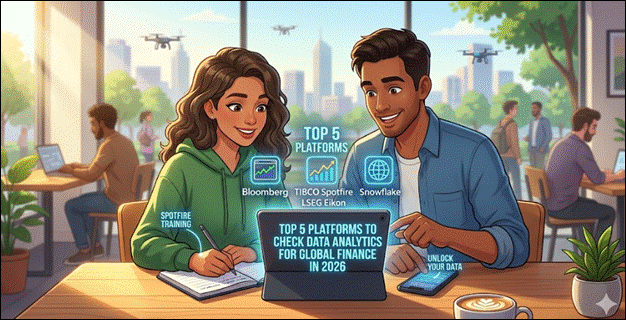
 Money moves fast, but in 2026, information moves even faster. If you are working in global finance, you know that the "old way" of doing things, relying on static spreadsheets and gut feelings, just doesn't cut it anymore. We are living in a world where a single tweet or a minor shift in a supply chain half a world away can send ripples through the markets in seconds.
To stay ahead, you need more than just a window into the markets; you need a high powered telescope that can see through the fog. Whether you are managing a hedge fund, working in corporate treasury, or just trying to navigate the complexities of international trade, the platform you choose is your most important ally. Let’s talk about the five platforms that are truly leading the charge in global finance this year.
1. Bloomberg Terminal: The Trusted Giant
Even in 2026, you cannot talk about global finance without mentioning the Bloomberg Terminal. It is the iconic "black box" that has sat on the desks of the world's most powerful bankers for decades. Why does it stay at the top? It is the sheer depth of the data.
Bloomberg gives you real time access to everything: bond yields in Japan, commodity prices in Brazil, and the latest central bank announcements from Europe. But more than just the numbers, it is the community. The Bloomberg chat is where the world’s financial elite actually talk to each other. It is expensive, and the interface still looks a bit like something from a 1980s sci fi movie, but for those who need to be at the center of the action, it is still the gold standard.
2. TIBCO Spotfire: The Analytical Powerhouse
If Bloomberg is the source of the data, TIBCO Spotfire is the brain that makes sense of it. In 2026, Spotfire has become the favorite for finance teams who need to go deeper than just checking the current price. It is built for complex, multi layered analysis.
Think about a global bank trying to manage its currency risk across fifty different countries. You have to account for interest rates, inflation, political stability, and historical trends all at once. Spotfire allows you to mash all that data together into a single, interactive view. It is particularly great for "predictive" work, helping you see not just where the market is, but where it is likely to go next.
Because it is so powerful, it does have a learning curve. I have seen many professionals take their careers to the next level by investing in spotfire training. Once you know how to build those deep, automated models, you aren't just a finance person anymore; you are a data strategist. It is the tool of choice for those who want to find the patterns that everyone else is missing.
3. FactSet: The Modern Integrator
FactSet has won over a lot of fans recently by being much more "user friendly" than the older terminals. It excels at integration. In finance, we often have to pull data from a dozen different places—internal spreadsheets, third party research, and public filings. FactSet acts like a universal translator, pulling all that info into a clean, modern workstation.
One thing I love about FactSet in 2026 is its focus on "workaround" efficiency. It understands that you spend a lot of time in Excel, so its integration there is seamless. You can pull live data into your models without worrying about breaking a link or manually typing in numbers. It is the perfect platform for analysts who want a high end tool that feels like it was built for the way humans actually work today.
4. LSEG Eikon (Refinitiv)
LSEG Eikon (formerly known as Refinitiv Eikon) is the biggest rival to Bloomberg. It is known for having a slightly more open feel. While Bloomberg can feel like a "walled garden," Eikon is built on open technology, making it easier to connect with other apps and custom built software.
In 2026, Eikon is a leader in ESG data (Environmental, Social, and Governance). As more investors prioritize sustainability, having clear, reliable data on a company’s carbon footprint or board diversity is no longer a "nice to have", it is a necessity. Eikon makes this data incredibly easy to find and analyze. It is a fantastic choice for the modern investor who wants a broad, global perspective without the steep price tag of some other terminals.
5. Snowflake: The Data Cloud
You might be surprised to see Snowflake on this list, as it isn't a traditional "financial terminal." However, in 2026, Snowflake has become the backbone of global finance. It is where the data lives.
Large financial institutions use Snowflake to store massive amounts of historical and real time information securely. Because it is a cloud based system, it allows different teams across the world to access the same "single source of truth" instantly. If you are building your own custom analytics or using a tool like Spotfire, you are likely pulling your data from a Snowflake warehouse. It is the silent engine that keeps the entire global finance machine running smoothly and securely.
Finding the Right Fit for You
Choosing a platform is a bit like choosing a pair of shoes. It doesn't matter how expensive they are if they don't fit the way you walk. If you are a fast paced trader, you might need the raw speed of Bloomberg. If you are a long term strategist, the deep analytical capabilities of Spotfire might be your best bet.
The key is to not get overwhelmed by the features. Start with the one or two things you do every single day and find the platform that makes those tasks easier. And don't be afraid to invest in yourself. Whether it is spending a few hours on a tutorial or signing up for formal spotfire training, the time you spend learning your tools is what actually turns data into profit.
Frequently Asked Questions
Which of these is the most affordable for an individual investor?
For individuals, platforms like FactSet or even a lighter version of Eikon are often more accessible than the full Bloomberg Terminal. There are also many "prosumer" tools like Koyfin or TradingView that provide a great deal of data analytics consulting for a fraction of the cost if you don't need the heavy enterprise features.
Is it worth getting professional training for these platforms?
Absolutely. These tools are incredibly deep. Most people only use about ten percent of what they are capable of. Investing in something like spotfire training or a Bloomberg certification ensures you are actually getting your money's worth out of the high subscription fees.
Can these platforms help me with crypto and digital assets?
Yes, by 2026, almost all major financial platforms have integrated deep crypto and blockchain data. Bloomberg and Eikon both have dedicated sections for digital assets, tracking everything from Bitcoin prices to on chain transaction volumes.
What is the "single source of truth" and why is it important?
In global finance, if the sales team is looking at one set of numbers and the risk team is looking at another, it leads to disaster. A "single source of truth" (like a well managed Snowflake warehouse) ensures that everyone in the company is looking at the exact same data at the exact same time.
How do these platforms handle data security?
Security is the top priority for all of them. They use military grade encryption and comply with global regulations like GDPR. Because they handle trillions of dollars in transactions, their security budgets are often larger than the entire revenue of smaller tech companies.
Is AI integrated into these financial tools?
Yes, heavily. In 2026, AI is used to summarize news, spot anomalies in trading patterns, and even suggest "best next moves" based on historical data. Many platforms now have "natural language" interfaces where you can simply ask, "Show me the top five undervalued stocks in the tech sector," and get an instant answer.
Can I use these tools on my phone?
Most of them have excellent mobile apps. While you wouldn't want to do a full multi year financial model on a tiny screen, they are perfect for checking your positions, reading the latest news, and receiving alerts while you are on the move.
Why is ESG data so important now?
Investors are increasingly being held accountable for the social and environmental impact of their money. ESG data allows you to see if a company is actually meeting its sustainability goals, which is now considered a key indicator of long term financial health.
What is the difference between a terminal and an analytics platform?
A terminal (like Bloomberg) is primarily a source of data and news. An analytics platform (like Spotfire) is a tool you use to manipulate and visualize that data to find new insights. In 2026, the lines are blurring, but you usually need both to be truly effective.
Which platform is best for someone just starting a career in finance?
Learning Excel is the absolute first step. After that, I would suggest getting familiar with a widely used tool like Power BI or Tableau for visualization, and then specializing in a high end tool like Spotfire or Bloomberg as you find your specific niche in the industry.