In the landscape of consumer packaged goods (CPG), few entities possess the multi-generational staying power and adaptability of Church & Dwight (NYSE: CHD). Known colloquially as the "House of Vulcan" for its iconic Arm & Hammer logo, the company has spent the last decade evolving from a quiet provider of household staples into a dynamic, brand-building powerhouse. Today, Church & Dwight stands at a critical inflection point. Following a massive portfolio reshuffling in 2025 and a leadership transition in early April of the same year, the company has pivoted toward high-growth "Power Brands" while divesting legacy laggards. This transition comes at a time when consumer behavior is bifurcating between a search for absolute value and a desire for premium, scientifically-backed personal care. As investors look for stability in a shifting macro environment, CHD’s unique "value-to-premium" strategy remains a central focus of Wall Street’s defensive playbook.
Historical Background
The story of Church & Dwight began in 1846 in a New York City kitchen. Brothers-in-law John Dwight and Dr. Austin Church began hand-packaging bicarbonate of soda—baking soda—into paper bags. Initially, two separate companies competed: John Dwight & Co. used the "Cow Brand" logo, while Dr. Church’s firm used the "Arm & Hammer" logo, depicting the muscular arm of Vulcan, the Roman god of fire and metalworking.
In 1896, the two families merged their interests to form Church & Dwight Co., Inc. For over a century, the company was defined by its near-monopoly on sodium bicarbonate. However, the true transformation began in the late 20th century as the firm aggressively expanded the Arm & Hammer brand into laundry detergent, cat litter, and oral care. This "brand stretching" became a blueprint for the industry. By the early 2000s, the company shifted toward an acquisition-heavy model, picking up brands like Trojan, Nair, and First Response, effectively diversifying away from a single-commodity reliance.
Business Model
Church & Dwight operates a lean, high-margin business model centered on three reporting segments:
- Consumer Domestic (approx. 76% of sales): This is the engine of the company, housing the "Power Brands." It covers everything from Arm & Hammer laundry detergent to Hero Cosmetics.
- Consumer International (approx. 18% of sales): A high-growth focus area. CHD identifies successful domestic brands and scales them across key markets like Canada, France, the UK, and increasingly, Southeast Asia.
- Specialty Products Division (approx. 6% of sales): This segment leverages the company’s massive chemical production capabilities. It provides animal nutrition (livestock productivity), industrial bicarbonate for medical and environmental uses, and professional janitorial supplies.
The core of the business model is the "Evergreen" strategy: a commitment to 3% organic sales growth and 8% EPS growth, fueled by aggressive marketing spend (roughly 11% of sales) and frequent, disciplined M&A.
Stock Performance Overview
Over the past decade, Church & Dwight has maintained its reputation as a "defensive darling."
- 10-Year Performance: CHD has delivered a Compound Annual Growth Rate (CAGR) of approximately 8.3%, consistently outperforming the broader consumer staples sector during periods of market volatility.
- 5-Year Performance: The stock saw significant gains during the 2021-2022 inflationary period as consumers "traded down" to Arm & Hammer laundry products.
- 1-Year Performance: As of April 1, 2026, the stock has traded in a 52-week range of $81.33 to $113.91. While the 2025 divestitures (Vitamins and Spinbrush) caused some short-term price volatility, the stock stabilized in early 2026 following a strong Q4 earnings report that signaled the success of the new "Power Brand" focus.
Financial Performance
The fiscal year 2025 was a year of transition. The company reported net sales of $6.20 billion, a 1.6% increase over 2024. However, this headline figure masked a more robust underlying performance: excluding the exited Vitamin business (VMS), organic sales grew by 2.0%.
Adjusted EPS for FY 2025 came in at $3.53, up 2.6% year-over-year. For 2026, management has guided for a reacceleration, with organic sales growth expected at 3% to 4% and EPS growth in the 5% to 8% range. The company remains a "dividend aristocrat" in the making, having increased its dividend for 30 consecutive years, with the most recent hike in January 2026. Debt levels remain manageable, providing ample "dry powder" for further acquisitions.
Leadership and Management
A new era began on April 2, 2025, when Richard "Rick" Dierker took the helm as President and CEO, succeeding long-time leader Matthew Farrell. Dierker, previously the company’s CFO, is a Church & Dwight veteran of 15 years. His appointment was widely viewed as a "continuity play," signaling that the company’s disciplined financial approach and M&A focus would remain intact.
Under Dierker, the management team has doubled down on "portfolio reshaping." The decision to sell off the Vitafusion and L'il Critters brands in 2025—which had become a drag on margins—demonstrated a willingness to cut ties with underperforming legacy segments in favor of higher-growth personal care categories.
Products, Services, and Innovations
The 2026 portfolio is leaner and faster-growing than at any point in the company's history. Key brands include:
- Arm & Hammer: A $2 billion franchise and the company's primary defense against inflation.
- Hero Cosmetics: Since its integration, Hero has captured 22% of the U.S. acne care market and is the spearhead for international expansion.
- TheraBreath: A leader in premium oral care with a 21% category share.
- Touchland: The May 2025 acquisition of this premium hand sanitizer brand has targeted the "prestige" market, reaching a younger, design-conscious demographic.
- Trojan: Maintaining over 70% of the U.S. retail condom market.
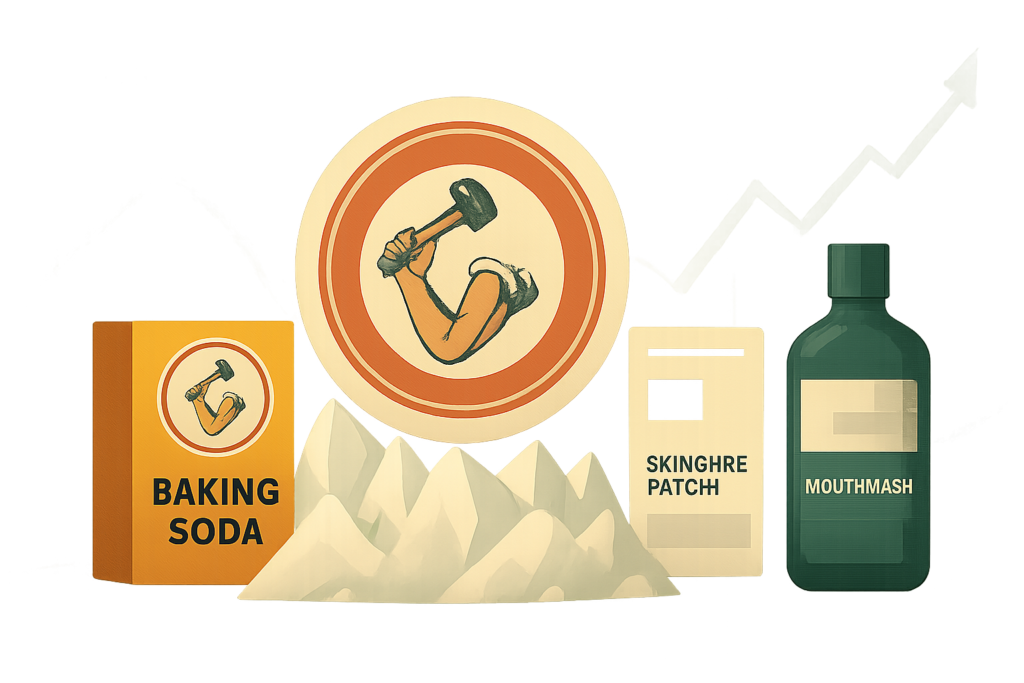
Innovation is focused on "premiumization." Instead of just selling baking soda, CHD is selling TheraBreath mouthwash and Hero "Mighty Patches," products that command higher price points and enjoy greater brand loyalty.
Competitive Landscape
Church & Dwight competes against giants like Procter & Gamble (NYSE: PG), Unilever (NYSE: UL), and Clorox (NYSE: CLX). While P&G has greater scale, CHD’s competitive advantage lies in its "value-to-premium" positioning.
- In Laundry: Arm & Hammer often gains market share when consumers trade down from P&G's Tide.
- In Personal Care: CHD focuses on "niche" leadership. While they don't compete in every beauty category, they dominate specific segments like acne patches (Hero) and specialty mouthwash (TheraBreath).
- The Private Label Threat: With rising food and housing costs, private label (store brand) products remain a major threat in the laundry and baking soda categories.
Industry and Market Trends
The CPG industry in 2026 is defined by two major trends:
- Bifurcation: Consumers are either buying "extreme value" or "prestige/specialty." Church & Dwight's portfolio is uniquely balanced to capture both.
- Digital Dominance: E-commerce has become a critical channel, accounting for 23% of CHD’s total sales by late 2025. The "Power Brands" like Hero and Touchland are "digital-first," heavily utilizing social media and influencer marketing to bypass traditional retail barriers.
Risks and Challenges
Despite its stability, CHD faces significant headwinds:
- Legal Volatility: The company is currently defending several class-action lawsuits. Notable among these are allegations regarding "forever chemicals" (PFAS) in certain Trojan condom products and a 2025 recall of Zicam and Orajel products due to alleged contamination.
- Concentration Risk: The Arm & Hammer brand remains the cornerstone of the company. Any reputational damage to this 180-year-old brand would be catastrophic.
- Acquisition Integration: The high-growth strategy relies on buying brands at high multiples (like the $880 million paid for Touchland). If these brands fail to scale internationally, the "Evergreen" model could stall.
Opportunities and Catalysts
- International Runway: Currently, only 18% of sales come from outside the U.S. Management sees a massive opportunity to bring brands like Hero, TheraBreath, and Waterpik to emerging markets.
- Gen Z Engagement: Acquisitions like Hero and Touchland have rejuvenated the company’s image, making it a favorite among younger consumers who value aesthetics and science-backed formulas.
- Margin Expansion: The exit from the low-margin Vitamin (VMS) business in 2025 is expected to yield significant gross margin improvements throughout 2026 and 2027.
Investor Sentiment and Analyst Coverage
Wall Street remains cautiously optimistic. The consensus rating is currently a "Moderate Buy." Analysts appreciate the $900 million share buyback program and the company’s ability to generate strong cash flow. Institutional ownership remains high (over 80%), as pension funds and ETFs view CHD as a staple for "low-beta" portfolios. However, some analysts have expressed concern over the high price paid for recent acquisitions and the potential for a slowdown in the "trade-down" effect if the economy strengthens significantly.
Regulatory, Policy, and Geopolitical Factors
Church & Dwight is under increasing pressure to meet stringent environmental standards.
- Packaging: The company set a goal for 95% of its packaging to be recyclable by the end of 2025. As of early 2026, it has successfully eliminated PVC from all non-pharmaceutical packaging.
- Climate: In late 2025, the company achieved carbon neutrality for its global owned operations (Scope 1 and 2), a milestone that has improved its ESG ratings (A- from CDP).
- Trade: Like all CPG firms, CHD remains sensitive to tariffs and trade tensions, particularly regarding raw materials used in its specialty products division.
Conclusion
Church & Dwight enters the second quarter of 2026 as a more focused and leaner entity than it was just two years ago. By shedding underperforming divisions and doubling down on "Power Brands" like Hero and TheraBreath, the company has positioned itself to capture the premium personal care market while maintaining its bedrock of value-oriented household staples.
For investors, CHD represents a rare combination: a defensive stock with a 180-year pedigree that is somehow successfully marketing to Gen Z. While legal challenges and the high cost of M&A remain points of concern, the company’s track record of disciplined growth suggests it will remain a cornerstone of the consumer staples sector for years to come. Watch for international sales growth and the 2026 integration of Touchland as the primary indicators of the stock's next move.
This content is intended for informational purposes only and is not financial advice.