Spent coffee fiber market grows as brands adopt sustainable, odor-resistant textiles, driven by innovation, supply partnerships, and rising demand in apparel and sportswear.
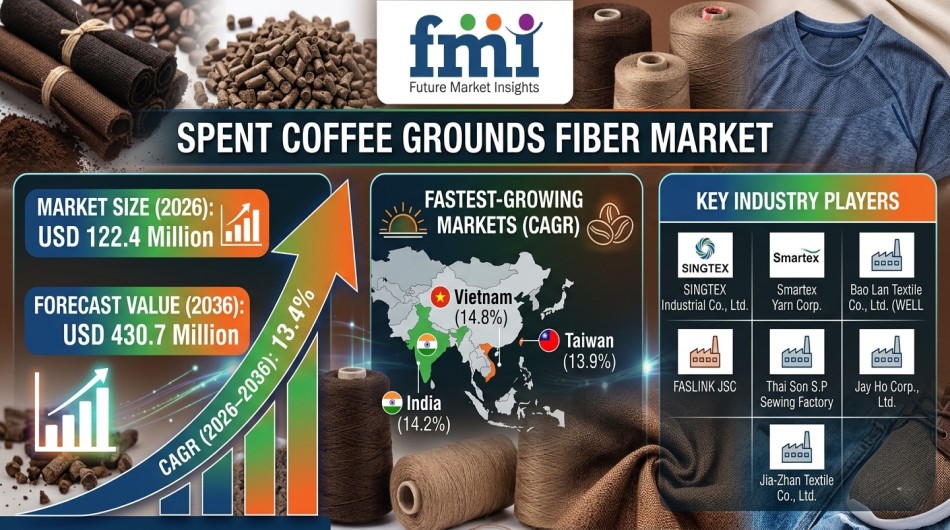
NEWARK, DE / ACCESS Newswire / April 21, 2026 / According to the latest analysis by Future Market Insights, the global spent coffee grounds fiber market is entering a high-growth phase, fueled by increasing demand for sustainable textile solutions, advanced material engineering, and the global shift toward circular economy practices. the market is valued at USD 122.4 million in 2026 and is projected to reach USD 430.7 million by 2036, registering a strong CAGR of 13.4% over the forecast period. This rapid expansion reflects the growing adoption of bio-enhanced fibers that integrate waste materials into high-performance textile applications.
Market Snapshot: Spent Coffee Grounds Fiber Market
Market Size (2026): USD 122.4 Million
Forecast Value (2036): USD 430.7 Million
CAGR (2026-2036): 13.4%
Leading Form Segment: Yarn (46.0% share)
Dominant Blend Type: Recycled Polyester (54.0%)
Leading Application Segment: Apparel (58.0%)
Dominant End Use: Sportswear (41.0%)
Primary Channel: B2B Supply (72.0%)
Fastest-Growing Markets: Vietnam (14.8%), India (14.2%), Taiwan (13.9%)
Get detailed market forecasts, competitive benchmarking, and pricing trends: https://www.futuremarketinsights.com/reports/sample/rep-gb-32765
Growth Dynamics and Demand Drivers
The market is witnessing accelerated growth as apparel manufacturers transition away from conventional synthetic fibers toward sustainable alternatives with embedded functional properties. Spent coffee grounds fiber offers permanent odor control, moisture management, and durability without relying on chemical surface treatments-making it highly attractive to performance apparel brands.
A key growth driver is the increasing pressure from regulatory bodies and retailers to eliminate environmentally harmful finishing processes. Integrating bio-particles directly into polymer matrices reduces water consumption and chemical discharge, aligning with sustainability mandates while maintaining performance standards.
Additionally, supply chain strategies are evolving. Apparel brands are securing long-term contracts with fiber producers to ensure access to limited masterbatch capacity. Early adopters are gaining a competitive advantage by locking in supply and avoiding price volatility associated with spot-market sourcing.
Segment Insights
By Form
Yarn dominates with a 46.0% share due to superior durability and integration
Pre-spinning masterbatch incorporation ensures consistent performance
Reduces reliance on post-production chemical treatments
By Blend
Recycled polyester leads with 54.0% share
Preferred for compatibility with existing extrusion infrastructure
Supports dual sustainability and performance requirements
By Application
Apparel accounts for 58.0% share
High demand for permanent odor control and moisture management
Strong adoption in premium and activewear segments
By End Use
Sportswear leads with 41.0% share
Driven by consumer demand for high-performance, odor-resistant garments
Premium positioning supports higher material costs
By Channel
B2B supply dominates with 72.0% share
Strong reliance on specialized compounders and certified suppliers
High technical barriers reinforce long-term partnerships
Supply Chain and Industry Structure
The spent coffee grounds fiber market operates through a highly specialized supply chain involving biomass collection, carbonization, micro-pulverization, and polymer compounding. Limited global capacity for producing uniform sub-micron particles creates supply constraints, giving established players significant pricing power.
Manufacturers depend on advanced extrusion technologies to ensure consistent dispersion and avoid production disruptions such as nozzle blockages. As a result, certified compounders and patented technologies play a critical role in maintaining quality and scalability.
Pricing and Value Trends
Pricing in the market is shifting toward a performance-based value model. While initial material costs may be higher than traditional fibers, long-term benefits such as reduced chemical usage, lower water consumption, and improved garment durability enhance overall cost efficiency.
Premium apparel brands are leveraging these advantages to justify higher retail pricing, while manufacturers benefit from reduced operational costs and compliance with environmental regulations.
Competitive Landscape
The market is characterized by strong intellectual property concentration and technological specialization. Companies with patented micro-pulverization and dispersion technologies maintain a competitive edge by controlling high-performance masterbatch production.
Key players include:
SINGTEX Industrial Co., Ltd.
Smartex Yarn Corp.
Bao Lan Textile Co., Ltd. (WELL FABRIC)
FASLINK JSC
Thai Son S.P Sewing Factory
Jay Ho Corp., Ltd.
Jia-Zhan Textile Co., Ltd.
Competition is centered on extrusion stability, material consistency, and supply reliability rather than volume alone. Emerging players are attempting to challenge incumbents through alternative processing techniques and open-source innovations.
Customize insights for your business strategy @ https://www.futuremarketinsights.com/customization-available/rep-gb-32765
Regional Analysis
Asia Pacific (High Growth Hub)
Vietnam (14.8% CAGR): Strong vertical integration in apparel manufacturing
India (14.2% CAGR): Rapid modernization of spinning infrastructure
Taiwan (13.9% CAGR): Innovation hub with strong patent concentration
China (12.8% CAGR): Large-scale production and capacity expansion
Europe
Germany (11.2%): Driven by strict sustainability regulations
Italy (10.9%): Premium textile innovation and luxury segment demand
North America
United States (11.6%): Strong demand from direct-to-consumer athletic brands
Focus on performance validation and sustainable sourcing
Future Outlook and Opportunities
The spent coffee grounds fiber market is poised for significant transformation as bio-based materials gain mainstream acceptance. Key opportunities include:
Masterbatch Localization: Reducing supply chain delays through regional production
Nonwoven Applications: Expansion into automotive and industrial textiles
Footwear Integration: Development of advanced breathable membranes
Bio-refinery Investments: Increasing global production capacity
Growth will depend on improving production scalability, expanding supply networks, and maintaining consistent material performance under industrial conditions.
Conclusion
The shift toward spent coffee grounds fiber represents a major evolution in textile manufacturing, combining sustainability with high-performance functionality. As regulatory pressures intensify and consumer expectations evolve, these bio-enhanced materials are set to play a central role in the future of apparel and advanced textiles. Companies that secure early access to supply, invest in processing technology, and deliver consistent performance will be best positioned to capitalize on this rapidly expanding market.
Unlock 360° insights for strategic decision making and investment planning @ https://www.futuremarketinsights.com/checkout/32765
Explore More Related Studies Published by FMI Research:
Biorational Pesticide Market: https://www.futuremarketinsights.com/reports/biorational-pesticide-market
Synthetic Zeolite Y Adsorbent Market: https://www.futuremarketinsights.com/reports/synthetic-zeolite-y-adsorbent-market
Sodium Iodide Market: https://www.futuremarketinsights.com/reports/sodium-iodide-market
Silicon Anode Lithium Ion Battery Market: https://www.futuremarketinsights.com/reports/silicon-anode-lithium-ion-battery-market
Fire Stopping Material Market: https://www.futuremarketinsights.com/reports/fire-stopping-material-market
About Future Market Insights (FMI)
Future Market Insights (FMI) is a leading provider of market intelligence and consulting services, serving clients in over 150 countries. Headquartered in Delaware, USA, with a global delivery center in India and offices in the UK and UAE, FMI delivers actionable insights to businesses across industries including automotive, technology, consumer products, manufacturing, energy, and chemicals.
An ESOMAR-certified research organization, FMI provides custom and syndicated market reports and consulting services, supporting both Fortune 1,000 companies and SMEs. Its team of 300+ experienced analysts ensures credible, data-driven insights to help clients navigate global markets and identify growth opportunities.
For Press & Corporate Inquiries
Rahul Singh
AVP - Marketing and Growth Strategy
Future Market Insights, Inc.
+91 8600020075
For Sales - sales@futuremarketinsights.com
For Media - Rahul.singh@futuremarketinsights.com
For web - https://www.futuremarketinsights.com/
SOURCE: Future Market Insights, Inc.
View the original press release on ACCESS Newswire