
Explosion Isolation Valve Market Gains Momentum as Industrial Safety Systems Shift Toward Advanced Dust Explosion Prevention and Compliance Engineering
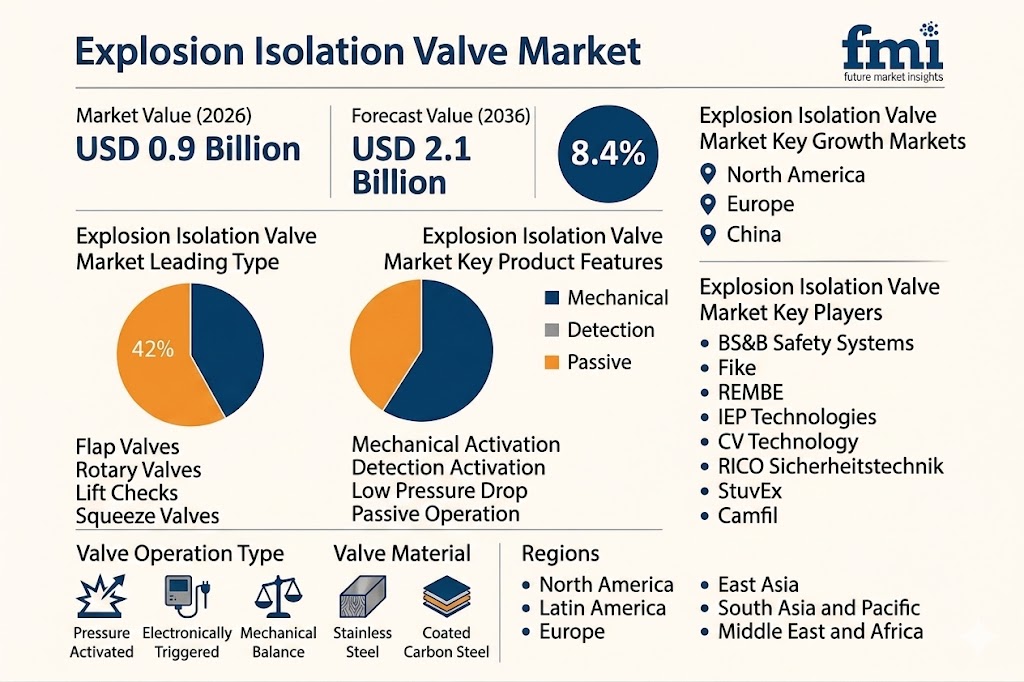
NEWARK, DE / ACCESS Newswire / April 21, 2026 / According to the latest analysis by Future Market Insights, the global explosion isolation valve market is entering a high-growth phase, driven by a fundamental shift in how industrial facilities approach dust explosion risks. Valued at USD 0.9 billion in 2026, the market is projected to reach USD 2.1 billion by 2036, expanding at a robust CAGR of 8.4% over the forecast period.
Explosion isolation is no longer treated as a secondary safety add-on. Instead, it is rapidly becoming a core engineering requirement in dust-handling systems, where preventing flame and pressure propagation across interconnected equipment is critical for operational continuity and worker safety.
Get detailed market forecasts, competitive benchmarking, and pricing trends:
https://www.futuremarketinsights.com/reports/sample/rep-gb-32760
Market Overview and Key Growth Drivers
The explosion isolation valve market is gaining strong traction as industries intensify investments in process safety, regulatory compliance, and risk mitigation. Facilities handling combustible dust-across sectors such as chemicals, food processing, mining, and biomass-are prioritizing mechanical isolation systems to prevent catastrophic chain reactions.
Quick Market Stats
Market Value (2026): USD 0.9 Billion
Forecast Value (2036): USD 2.1 Billion
CAGR (2026-2036): 8.4%
Incremental Opportunity: USD 1.5 Billion
Leading Valve Type: Flap Valves (42% Share)
Top End-Use Sector: Chemicals (27% Share)
Dominant Installation Area: Ducting (54% Share)
Primary Growth Driver: Explosion propagation control in dust-handling systems
From Detection to Prevention: A Structural Safety Shift
Industrial safety strategies are evolving beyond explosion venting and detection toward active and passive isolation mechanisms. Explosion isolation valves are critical in stopping flame fronts and pressure waves from traveling through ducts, filters, and conveying systems.
Industry experts note a clear transformation:
Safety design now prioritizes system-wide containment
Engineering decisions are based on restart time, airflow impact, and certification compatibility
Isolation is increasingly integrated during initial plant design, not post-incident
This shift is accelerating adoption across both greenfield projects and brownfield retrofits.
Segment Insights: Engineering Practicality Drives Selection
Valve Type: Flap Valves Lead with Simplicity
Flap valves account for 42% of the market, favored for their:
Passive operation (no external actuation required)
Lower maintenance burden
Simpler reset procedures
High-speed valves and pinch valves are used in specialized applications requiring faster response or full-bore flow paths.
End Use: Chemicals Sector Dominates
The chemicals industry holds 27% share, driven by:
Strict safety regulations
High-risk powder handling processes
Need for reliable containment across interconnected systems
Food processing and biomass sectors also maintain strong demand due to hygiene and combustible dust concerns.
Installation: Ducting Remains Critical
Ducting applications lead with a 54% share, as they represent the primary pathways for explosion propagation. Proper placement, airflow balance, and maintenance access are key considerations influencing installation decisions.
Channel Dynamics: Retrofit Demand Surges
Retrofit and safety upgrades account for 51% of market demand, reflecting:
Increased safety audits
Insurance-driven compliance requirements
Modernization of legacy industrial infrastructure
Access the Complete Report in PDF Format: https://www.futuremarketinsights.com/reports/brochure/rep-gb-32760
Regional Insights: Asia Leads Growth, West Drives Compliance
Asia-Pacific: High-Growth Industrial Expansion
India (8.9% CAGR) leads global growth, supported by rapid industrialization and new process installations
China (8.0% CAGR) benefits from large-scale manufacturing and ongoing safety upgrades
South Korea (6.4% CAGR) sees demand driven by precision engineering and system upgrades
North America: Retrofit-Driven Demand
The United States (7.0% CAGR) remains a key market, where demand is shaped by:
Existing installed base of dust-handling systems
Post-assessment safety upgrades
Focus on minimizing downtime and improving restart efficiency
Europe: Compliance-Centric Market
Germany (6.1% CAGR) and UK (5.8% CAGR) emphasize certification, documentation, and system integration
Strong adoption of ATEX-certified systems (47% share) reflects regulatory rigor and export requirements
Market Challenges: Engineering Complexity and Approval Delays
Despite strong growth, the market faces critical constraints:
Complex system qualification processes tied to plant-specific layouts
Integration challenges with existing ducting and airflow systems
Multi-team approval requirements, slowing project timelines
High retrofit complexity, especially in older facilities
Each installation requires detailed validation, limiting standardization across projects.
Competitive Landscape: Application Expertise Defines Success
The market remains moderately fragmented, with competition centered on application fit, certification alignment, and engineering support rather than product breadth alone.
Key Players Include:
BS&B Safety Systems
Fike
REMBE
IEP Technologies
CV Technology
RICO Sicherheitstechnik
StuvEx
Camfil
Leading companies differentiate through:
Strong technical documentation
Installation support and system integration expertise
Ability to simplify retrofit deployment
Buy Report: Unlock 360° insights for strategic decision making and investment planning:
https://www.futuremarketinsights.com/checkout/32760
Future Outlook: From Optional Safety to Mandatory Design Element
By 2036, explosion isolation valves are expected to become a standard component in industrial safety architecture, particularly in facilities handling combustible dust and interconnected processing systems.
As industries increasingly adopt a holistic safety engineering approach, isolation systems will play a central role in:
Preventing operational disruptions
Reducing financial and human risk
Ensuring compliance with evolving global safety standards
The market's trajectory reflects a broader transformation where safety is no longer reactive but engineered into the system from the ground up.
Related Reports:
Valve Manifold Box Market- https://www.futuremarketinsights.com/reports/valve-manifold-box-market
Valve Grinder Market- https://www.futuremarketinsights.com/reports/valve-grinder-market
HVAC Valve Market- https://www.futuremarketinsights.com/reports/hvac-valve-market
About Future Market Insights (FMI)
Future Market Insights (FMI) is a leading provider of market intelligence and consulting services, serving clients in over 150 countries. Headquartered in Delaware, USA, with a global delivery center in India and offices in the UK and UAE, FMI delivers actionable insights to businesses across industries including automotive, technology, consumer products, manufacturing, energy, and chemicals.
An ESOMAR-certified research organization, FMI provides custom and syndicated market reports and consulting services, supporting both Fortune 1,000 companies and SMEs. Its team of 300+ experienced analysts ensures credible, data-driven insights to help clients navigate global markets and identify growth opportunities.
For Press & Corporate Inquiries
Rahul Singh
AVP - Marketing and Growth Strategy
Future Market Insights, Inc.
+91 8600020075
For Sales - sales@futuremarketinsights.com
For Media - Rahul.singh@futuremarketinsights.com
For web - https://www.futuremarketinsights.com/
SOURCE: Future Market Insights, Inc.
View the original press release on ACCESS Newswire