
Bean flour market expands steadily as demand rises for gluten-free, protein-rich, and clean-label foods, supported by innovation in bakery, snacks, and plant-based formulations.
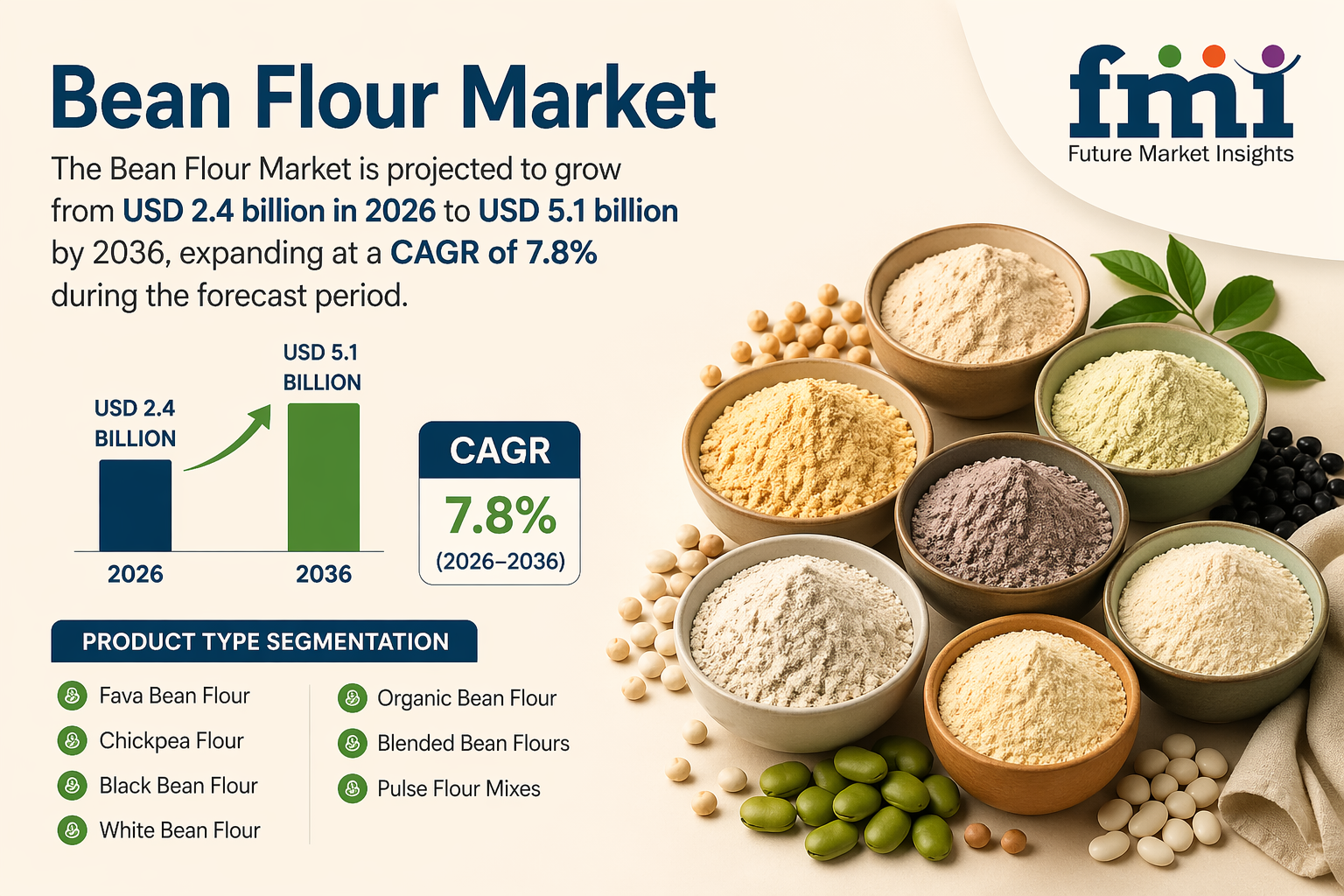
NEWARK, DE / ACCESS Newswire / April 21, 2026 / According to the latest market analysis by Future Market Insights, the global bean flour market is entering a high-growth phase as food manufacturers accelerate the shift toward gluten-free, protein-rich, and clean-label formulations. The market, valued at USD 2.3 billion in 2025, is projected to reach USD 2.4 billion in 2026 and is forecast to expand to USD 5.1 billion by 2036, registering a CAGR of 7.8% during the forecast period.
The increasing use of pulse-based ingredients in bakery, snacks, and prepared foods is positioning bean flour as a functional alternative to traditional wheat flour. Its ability to deliver protein density, fiber enrichment, and gluten-free compatibility is driving adoption across both industrial food processing and household consumption.
Quick Stats: Bean Flour Market
Market Size (2025): USD 2.3 Billion
Market Size (2026): USD 2.4 Billion
Market Size (2036): USD 5.1 Billion
Growth Rate: 7.8% CAGR (2026-2036)
Incremental Opportunity: USD 2.7 Billion
Top Growth Countries: India (8.4%), China (8.0%), United States (7.2%)
Leading Product Type: Fava Bean Flour (30% share in 2026)
Get detailed market forecasts, competitive benchmarking, and pricing trends: https://www.futuremarketinsights.com/reports/sample/rep-gb-4737
Supply Chain Pressures and Raw Material Dynamics
The bean flour market remains closely tied to pulse availability, seasonal harvest cycles, and milling quality consistency. Fluctuations in raw pulse prices and variability in supply can impact production costs and margins across the value chain.
Manufacturers rely on stable sourcing and efficient dry milling systems to maintain consistent flour performance. Any disruption in pulse procurement or inconsistencies in milling quality can lead to formulation challenges, affecting product texture, taste, and scalability.
Demand Drivers and Consumer Trends
Key factors supporting market growth include:
Rising demand for gluten-free and plant-based food products
Increasing preference for protein-rich and fiber-enriched ingredients
Expansion of clean-label and minimally processed food formulations
Growing use in bakery, snacks, pasta, and functional foods
Rising adoption in household cooking and wellness-focused diets
Bean flour is gaining traction where food manufacturers seek to improve nutritional value without shifting toward highly processed protein isolates. This balance between functionality and simplicity is accelerating its use across mainstream packaged foods.
Product Trends and Segment Insights
The bean flour market includes a wide range of pulse-based flours such as fava bean, chickpea, and black bean variants, used across multiple food applications.
Fava Bean Flour leads with a 30% share due to strong protein content and formulation versatility
Bakery applications account for 28% of demand, driven by breads, biscuits, and premixes
Retail channels hold 26% share, supported by home cooking and pantry stocking trends
Snacks (20%) and gluten-free foods (15%) highlight expansion beyond traditional bakery use
The category continues to diversify as manufacturers experiment with blended pulse flours and application-specific formulations to improve taste, texture, and processing performance.
Processing Constraints and Operational Challenges
Despite strong growth prospects, the market faces several technical and operational barriers:
Flavor masking challenges due to inherent bean taste profiles
Color variation across different bean types affecting product consistency
Texture control issues in wheat-replacement systems
Milling inconsistencies impacting large-scale production
Additionally, each application requires tailored formulation, increasing development time and complexity for food manufacturers. Misalignment between flour type and application can lead to extended reformulation cycles and delayed product launches.
Speak to Analyst: Customize insights for your business strategy: https://www.futuremarketinsights.com/customization-available/rep-gb-4737
Regional Growth Dynamics and Key Markets
Growth patterns vary by region based on dietary habits, pulse consumption, and food processing infrastructure:
South Asia leads growth due to strong pulse consumption and expanding packaged food sector
East Asia shows rapid adoption across bakery, noodles, and functional foods
North America benefits from gluten-free and plant-based product innovation
Europe focuses on premium, quality-driven applications with strict formulation standards
Country Highlights:
India: 8.4% CAGR driven by pulse familiarity and packaged food expansion
China: 8.0% CAGR supported by product innovation across multiple categories
United States: 7.2% CAGR led by health-focused reformulation trends
Brazil: 7.0% CAGR driven by broad food processing applications
Germany: 6.2% CAGR reflecting premium and quality-focused demand
South Korea: 6.0% CAGR supported by functional food positioning
Japan: 5.5% CAGR driven by specialty nutrition and product precision
Opportunities in Innovation and Product Development
Emerging opportunities are reshaping the competitive landscape:
Bakery reformulation: Enhancing protein and fiber in breads and baked goods
Snack innovation: Expanding into extruded and baked snack formats
Blended flour systems: Combining pulse flours for improved functionality
Clean-label development: Replacing refined flours with nutrient-dense alternatives
Manufacturers that successfully integrate bean flour into scalable food systems are likely to gain a competitive advantage in health-driven product categories.
Competitive Landscape
The bean flour market remains moderately fragmented, with competition driven by ingredient functionality, supply consistency, and application support.
Key players include:
Ingredion
ADM
Batory Foods
AGT Food
Roquette
Bunge
The Scoular Company
Competitive differentiation is increasingly based on:
Consistent milling quality and product performance
Strong application and formulation support
Ability to serve both retail and industrial markets
Broad portfolio of pulse-based ingredients
Future Outlook
The bean flour market is transitioning from a niche gluten-free alternative into a core ingredient within modern food formulation. As demand for protein-rich, clean-label, and plant-based foods continues to grow, bean flour is expected to play a larger role across bakery, snacks, and prepared food categories.
Manufacturers that can manage raw material sourcing, ensure consistent product performance, and support large-scale application development are expected to capture significant value in this expanding market.
Unlock 360° insights for strategic decision making and investment planning@ https://www.futuremarketinsights.com/checkout/4737
Related Reports:
Bean Flour Market Share Analysis: https://www.futuremarketinsights.com/reports/bean-flour-market-share-analysis
Demand for Bean Flour in EU: https://www.futuremarketinsights.com/reports/demand-for-bean-flour-in-eu
Bean Ingredients Market: https://www.futuremarketinsights.com/reports/bean-ingredients-market
Flour Mixes Market: https://www.futuremarketinsights.com/reports/flour-mixes-market
Corn Flour Market: https://www.futuremarketinsights.com/reports/corn-flour-market
About Future Market Insights (FMI)
Future Market Insights (FMI) stands out by delivering actionable, decision-maker-focused research, not just data. Unlike traditional reports that focus only on market size and forecasts, FMI provides:
Deep pricing analysis and cost benchmarking across ingredients and technologies
Installed base and consumption insights to predict real demand
Procurement and buyer behavior analysis across industries
Supply chain intelligence including sourcing and distribution trends
Technology and formulation insights across functional and fortified food segments
FMI follows a bottom-up research approach, combining real industry inputs from procurement heads, technical experts, and supply chain leaders to deliver practical, validated, and business-ready insights.
For Press & Corporate Inquiries
Rahul Singh
AVP - Marketing and Growth Strategy
Future Market Insights, Inc.
+91 8600020075
For Sales - sales@futuremarketinsights.com
For Media - Rahul.Singh@futuremarketinsights.com
For web - https://www.futuremarketinsights.com/
SOURCE: Future Market Insights, Inc.
View the original press release on ACCESS Newswire