
AI-driven warehouse orchestration platforms redefine fulfillment efficiency as human-robot collaboration unlocks scalable, congestion-free logistics ecosystems worldwide
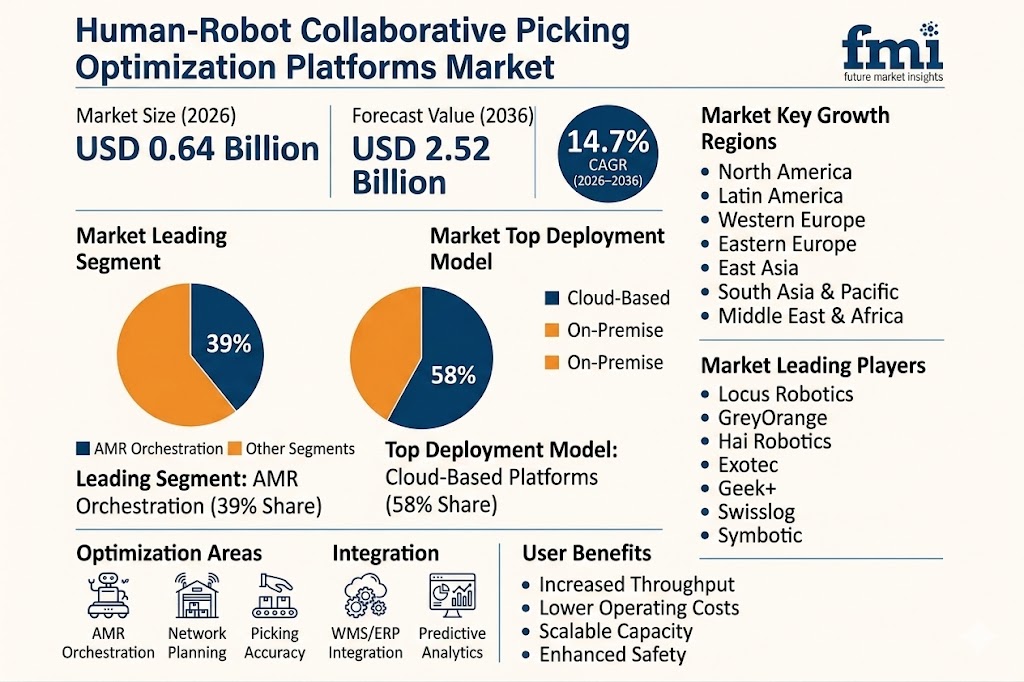
NEWARK, DE / ACCESS Newswire / April 10, 2026 / The global logistics sector is undergoing a structural transformation as warehouses shift from hardware-heavy automation to intelligence-driven orchestration. The Human-Robot Collaborative Picking Optimization Platforms Market, valued at USD 0.64 billion in 2026, is projected to reach USD 2.52 billion by 2036, expanding at a robust CAGR of 14.7%.
Driven by rising e-commerce volumes, labor shortages, and the urgent need to maximize warehouse throughput, companies are increasingly deploying AI-powered platforms that dynamically coordinate human workers and autonomous mobile robots (AMRs) in real time.
Get detailed market forecasts, competitive benchmarking, and pricing trends:
https://www.futuremarketinsights.com/reports/sample/rep-gb-32546
Quick Stats: Human-Robot Collaborative Picking Optimization Platforms Market
Market Size (2026): USD 0.64 Billion
Forecast Value (2036): USD 2.52 Billion
CAGR (2026-2036): 14.7%
Leading Segment: AMR Orchestration (39% Share)
Top Deployment Model: Cloud-Based Platforms (58% Share)
Key Application: E-commerce Fulfillment (34% Share)
Fastest Growing Market: India (17.1% CAGR)
The Algorithmic Shift: From Robots to Real-Time Intelligence
Warehouses are no longer competing based on the number of robots deployed, but on how intelligently those robots collaborate with human workers. Static automation models are rapidly becoming obsolete as fulfillment centers face unpredictable order volumes and increasing operational complexity.
Modern collaborative picking platforms act as a central intelligence layer, ingesting real-time data such as worker movement, order priority, and robot location to dynamically assign tasks. This ensures seamless coordination, reduced congestion, and significantly improved throughput.
Key Demand Drivers Reshaping Warehouse Operations
1. E-commerce Volatility & Peak Season Pressure
Explosive growth in online retail has created unpredictable order spikes, forcing warehouses to adopt flexible, scalable picking systems. Collaborative platforms enable real-time workload balancing, ensuring smooth operations during peak demand cycles.
2. Persistent Labor Shortages
Global labor constraints are pushing logistics providers to extract maximum productivity from existing workforce pools. These platforms enhance worker efficiency by minimizing walking distances and automating repetitive transport tasks.
3. Congestion & Inefficiency in Robot-Heavy Facilities
Without intelligent coordination, large robot fleets can create traffic bottlenecks. Advanced orchestration software uses predictive pathfinding and spatial analytics to eliminate collisions and idle time.
Speak to Analyst: Customize insights for your business strategy: https://www.futuremarketinsights.com/customization-available/rep-gb-32546
Segment Insights: Where Growth is Concentrated
AMR Orchestration Leads the Market (39% Share)
Autonomous Mobile Robot (AMR) orchestration platforms dominate due to their ability to dynamically manage fleet movement and prevent congestion in high-density warehouse environments.
Cloud Deployment Dominates (58% Share)
Cloud-based platforms are rapidly replacing on-premise systems, enabling continuous updates, real-time data processing, and cross-facility learning.
E-commerce Fulfillment Drives Adoption (34% Share)
Retail and e-commerce warehouses remain the primary adopters, leveraging these platforms to manage extreme fluctuations in order volumes.
RaaS Model Gains Traction (46% Share)
Robotics-as-a-Service (RaaS) is lowering entry barriers by converting capital expenditure into scalable operational costs, accelerating adoption among mid-sized logistics providers.
Regional Outlook: Asia Pacific Emerges as Growth Engine
India (17.1% CAGR): Rapid expansion of e-commerce infrastructure and greenfield warehouse development is driving early adoption of AI-driven orchestration systems.
China (16.2% CAGR): Massive transaction volumes and warehouse digitization are accelerating demand for high-performance collaborative platforms.
Europe (14%+ CAGR): Countries like Germany and the Netherlands are leveraging advanced automation ecosystems and regulatory frameworks focused on worker safety.
United States (13.9% CAGR): Mature logistics networks are undergoing software-led transformation to enhance efficiency across legacy infrastructure.
Technology Trends: The Rise of Predictive Warehouse Intelligence
The next generation of collaborative picking platforms is defined by:
Predictive Task Allocation: Algorithms anticipate worker fatigue and optimize task distribution accordingly
Real-Time Spatial Mapping: Continuous monitoring of warehouse traffic to prevent congestion
Cross-Facility Learning: AI models replicate successful workflows across multiple warehouse locations
Wearable Integration: Linking worker data with robotics systems to enhance synchronization
These innovations are transforming warehouses into self-optimizing environments, where machines and humans operate in perfect harmony.
Challenges: Integration Complexity & Legacy Systems
Despite strong growth prospects, the market faces key challenges:
Integration with Legacy Warehouse Management Systems (WMS)
High initial deployment complexity
Data latency issues in hybrid environments
Resistance to replacing existing infrastructure
Organizations must prioritize software integration capabilities and adopt phased deployment strategies to overcome these barriers.
Competitive Landscape: Software Becomes the Differentiator
The competitive landscape is rapidly shifting toward algorithm-driven differentiation. Leading players such as:
Locus Robotics,
GreyOrange,
Hai Robotics,
Exotec,
Geek+,
Swisslog,
and Symbotic
are focusing on:
Advanced AI-based orchestration engines
Open API ecosystems for seamless integration
Real-time analytics and machine learning capabilities
Companies with access to large-scale operational datasets are building significant competitive advantages, as their algorithms continuously improve through real-world learning.
Strategic Takeaways for Decision-Makers
Prioritize orchestration software over hardware expansion
Invest in cloud-based platforms for scalability and agility
Adopt RaaS models to reduce capital expenditure risks
Focus on integration with existing systems to avoid disruptions
Leverage predictive analytics to maximize ROI from automation investments
Future Outlook: From Automation to Autonomous Decision-Making
By 2036, human-robot collaborative platforms will evolve from operational tools into autonomous decision-making engines, capable of managing entire warehouse ecosystems with minimal human intervention.
As supply chains become more complex and customer expectations continue to rise, these platforms will play a critical role in enabling faster, smarter, and more resilient logistics operations.
The future of warehousing is no longer about man versus machine-it is about man and machine, perfectly synchronized by intelligent algorithms.
Unlock 360° insights for strategic decision making and investment planning:
https://www.futuremarketinsights.com/checkout/32546
Related Reports:
Collaborative Robot OmniCore Welding Controllers Market- https://www.futuremarketinsights.com/reports/collaborative-robot-omnicore-welding-controllers-market
Collaborative Manufacturing Robots Market- https://www.futuremarketinsights.com/reports/collaborative-manufacturing-robots-market
Collaborative Robots Market- https://www.futuremarketinsights.com/reports/collaborative-robot-market
About Future Market Insights (FMI)
Future Market Insights (FMI) is a leading provider of market intelligence and consulting services, serving clients in over 150 countries. Headquartered in Delaware, USA, with a global delivery center in India and offices in the UK and UAE, FMI delivers actionable insights to businesses across industries including automotive, technology, consumer products, manufacturing, energy, and chemicals.
An ESOMAR-certified research organization, FMI provides custom and syndicated market reports and consulting services, supporting both Fortune 1,000 companies and SMEs. Its team of 300+ experienced analysts ensures credible, data-driven insights to help clients navigate global markets and identify growth opportunities.
For Press & Corporate Inquiries
Rahul Singh
AVP - Marketing and Growth Strategy
Future Market Insights, Inc.
+91 8600020075
For Sales - sales@futuremarketinsights.com
For Media - Rahul.singh@futuremarketinsights.com
For web - https://www.futuremarketinsights.com/
SOURCE: Future Market Insights, Inc.
View the original press release on ACCESS Newswire