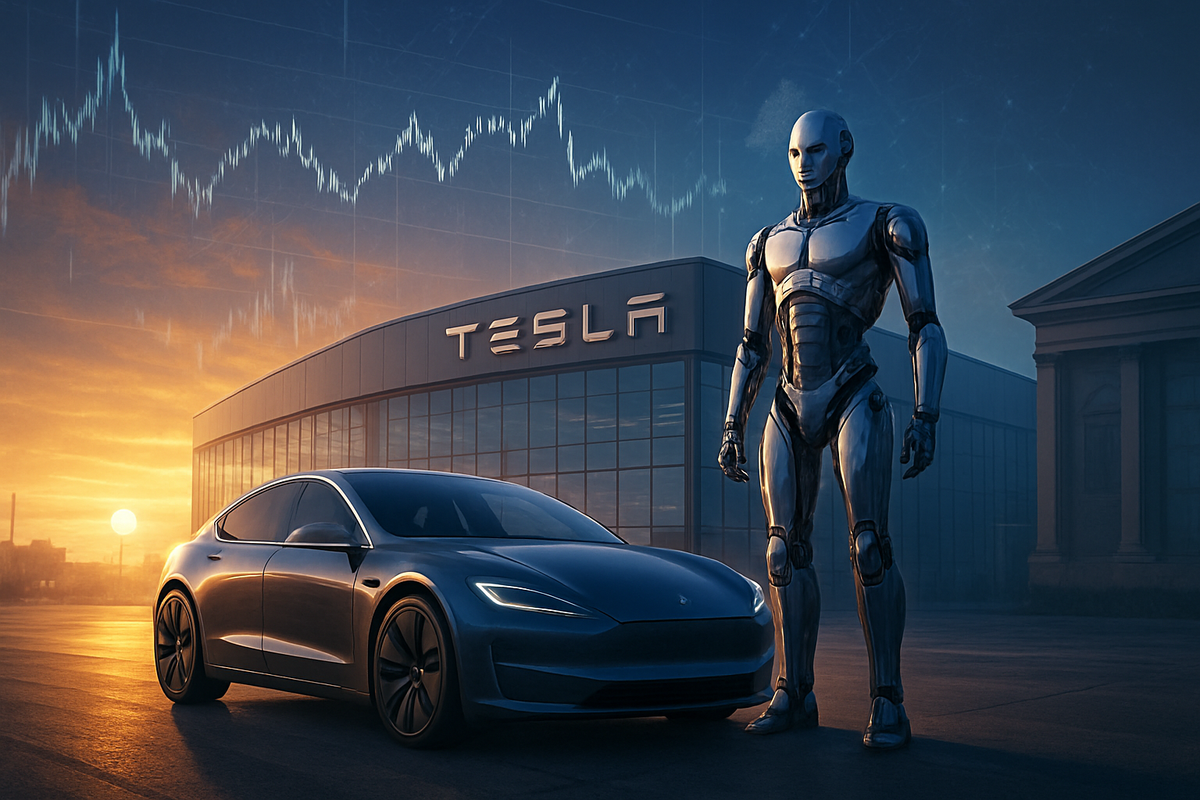
Tesla (NASDAQ: TSLA) shares are navigating a turbulent trading session this Tuesday, January 13, 2026, as the electric vehicle giant finds itself at a critical crossroads. In early trading, the stock opened at $450.20, a slight increase from its previous close of $448.96, but quickly encountered resistance as investors digested a complex cocktail of massive capital expenditures into artificial intelligence and a fresh wave of legal challenges. The premarket session saw shares dipping as low as $448.20, reflecting a cautious sentiment that has come to define the start of the 2026 fiscal year.
The volatility underscores a fundamental shift in how Wall Street perceives the company. No longer judged solely on vehicle delivery numbers, Tesla is now being valued as a high-growth AI and robotics firm. However, this transition is proving expensive and legally fraught. With the company’s price-to-earnings ratio sitting at a staggering 297x, the pressure to deliver on "moonshot" projects like the Optimus humanoid robot and the upcoming Cybercab has never been higher, even as its core automotive market share faces unprecedented pressure from global rivals.
The Cost of Innovation: AI Spending vs. Legal Headwinds
The primary driver of today’s market movement is the intensifying debate over Tesla’s relationship with xAI, the private artificial intelligence startup also owned by Elon Musk. Reports circulating this week suggest that xAI will be the primary developer for the intelligence powering Tesla’s Optimus robot, rather than the work being done entirely in-house. This has reignited concerns regarding a potential "breach of fiduciary duty," with some institutional investors questioning whether core value is being siphoned away from the public Tesla entity into a private venture. This internal tension comes at a time when Tesla’s AI infrastructure spending has reached record levels, including a massive deepening of its reliance on high-end semiconductor clusters.
Simultaneously, the legal landscape for Tesla has darkened. A new class-action lawsuit was filed today concerning "defective" door handles on the Model S, which plaintiffs claim fail prematurely and create life-threatening risks during emergencies. This follows a high-profile wrongful death suit involving a Cybertruck, where allegations surfaced that the vehicle’s doors cannot be manually opened once power is lost. These safety concerns have already caught the attention of federal regulators, with a new bill being proposed in the U.S. House of Representatives that would mandate intuitive manual door releases in all new vehicles—a move that could force a costly redesign of Tesla’s current fleet.
The timeline leading to this moment has been one of rapid pivots. Throughout 2025, Tesla aggressively transitioned its engineering focus away from the long-rumored $25,000 "Model 2" toward autonomous platforms. While this shift was celebrated by tech-focused bulls, it left a "demand vacuum" in the mass-market EV space. By the end of 2025, BYD (OTC: BYDDY) officially surpassed Tesla as the world’s largest manufacturer of battery electric vehicles (BEVs), delivering 2.26 million units compared to Tesla’s 1.64 million. Today’s stock performance reflects the market’s attempt to reconcile these two realities: a shrinking lead in manufacturing and a growing, but unproven, lead in robotics.
Winners and Losers in the AI-Automotive Convergence
In this new landscape, the "winners" are often the companies supplying the picks and shovels for Tesla’s AI ambitions. Nvidia (NASDAQ: NVDA) remains the largest beneficiary, as Tesla continues to scale its "Cortex" cluster using thousands of Nvidia H100 and H200 chips. Despite Tesla’s efforts to develop its own "Dojo 3" supercomputer architecture, the company has reportedly increased its procurement of Nvidia’s next-generation Rubin platform to ensure its Full Self-Driving (FSD) v14 software remains competitive. Similarly, Samsung (KRX: 005930) has secured a massive $16.5 billion contract to manufacture the AI6 chips for Tesla’s Hardware 6, positioning the South Korean giant as a critical pillar of Tesla’s future.
Conversely, the "losers" in this pivot appear to be Tesla’s traditional automotive competitors who failed to anticipate the speed of the AI revolution. Legacy automakers like Ford (NYSE: F) and General Motors (NYSE: GM) are currently caught in a "no-man's land," struggling with high production costs for their first-generation EVs while Tesla and Chinese rivals like Xiaomi (OTC: XIACY) move toward fully autonomous ecosystems. Xiaomi, in particular, has emerged as a formidable threat in 2026, siphoning off tech-savvy buyers with vehicles that integrate seamlessly into a broader consumer electronics ecosystem—a feat Tesla has yet to match with its own software suite.
For Tesla’s shareholders, the "loss" is felt in the erosion of automotive margins. To fund the billions required for AI training and robotics R&D, Tesla has been forced to maintain a lean operation in its vehicle division, leading to the aforementioned delays in low-cost models. This has allowed Rivian (NASDAQ: RIVN) to gain ground in the North American market. With the launch of the Rivian R2 SUV earlier this year, the company has successfully targeted the "premium-adventure" segment that was once a stronghold for the Model Y, offering a fresh alternative to Tesla’s aging lineup.
A Broader Industry Shift: From Cars to Computers on Wheels
The events unfolding today are part of a broader industry trend where the "car" is becoming secondary to the "software." Tesla’s pivot is a high-stakes gamble that the future of transportation lies not in selling hardware to individuals, but in operating a global fleet of autonomous "Cybercabs." This mirrors the historical precedent set by the smartphone industry, where hardware eventually became a commodity and the real value shifted to the operating systems and services. Tesla is betting that it can become the "iOS of autonomy," but the regulatory and safety hurdles are far more complex than those faced by Silicon Valley’s software giants.
The ripple effects are being felt across the regulatory spectrum. The proposed legislation regarding manual door releases is just the beginning; as Tesla pushes toward its April 2026 Robotaxi launch, the National Highway Traffic Safety Administration (NHTSA) is under pressure to establish new safety standards for vehicles without steering wheels or pedals. This regulatory scrutiny could create a "bottleneck" that prevents Tesla from monetizing its AI investments as quickly as the market expects. Furthermore, the expiration of U.S. federal EV tax credits in late 2025 has created a "pull-forward" effect, meaning Q1 2026 delivery numbers—expected in a few weeks—could be significantly weaker than anticipated.
The Road Ahead: Strategic Pivots and Scenarios
Looking forward, the next six months will be the most consequential in Tesla’s history. The scheduled launch of the Cybercab in April 2026 serves as the ultimate "litmus test" for the company’s autonomous strategy. If Tesla can demonstrate a viable, safe, and scalable robotaxi network, it could justify its premium valuation and silence critics who argue the company is overextended. However, any further delays or safety incidents during the pilot phase could lead to a significant re-rating of the stock, potentially stripping away the "AI premium" that currently supports its price.
In the short term, investors should watch for a potential strategic pivot regarding the "Model 2." There are growing whispers that Tesla may need to fast-track a simplified, human-driven version of its next-gen platform to recapture market share in Europe and China, where BYD and Xiaomi are currently dominant. Such a move would require a massive reallocation of resources but might be necessary to provide the cash flow needed to sustain the company’s $10 billion-plus annual AI spend.
Conclusion: A "Prove-It" Year for the Technoking
As the trading day progresses on January 13, 2026, the takeaway for investors is clear: Tesla is no longer a safe bet on the growth of electric vehicles; it is a speculative bet on the future of artificial intelligence. The stock’s current volatility is a reflection of the massive gap between the company’s vision and its current operational reality. While the potential for Optimus and the Cybercab to revolutionize labor and transport is undeniable, the immediate risks—ranging from fiduciary lawsuits to basic vehicle safety recalls—cannot be ignored.
Moving forward, the market will be hyper-focused on three things: the April Robotaxi reveal, the resilience of Model Y sales in a post-subsidy world, and any clarity regarding the intellectual property split between Tesla and xAI. For the "Magnificent One," as some have dubbed the now-singularly-dominant Tesla, 2026 is the year where the "future" must finally start paying the bills. Investors should remain braced for a year of high-beta swings as Tesla attempts to complete the most ambitious corporate transformation in modern history.
This content is intended for informational purposes only and is not financial advice.