
Internet service provider Cogent Communications (NASDAQ: CCOI) fell short of the market’s revenue expectations in Q2 CY2026, with sales falling 4.3% year on year to $235.6 million. Its GAAP profit of $1.38 per share was significantly above analysts’ consensus estimates.
Is now the time to buy Cogent? Find out by accessing our full research report, it’s free.
Cogent (CCOI) Q2 CY2026 Highlights:
- Revenue: $235.6 million vs analyst estimates of $239.5 million (4.3% year-on-year decline, 1.7% miss)
- EPS (GAAP): $1.38 vs analyst estimates of -$1.01 (significant beat)
- Adjusted EBITDA: $71.1 million vs analyst estimates of $75.56 million (30.2% margin, 5.9% miss)
- Operating Margin: 50.5%, up from -12.8% in the same quarter last year
- Free Cash Flow was -$35.34 million compared to -$100.2 million in the same quarter last year
- Total Connections: 115.8 million, down 2.89 million year on year
- Market Capitalization: $614.8 million
Company Overview
Operating a massive network spanning 20,000 miles of fiber optic cable and connecting to over 3,200 buildings worldwide, Cogent Communications (NASDAQ: CCOI) provides high-speed Internet access, private network services, and data center colocation to businesses and bandwidth-intensive organizations across 54 countries.
Revenue Growth
A company’s long-term performance is an indicator of its overall quality. Any business can experience short-term success, but top-performing ones enjoy sustained growth for years.
With $957.2 million in revenue over the past 12 months, Cogent is a small player in the business services space, which sometimes brings disadvantages compared to larger competitors benefiting from economies of scale and numerous distribution channels. On the bright side, it can grow faster because it has more room to expand.
As you can see below, Cogent’s sales grew at an impressive 10.5% compounded annual growth rate over the last five years. This shows it had high demand, a useful starting point for our analysis.
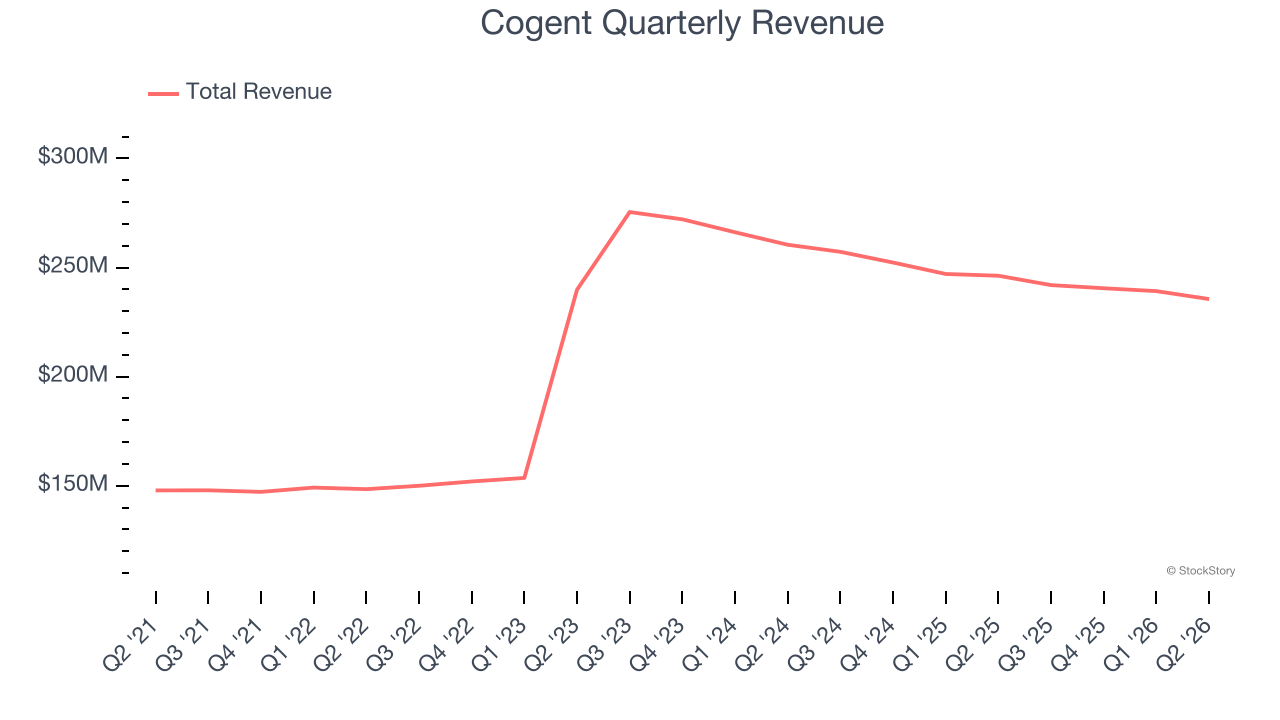
We at StockStory place the most emphasis on long-term growth, but within business services, a half-decade historical view may miss recent innovations or disruptive industry trends. Cogent’s recent performance marks a sharp pivot from its five-year trend as its revenue has shown annualized declines of 5.6% over the last two years. 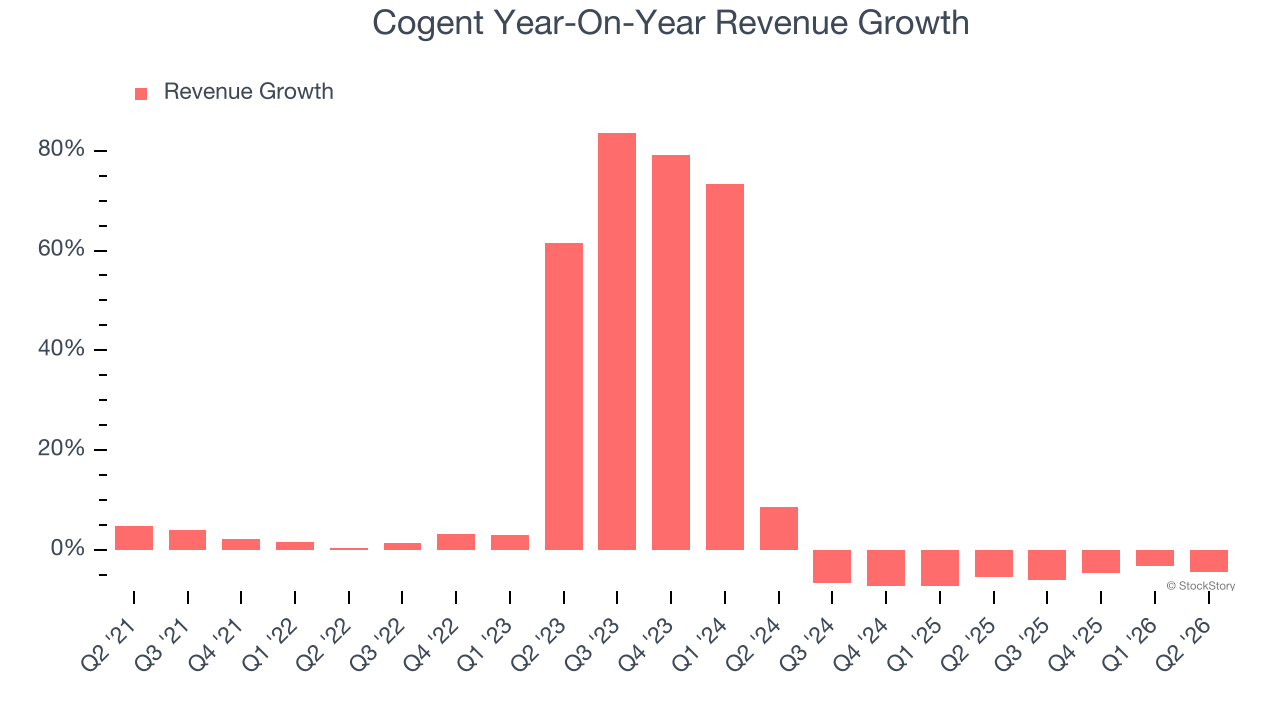
This quarter, Cogent missed Wall Street’s estimates and reported a rather uninspiring 4.3% year-on-year revenue decline, generating $235.6 million of revenue.
Looking ahead, sell-side analysts expect revenue to grow 2.4% over the next 12 months. While this projection implies its newer products and services will catalyze better top-line performance, it is still below the sector average.
WHILE YOU’RE HERE: The Next Palantir? One satellite company captures images of every point on Earth. Every single day. The Pentagon wants it. Hedge funds are using it to beat earnings. You’ve probably never heard of it.
This is what the early days of Palantir looked like before it became a giant. Same playbook. Different technology. If you missed Palantir, you need to see this. Claim The Stock Ticker for Free HERE.
Adjusted Operating Margin
Adjusted operating margin is an important measure of profitability as it shows the portion of revenue left after accounting for all core expenses — everything from the cost of goods sold to advertising and wages. It’s also useful for comparing profitability across companies because it excludes non-recurring expenses, interest on debt, and taxes.
Although Cogent was profitable this quarter from an operational perspective, it’s generally struggled over a longer time period. Its expensive cost structure has contributed to an average adjusted operating margin of negative 3.1% over the last five years. Unprofitable business services companies require extra attention because they could get caught swimming naked when the tide goes out. It’s hard to trust that the business can endure a full cycle.
Looking at the trend in its profitability, Cogent’s adjusted operating margin decreased by 12 percentage points over the last five years. This raises questions about the company’s expense base because its revenue growth should have given it leverage on its fixed costs, resulting in better economies of scale and profitability. Cogent’s performance was poor no matter how you look at it - it shows that costs were rising and it couldn’t pass them onto its customers.
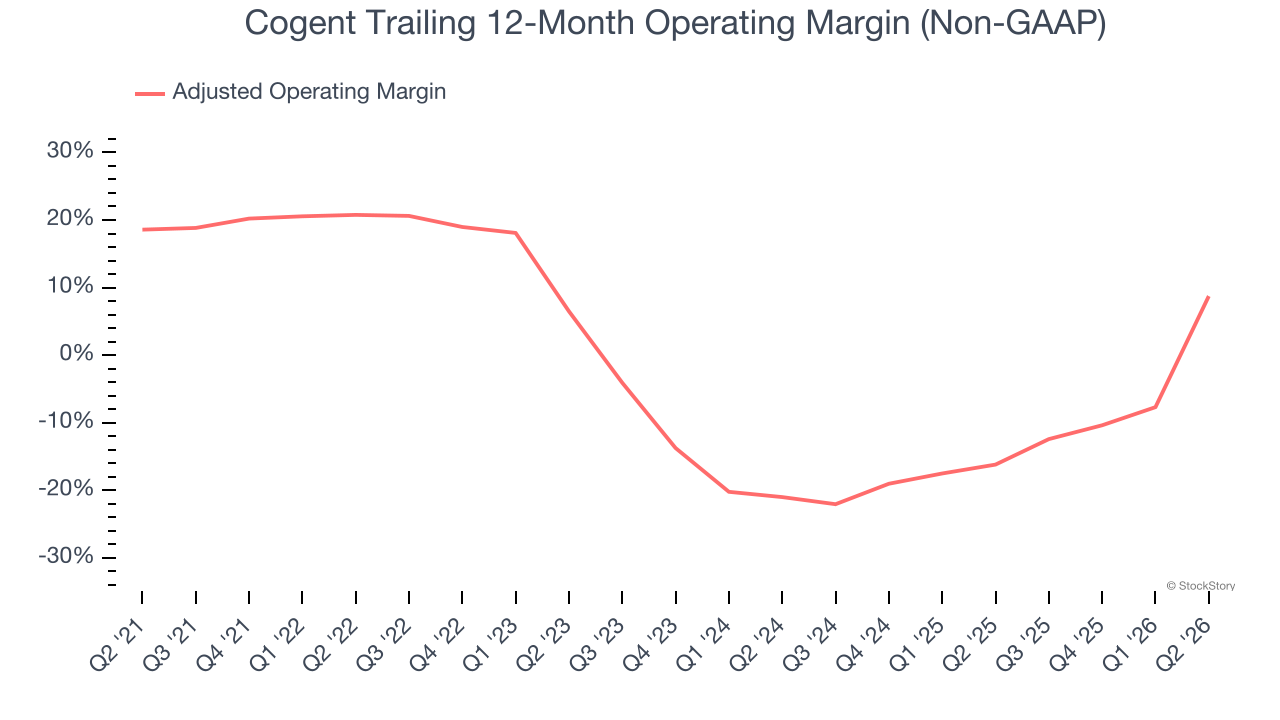
In Q2, Cogent generated an adjusted operating margin profit margin of 53.7%, up 66.5 percentage points year on year. This increase was a welcome development, especially since its revenue fell, showing it was more efficient because it scaled down its expenses.
Earnings Per Share
We track the long-term change in earnings per share (EPS) for the same reason as long-term revenue growth. Compared to revenue, however, EPS highlights whether a company’s growth is profitable.
Sadly for Cogent, its EPS declined by 63.7% annually over the last five years while its revenue grew by 10.5%. However, its adjusted operating margin actually improved during this time, telling us that non-fundamental factors such as interest expenses and taxes affected its ultimate earnings.
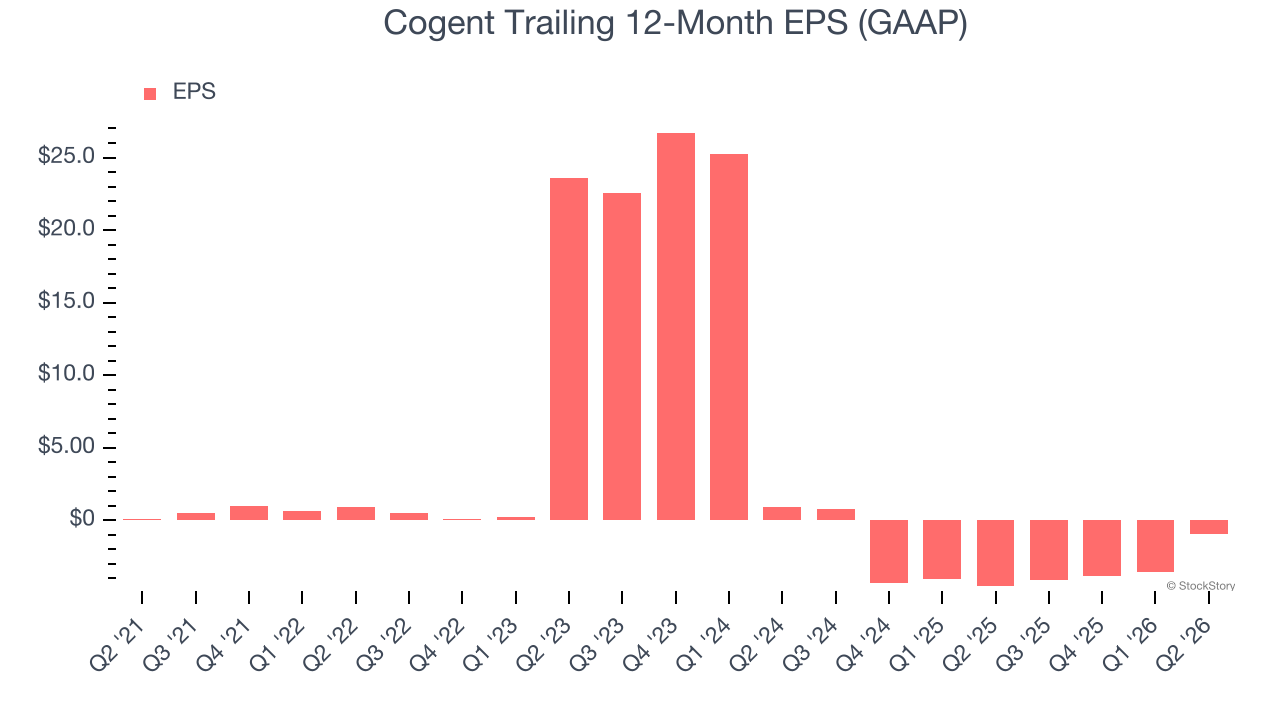
We can take a deeper look into Cogent’s earnings to better understand the drivers of its performance. As we mentioned earlier, Cogent’s adjusted operating margin expanded this quarter but declined by 12 percentage points over the last five years. Its share count also grew by 4.8%, meaning the company not only became less efficient with its operating expenses but also diluted its shareholders. 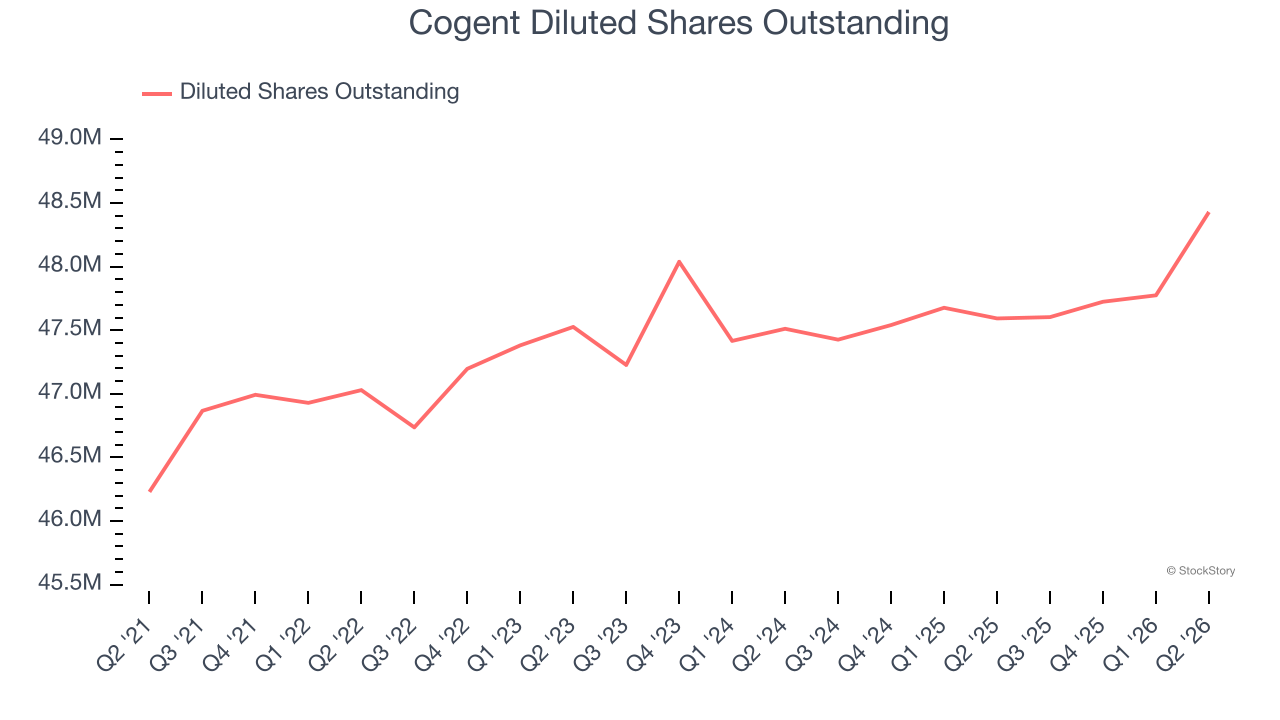
Like with revenue, we analyze EPS over a more recent period because it can provide insight into an emerging theme or development for the business.
For Cogent, its two-year annual EPS declines of 75% show it’s continued to underperform. These results were bad no matter how you slice the data.
In Q2, Cogent reported EPS of $1.38, up from negative $1.21 in the same quarter last year. This print easily cleared analysts’ estimates, and shareholders should be content with the results. Over the next 12 months, Wall Street expects Cogent to perform poorly. Analysts forecast its full-year EPS will tumble from negative $0.97 to negative $3.35.
Key Takeaways from Cogent’s Q2 Results
It was good to see Cogent beat analysts’ EPS expectations this quarter. On the other hand, its revenue missed. Overall, this print had some key positives. The stock traded up 2.8% to $13.24 immediately after reporting.
Cogent put up rock-solid earnings, but one quarter doesn’t necessarily make the stock a buy. Let’s see if this is a good investment. What happened in the latest quarter matters, but not as much as longer-term business quality and valuation, when deciding whether to invest in this stock. We cover that in our actionable full research report which you can read here (it’s free).