

Looking back on healthcare equipment and supplies stocks’ Q1 earnings, we examine this quarter’s best and worst performers, including Lantheus (NASDAQ: LNTH) and its peers.
The healthcare equipment and supplies sector thrives on innovation in medical devices and consumables, the latter providing recurring revenue. Future growth is buoyed by an aging population with increasing chronic diseases and a shift towards minimally-invasive surgery. Advancements in materials science and AI-driven diagnostics also offer significant opportunities. Key headwinds remain, including pricing pressure from cost-conscious healthcare providers, evolving regulations, and potential supply chain disruptions.
The 37 healthcare equipment and supplies stocks we track reported a satisfactory Q1. As a group, revenues beat analysts’ consensus estimates by 2.3% while next quarter’s revenue guidance was 1.3% below.
While some healthcare equipment and supplies stocks have fared somewhat better than others, they have collectively declined. On average, share prices are down 1.4% since the latest earnings results.
Lantheus (NASDAQ: LNTH)
Pioneering the "Find, Fight and Follow" approach to disease management, Lantheus Holdings (NASDAQGM:LNTH) develops and commercializes radiopharmaceuticals and other imaging agents that help healthcare professionals detect, diagnose, and treat diseases.
Lantheus reported revenues of $377.3 million, up 1.2% year on year. This print exceeded analysts’ expectations by 6.4%. Overall, it was a satisfactory quarter for the company with a beat of analysts’ EPS estimates but full-year revenue guidance missing analysts’ expectations.
“Our first quarter results demonstrate disciplined execution across the business, with strong performance from PYLARIFY, Neuraceq, and DEFINITY, and continued progress against the priorities that underpin our long-term strategy,” said Mary Anne Heino, Chief Executive Officer of Lantheus.
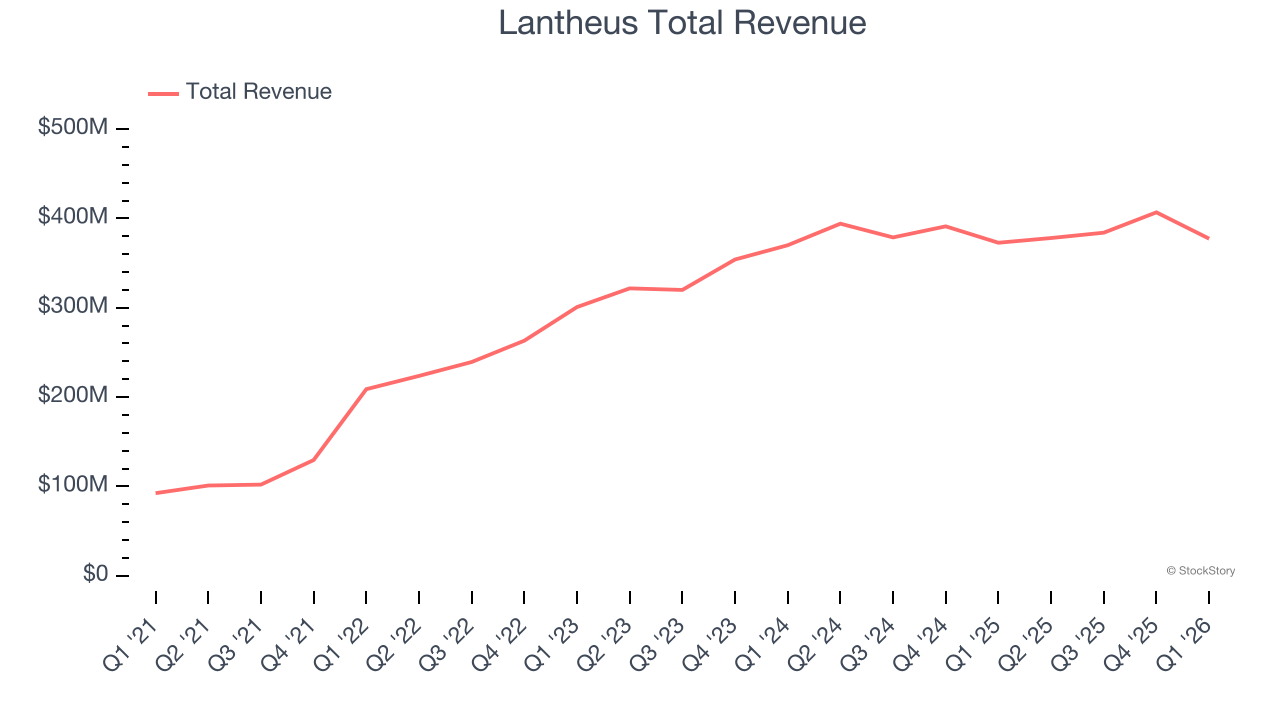
Interestingly, the stock is up 23.5% since reporting and currently trades at $106.43.
Is now the time to buy Lantheus? Access our full analysis of the earnings results here, it’s free.
Best Q1: STAAR Surgical (NASDAQ: STAA)
With over 2.5 million implants performed worldwide, STAAR Surgical (NASDAQ: STAA) designs and manufactures implantable lenses that correct vision problems without removing the eye's natural lens.
STAAR Surgical reported revenues of $93.52 million, up 120% year on year, outperforming analysts’ expectations by 20.8%. The business had an incredible quarter with a beat of analysts’ EPS estimates.
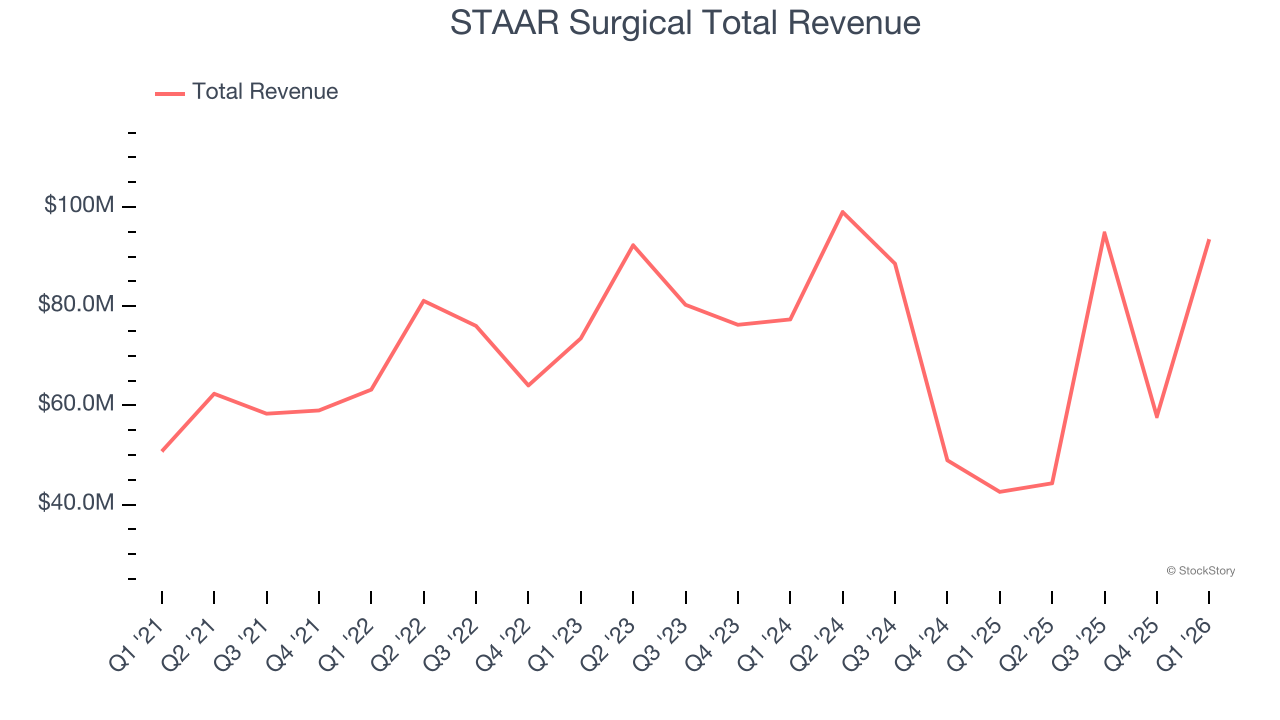
STAAR Surgical scored the biggest analyst estimate beat and fastest revenue growth among its peers. Although it had a fine quarter compared to its peers, the market seems unhappy with the results as the stock is down 3.6% since reporting. It currently trades at $28.36.
Is now the time to buy STAAR Surgical? Access our full analysis of the earnings results here, it’s free.
Weakest Q1: Stryker (NYSE: SYK)
With over 150 million patients impacted annually through its innovative healthcare technologies, Stryker (NYSE: SYK) develops and manufactures advanced medical devices and equipment across orthopedics, surgical tools, neurotechnology, and patient care solutions.
Stryker reported revenues of $6.02 billion, up 2.6% year on year, falling short of analysts’ expectations by 5%. It was a disappointing quarter as it posted a significant miss of analysts’ EPS and organic revenue estimates.
As expected, the stock is down 2% since the results and currently trades at $308.88.
Read our full analysis of Stryker’s results here.
Abbott Laboratories (NYSE: ABT)
With roots dating back to 1888 when founder Dr. Wallace Abbott began producing precise, dosage-form medications, Abbott Laboratories (NYSE: ABT) develops and sells a diverse range of healthcare products including medical devices, diagnostics, nutrition products, and branded generic pharmaceuticals.
Abbott Laboratories reported revenues of $11.16 billion, up 7.8% year on year. This number surpassed analysts’ expectations by 1.3%. Overall, it was a satisfactory quarter as it also produced full-year EPS guidance in line with analysts’ estimates.
The stock is down 11.1% since reporting and currently trades at $90.25.
Read our full, actionable report on Abbott Laboratories here, it’s free.
Integra LifeSciences (NASDAQ: IART)
Founded in 1989 as a pioneer in regenerative medicine technology, Integra LifeSciences (NASDAQ: IART) develops and manufactures medical technologies for neurosurgery, wound care, and surgical reconstruction, including regenerative tissue products and surgical instruments.
Integra LifeSciences reported revenues of $391.9 million, up 2.4% year on year. This result topped analysts’ expectations by 2.6%. Overall, it was a strong quarter as it also recorded a beat of analysts’ EPS estimates.
The stock is up 66.1% since reporting and currently trades at $17.69.
Read our full, actionable report on Integra LifeSciences here, it’s free.
Market Update
Late in 2025 into early 2026, there was hand-wringing around artificial intelligence. For software companies, the fear was that AI would erode pricing power and compress margins as new tools made it easier to replicate what once required expensive enterprise platforms. Crypto investors had their own version of the same anxiety: if AI agents could trade, allocate capital, and manage wallets autonomously, what exactly was the long-term value of today’s crypto infrastructure?
These concerns triggered a noticeable rotation away from these sectors and into safer havens. But markets rarely dwell on one narrative for long. Spring 2026 came, and the focus shifted abruptly from technological disruption to geopolitical risk. The US’ conflict with Iran became the dominant driver of market psychology, and when geopolitics takes center stage, the script changes quickly. Investors stop debating growth rates and start worrying about oil supply, inflation, and global stability.
Want to invest in winners with rock-solid fundamentals? Check out our Top 5 Quality Compounder Stocks and add them to your watchlist. These companies are poised for growth regardless of the political or macroeconomic climate.
StockStory’s analyst team — all seasoned professional investors — uses quantitative analysis and automation to deliver market-beating insights faster and with higher quality.