
Looking back on investment banking & brokerage stocks’ Q1 earnings, we examine this quarter’s best and worst performers, including Stifel (NYSE: SF) and its peers.
Investment banks and brokerages facilitate capital raises, mergers and acquisitions, and securities trading. The sector benefits from corporate activity during economic expansion, increased retail trading participation, and advisory opportunities in emerging sectors. Headwinds include economic cycle vulnerability affecting deal flow, compressed trading commissions due to electronic platforms, and regulatory capital requirements constraining certain higher-risk activities.
The 15 investment banking & brokerage stocks we track reported a mixed Q1. As a group, revenues beat analysts’ consensus estimates by 0.8% while next quarter’s revenue guidance was 1.4% below.
In light of this news, share prices of the companies have held steady as they are up 3.5% on average since the latest earnings results.
Stifel (NYSE: SF)
Tracing its roots back to 1890 when the firm was established in St. Louis, Stifel Financial (NYSE: SF) is a financial services firm that provides wealth management, investment banking, and institutional brokerage services to individuals, corporations, and institutions.
Stifel reported revenues of $1.44 billion, up 14.8% year on year. This print was in line with analysts’ expectations, but overall, it was a mixed quarter for the company with a beat of analysts’ EPS estimates.
Chairman and Chief Executive Officer, said “Stifel delivered record first quarter results with approximately $1.5 billion in revenue and earnings per share of $1.48. Even amid heightened volatility driven by geopolitical events, we achieved our strongest ever first quarter performance across both operating segments, underscoring the durability and diversification of our model. Looking ahead, client engagement remains high across wealth management and institutional, and our investment banking pipelines are among the strongest we have seen. Assuming market risks remain within current expectations, we are well positioned for a strong 2026.”
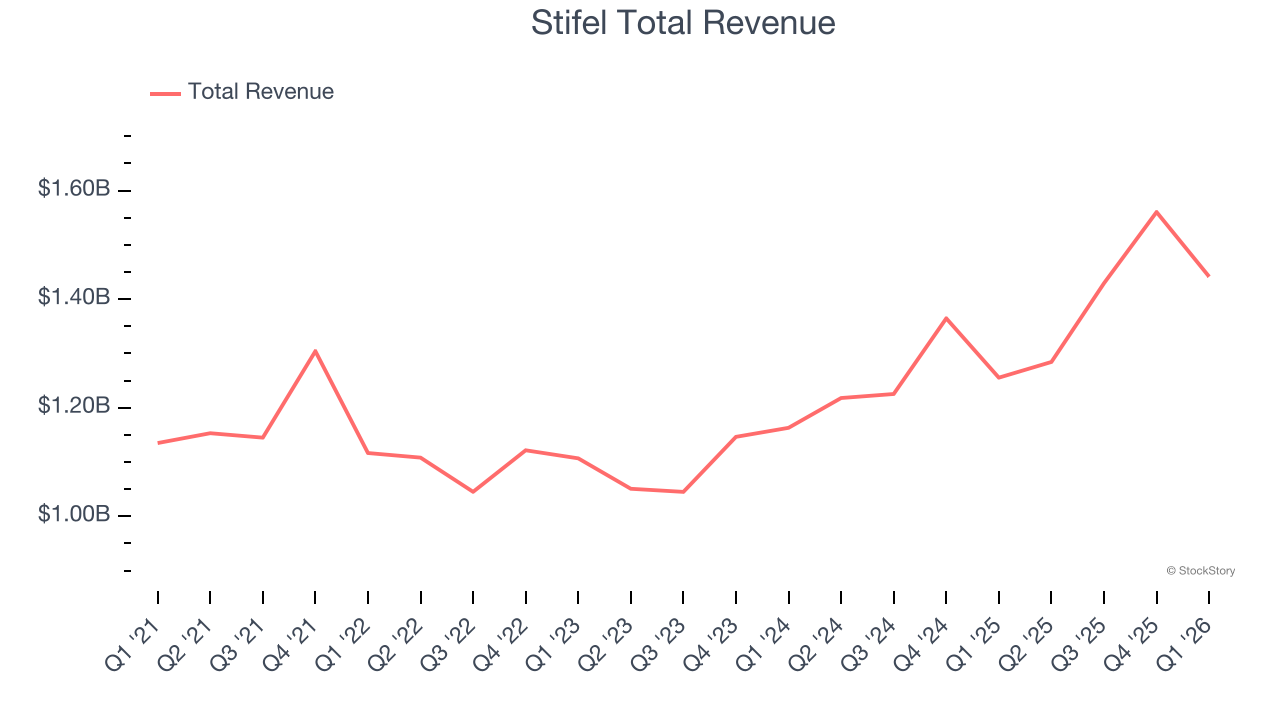
The market seems disappointed with the results as the stock is down 10.3% since reporting and currently trades at $73.82.
Is now the time to buy Stifel? Access our full analysis of the earnings results here, it’s free.
Best Q1: Evercore (NYSE: EVR)
Founded in 1995 as a boutique advisory firm focused on independence and client trust, Evercore (NYSE: EVR) is an independent investment banking firm that provides strategic advisory, capital markets, and wealth management services to corporations, financial sponsors, and high-net-worth individuals.
Evercore reported revenues of $1.40 billion, up 100% year on year, outperforming analysts’ expectations by 16.6%. The business had an incredible quarter with a beat of analysts’ EPS and EBITDA estimates.
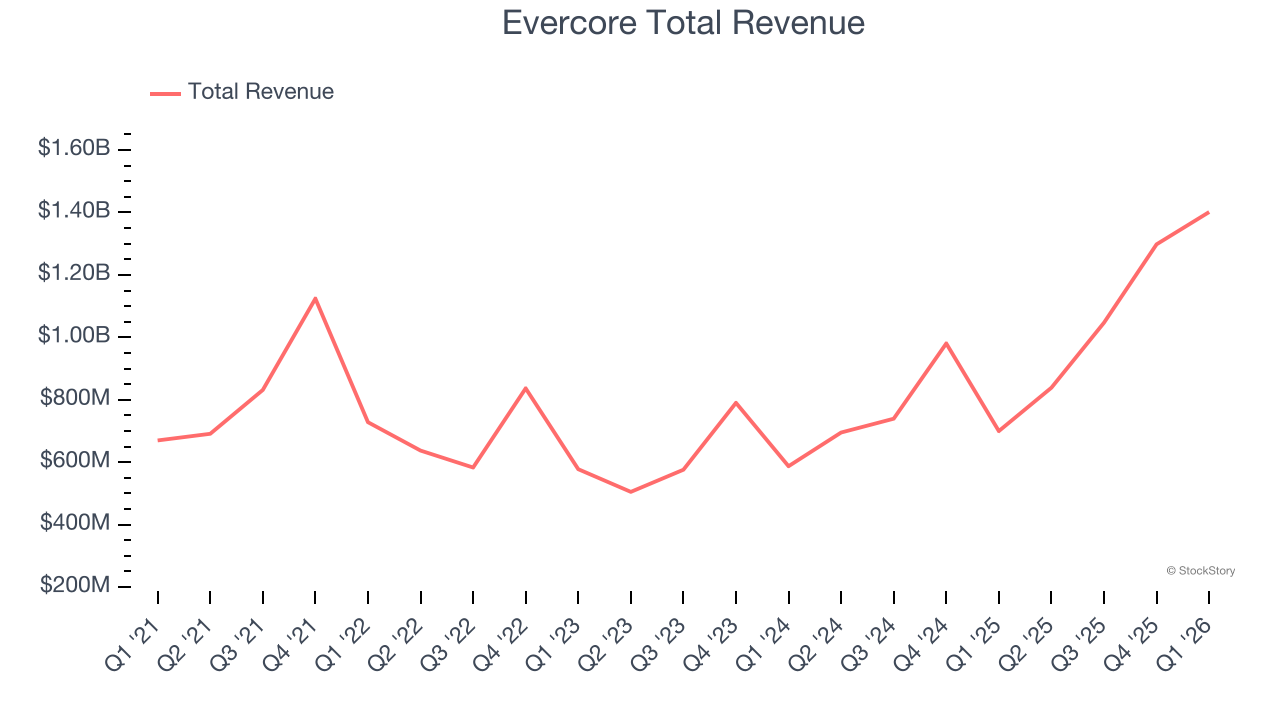
Evercore pulled off the biggest analyst estimate beat and fastest revenue growth among its peers. The market seems happy with the results as the stock is up 9.8% since reporting. It currently trades at $373.84.
Is now the time to buy Evercore? Access our full analysis of the earnings results here, it’s free.
Weakest Q1: Perella Weinberg (NASDAQ: PWP)
Founded in 2006 by veteran investment bankers Joseph Perella and Peter Weinberg during a wave of boutique advisory firm launches, Perella Weinberg Partners (NASDAQ: PWP) is a global independent advisory firm that provides strategic and financial advice to corporations, financial sponsors, and government institutions.
Perella Weinberg reported revenues of $148.9 million, down 29.7% year on year, falling short of analysts’ expectations by 10.5%. It was a disappointing quarter as it posted a significant miss of analysts’ EPS estimates.
Perella Weinberg delivered the weakest performance against analyst estimates and slowest revenue growth in the group. As expected, the stock is down 29.7% since the results and currently trades at $15.99.
Read our full analysis of Perella Weinberg’s results here.
Morgan Stanley (NYSE: MS)
Founded in 1924 during the post-WWI economic boom by former JP Morgan partners, Morgan Stanley (NYSE: MS) is a global financial services firm that provides investment banking, wealth management, and investment management services to corporations, governments, institutions, and individuals.
Morgan Stanley reported revenues of $20.58 billion, up 16% year on year. This print surpassed analysts’ expectations by 4%. It was an exceptional quarter as it also produced a beat of analysts’ EPS estimates.
The stock is up 24% since reporting and currently trades at $227.34.
Read our full, actionable report on Morgan Stanley here, it’s free.
Charles Schwab (NYSE: SCHW)
Founded in 1971 as a disruptive force challenging Wall Street's high fees and limited access, Charles Schwab (NYSE: SCHW) is a wealth management and brokerage firm that provides investment services, banking, and financial advice to individual investors and independent advisors.
Charles Schwab reported revenues of $6.48 billion, up 15.8% year on year. This result was in line with analysts’ expectations. Aside from that, it was a mixed quarter as it also logged a beat of analysts’ EPS estimates but a slight miss of analysts’ EBITDA estimates.
The stock is flat since reporting and currently trades at $92.08.
Read our full, actionable report on Charles Schwab here, it’s free.
Market Update
Late in 2025 into early 2026, there was hand-wringing around artificial intelligence. For software companies, the fear was that AI would erode pricing power and compress margins as new tools made it easier to replicate what once required expensive enterprise platforms. Crypto investors had their own version of the same anxiety: if AI agents could trade, allocate capital, and manage wallets autonomously, what exactly was the long-term value of today’s crypto infrastructure?
These concerns triggered a noticeable rotation away from these sectors and into safer havens. But markets rarely dwell on one narrative for long. Spring 2026 came, and the focus shifted abruptly from technological disruption to geopolitical risk. The US’ conflict with Iran became the dominant driver of market psychology, and when geopolitics takes center stage, the script changes quickly. Investors stop debating growth rates and start worrying about oil supply, inflation, and global stability.
Want to invest in winners with rock-solid fundamentals? Check out our Top 5 Growth Stocks and add them to your watchlist. These companies are poised for growth regardless of the political or macroeconomic climate.
StockStory’s analyst team — all seasoned professional investors — uses quantitative analysis and automation to deliver market-beating insights faster and with higher quality.