

The end of an earnings season can be a great time to discover new stocks and assess how companies are handling the current business environment. Let’s take a look at how Sherwin-Williams (NYSE: SHW) and the rest of the building materials stocks fared in Q1.
Traditionally, building materials companies have built competitive advantages with economies of scale, brand recognition, and strong relationships with builders and contractors. More recently, advances to address labor availability and job site productivity have spurred innovation. Additionally, companies in the space that can produce more energy-efficient materials have opportunities to take share. However, these companies are at the whim of construction volumes, which tend to be cyclical and can be impacted heavily by economic factors such as interest rates. Additionally, the costs of raw materials can be driven by a myriad of worldwide factors and greatly influence the profitability of building materials companies.
The 9 building materials stocks we track reported a mixed Q1. As a group, revenues beat analysts’ consensus estimates by 1.4% while next quarter’s revenue guidance was 2.5% below.
While some building materials stocks have fared somewhat better than others, they have collectively declined. On average, share prices are down 1.5% since the latest earnings results.
Sherwin-Williams (NYSE: SHW)
Widely known for its success in the paint industry, Sherwin-Williams (NYSE: SHW) is a manufacturer of paints, coatings, and related products.
Sherwin-Williams reported revenues of $5.67 billion, up 6.8% year on year. This print exceeded analysts’ expectations by 2.1%. Overall, it was a satisfactory quarter for the company with a beat of analysts’ EPS estimates and full-year EPS guidance meeting analysts’ expectations.
"Sherwin-Williams delivered strong sales in a quarter characterized by heightened global uncertainty and continued demand softness in most end markets," said Chair, President and Chief Executive Officer, Heidi G. Petz.
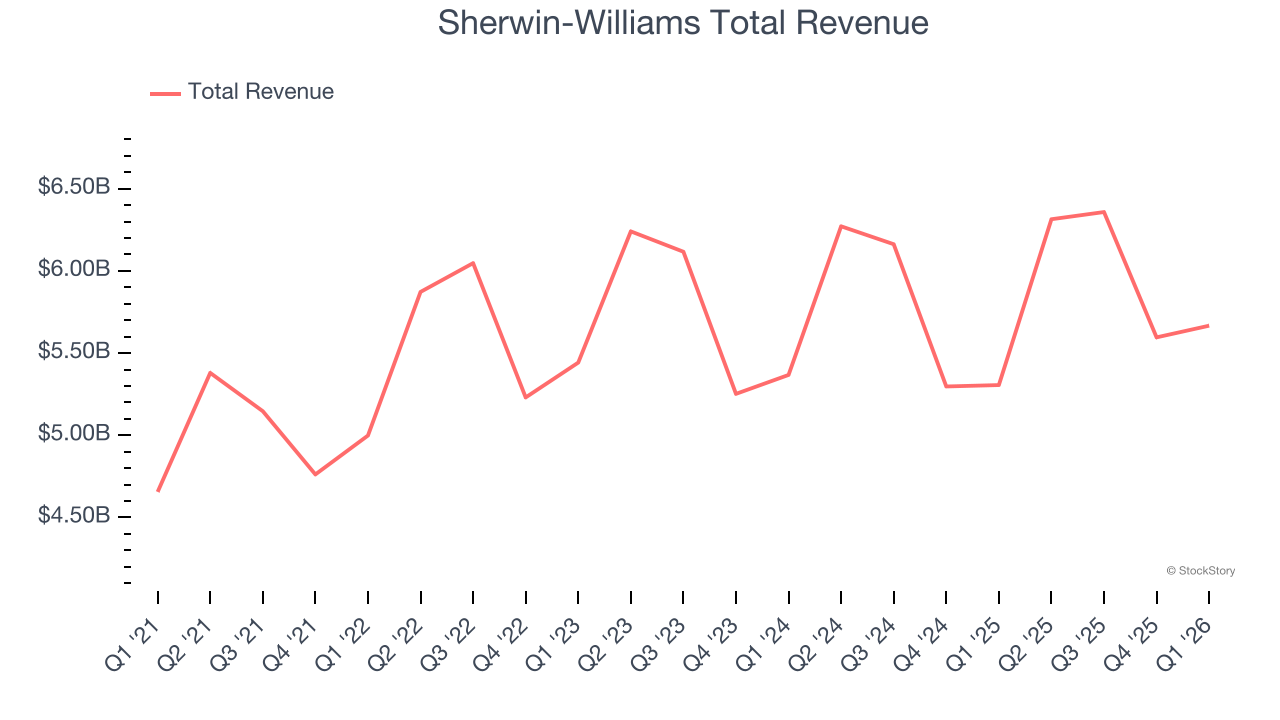
Even though it had a relatively good quarter, the market seems discontent with the results. The stock is down 6.3% since reporting and currently trades at $314.77.
Is now the time to buy Sherwin-Williams? Access our full analysis of the earnings results here, it’s free.
Best Q1: Vulcan Materials (NYSE: VMC)
Founded in 1909, Vulcan Materials (NYSE: VMC) is a producer of construction aggregates, primarily crushed stone, sand, and gravel.
Vulcan Materials reported revenues of $1.76 billion, up 7.4% year on year, outperforming analysts’ expectations by 5.8%. The business had a stunning quarter with a solid beat of analysts’ EBITDA estimates.
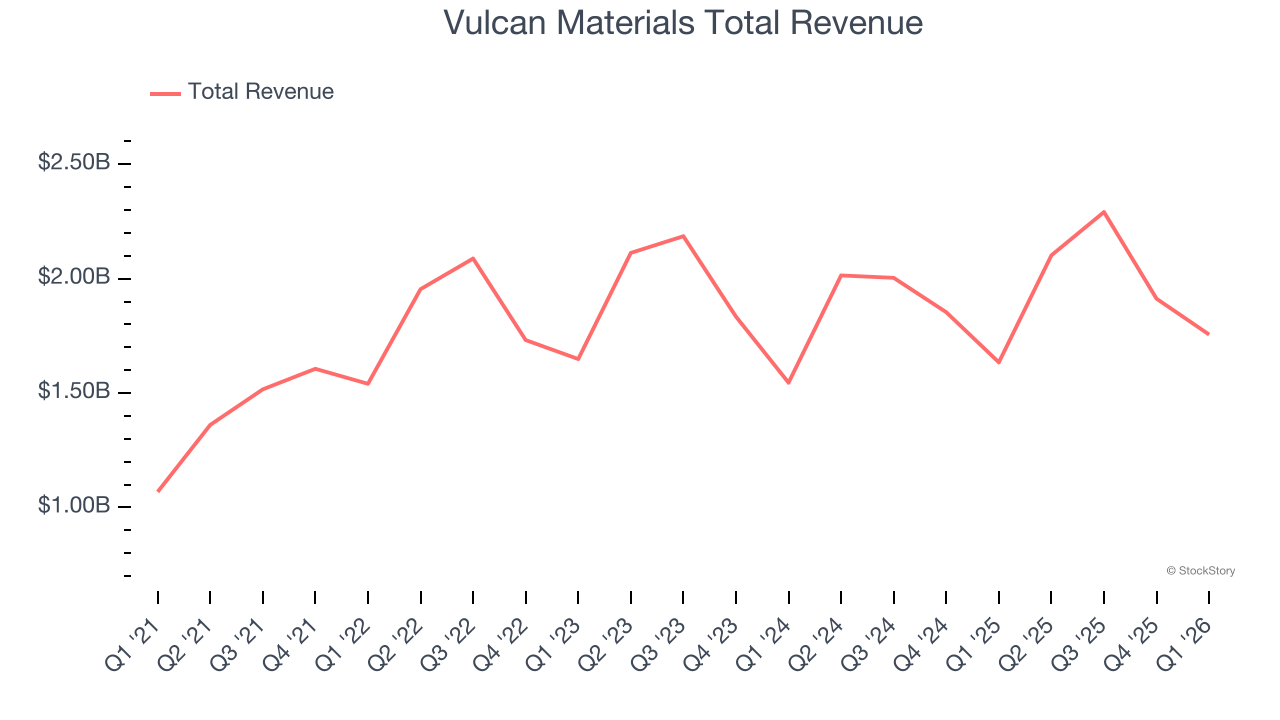
Vulcan Materials pulled off the biggest analyst estimate beat among its peers. The market seems content with the results as the stock is up 1.2% since reporting. It currently trades at $294.83.
Is now the time to buy Vulcan Materials? Access our full analysis of the earnings results here, it’s free.
Weakest Q1: UFP Industries (NASDAQ: UFPI)
Beginning as a lumber supplier in the 1950s, UFP Industries (NASDAQ: UFPI) is a holding company making building materials for the construction, retail, and industrial sectors.
UFP Industries reported revenues of $1.46 billion, down 8.4% year on year, falling short of analysts’ expectations by 3.5%. It was a disappointing quarter as it posted a significant miss of analysts’ adjusted operating income estimates.
UFP Industries delivered the weakest performance against analyst estimates and slowest revenue growth in the group. As expected, the stock is down 9.6% since the results and currently trades at $84.01.
Read our full analysis of UFP Industries’s results here.
Tecnoglass (NYSE: TGLS)
The first-ever Colombian company to trade on the NASDAQ, Tecnoglass (NYSE: TGLS) is a manufacturer of architectural glass, windows, and aluminum products.
Tecnoglass reported revenues of $249 million, up 12% year on year. This number topped analysts’ expectations by 2.7%. Aside from that, it was a satisfactory quarter as it also produced full-year EBITDA guidance exceeding analysts’ expectations but a significant miss of analysts’ adjusted operating income estimates.
Tecnoglass had the weakest full-year guidance update among its peers. The stock is up 3% since reporting and currently trades at $45.36.
Read our full, actionable report on Tecnoglass here, it’s free.
Armstrong World (NYSE: AWI)
Started as a two-man shop dating back to the 1860s, Armstrong (NYSE: AWI) provides ceiling and wall products to commercial and residential spaces.
Armstrong World reported revenues of $409.9 million, up 7.1% year on year. This print met analysts’ expectations. Zooming out, it was a softer quarter as it logged a significant miss of analysts’ adjusted operating income estimates and a significant miss of analysts’ EBITDA estimates.
The stock is down 13.5% since reporting and currently trades at $153.79.
Read our full, actionable report on Armstrong World here, it’s free.
Market Update
Late in 2025 into early 2026, there was hand-wringing around artificial intelligence. For software companies, the fear was that AI would erode pricing power and compress margins as new tools made it easier to replicate what once required expensive enterprise platforms. Crypto investors had their own version of the same anxiety: if AI agents could trade, allocate capital, and manage wallets autonomously, what exactly was the long-term value of today’s crypto infrastructure?
These concerns triggered a noticeable rotation away from these sectors and into safer havens. But markets rarely dwell on one narrative for long. Spring 2026 came, and the focus shifted abruptly from technological disruption to geopolitical risk. The US’ conflict with Iran became the dominant driver of market psychology, and when geopolitics takes center stage, the script changes quickly. Investors stop debating growth rates and start worrying about oil supply, inflation, and global stability.
Want to invest in winners with rock-solid fundamentals? Check out our Top 6 Stocks and add them to your watchlist. These companies are poised for growth regardless of the political or macroeconomic climate.
StockStory’s analyst team — all seasoned professional investors — uses quantitative analysis and automation to deliver market-beating insights faster and with higher quality.