
As the Q2 earnings season comes to a close, it’s time to take stock of this quarter’s best and worst performers in the traditional fast food industry, including Papa John's (NASDAQ: PZZA) and its peers.
Traditional fast-food restaurants are renowned for their speed and convenience, boasting menus filled with familiar and budget-friendly items. Their reputations for on-the-go consumption make them favored destinations for individuals and families needing a quick meal. This class of restaurants, however, is fighting the perception that their meals are unhealthy and made with inferior ingredients, a battle that's especially relevant today given the consumers increasing focus on health and wellness.
The 12 traditional fast food stocks we track reported a satisfactory Q2. As a group, revenues beat analysts’ consensus estimates by 1.6%.
Amidst this news, share prices of the companies have had a rough stretch. On average, they are down 13.2% since the latest earnings results.
Weakest Q2: Papa John's (NASDAQ: PZZA)
Founded by the eclectic John “Papa John” Schnatter, Papa John’s (NASDAQ: PZZA) is a globally recognized pizza delivery and carryout chain known for “better ingredients” and “better pizza”.
Papa John's reported revenues of $482.4 million, down 8.8% year on year. This print was in line with analysts’ expectations, but overall, it was a softer quarter for the company with full-year EBITDA guidance missing analysts’ expectations significantly and a significant miss of analysts’ EBITDA estimates.
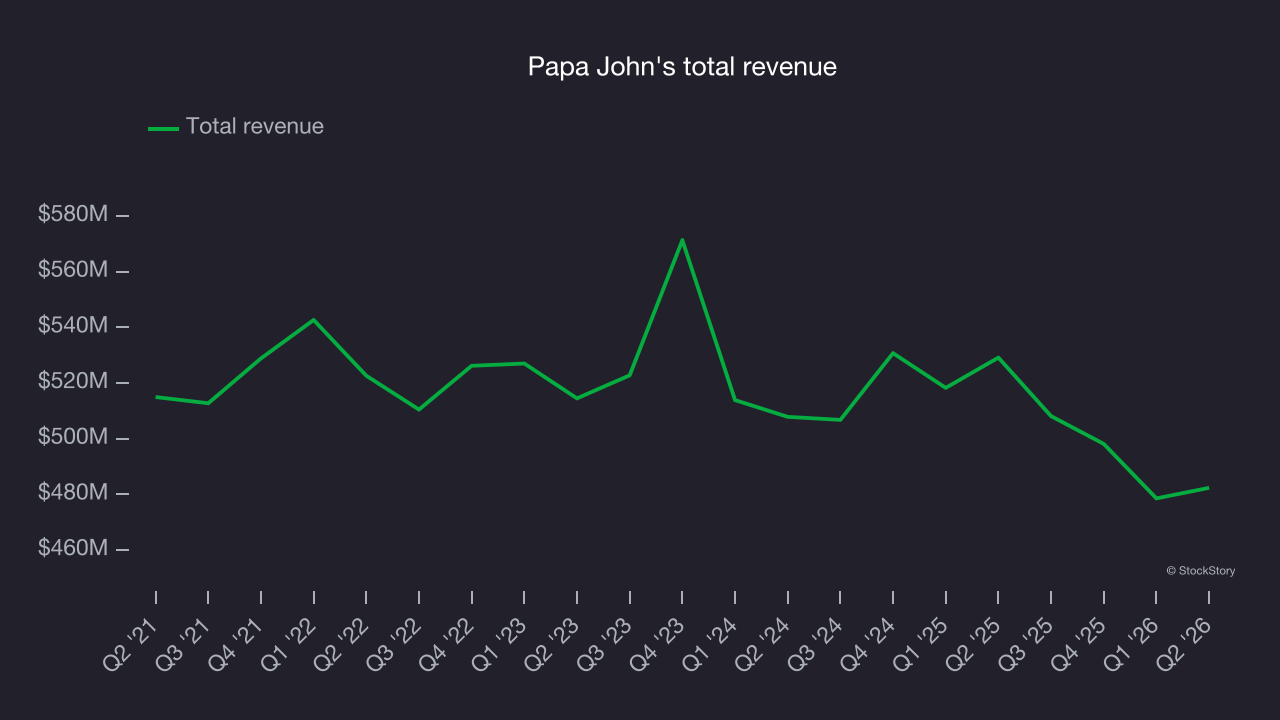
The market seems disappointed with the results as the stock is down 38.4% since reporting and currently trades at $18.33.
Read our full report on Papa John's here, it’s free.
Best Q2: Starbucks (NASDAQ: SBUX)
Started by three friends in Seattle’s historic Pike Place Market, Starbucks (NASDAQ: SBUX) is a globally-renowned coffeehouse chain that offers a wide selection of high-quality coffee, beverages, and food items.
Starbucks reported revenues of $9.32 billion, down 1.4% year on year, outperforming analysts’ expectations by 1.5%. The business had an exceptional quarter with a solid beat of analysts’ same-store sales estimates and full-year EPS guidance exceeding analysts’ expectations.
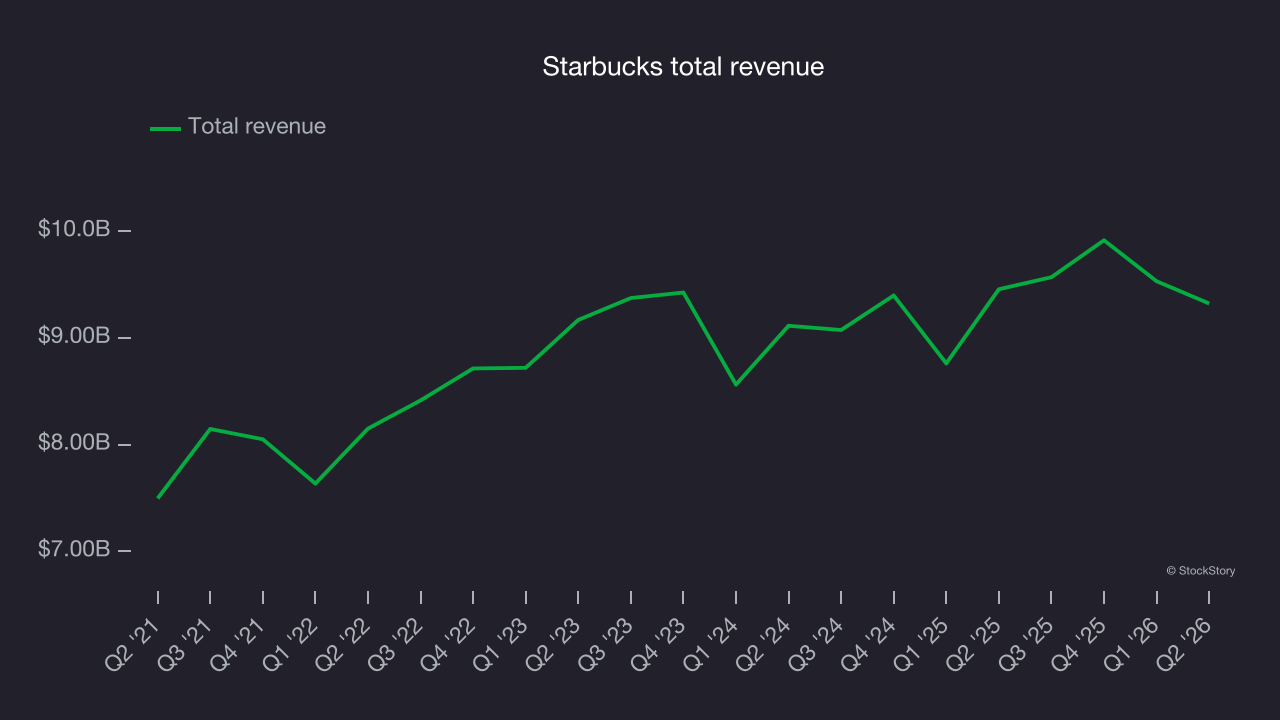
Although it had a fine quarter compared to its peers, the market seems unhappy with the results as the stock is down 1.6% since reporting. It currently trades at $102.50.
Is now the time to buy Starbucks? Access our full analysis of the earnings results here, it’s free.
McDonald's (NYSE: MCD)
With nicknames spanning Mickey D's in the U.S. to Makku in Japan, McDonald’s (NYSE: MCD) is a fast-food behemoth known for its convenience and broken ice cream machines.
McDonald's reported revenues of $7.10 billion, up 3.7% year on year, in line with analysts’ expectations. It was a mixed quarter as it posted same-store sales in line with analysts’ estimates.
As expected, the stock is down 5.6% since the results and currently trades at $250.40.
Read our full analysis of McDonald’s results here.
Krispy Kreme (NASDAQ: DNUT)
Famous for its Original Glazed doughnuts and parent company of Insomnia Cookies, Krispy Kreme (NASDAQ: DNUT) is one of the most beloved and well-known fast-food chains in the world.
Krispy Kreme reported revenues of $331 million, down 12.8% year on year. This print beat analysts’ expectations by 9.4%. Taking a step back, it was a satisfactory quarter as it also produced an impressive beat of analysts’ EBITDA estimates but EPS in line with analysts’ estimates.
Krispy Kreme delivered the biggest analyst estimate beat of the whole group. The stock is down 7.1% since reporting and currently trades at $2.88.
Read our full, actionable report on Krispy Kreme here, it’s free.
Yum China (NYSE: YUMC)
One of China’s largest restaurant companies, Yum China (NYSE: YUMC) is an independent entity spun off from Yum! Brands in 2016.
Yum China reported revenues of $3.14 billion, up 12.6% year on year. This number topped analysts’ expectations by 4.2%. Overall, it was a very strong quarter as it also put up an impressive beat of analysts’ EBITDA estimates and a beat of analysts’ EPS estimates.
The stock is flat since reporting and currently trades at $45.44.
Read our full, actionable report on Yum China here, it’s free.
Market update
Over the past year, investors have been forced to repeatedly answer the same question: what is the market’s biggest risk? The answer has changed several times, and each shift has reshaped market leadership.
Late in 2025 and early 2026, artificial intelligence became the market’s primary uncertainty. Investors questioned whether AI would erode software pricing power and weaken competitive moats as AI made it easier to replicate once-differentiated products.
By the spring, technology took a back seat to geopolitics. The U.S. conflict with Iran briefly became the market’s dominant narrative, raising concerns about oil prices, inflation, and global growth. But as energy markets remained orderly and fears of a prolonged supply disruption faded, investors quickly turned their focus back to fundamentals.
Want to invest in winners with rock-solid fundamentals? Check out our Top 5 Quality Compounder Stocks and add them to your watchlist. These companies are poised for growth regardless of the political or macroeconomic climate.