
New performance release accelerates large workspace recovery by 71.6%, cuts first-use code by up to 99.9%, and quiets background activity across the Cortex experience.
San Francisco, CA (PRUnderground) November 20th, 2026
Pervaziv AI today announced Cortex 6.5 and Cortex Discover 1.7, expanding the company's performance program from the agentic AI browser into a broader effort spanning the Cortex Browser Extension, Cortex VS Code Extension, Cortex Mobile and Cortex CLI.
Earlier Cortex Discover studies asked whether an agentic browser could remain competitive with mainstream browsers, stay healthy through sustained use, and keep large conversations practical as context accumulated.
Cortex 6.5 takes the next step. Performance becomes a product contract across the places where customers browse, code, review, move between devices and continue work from the terminal.
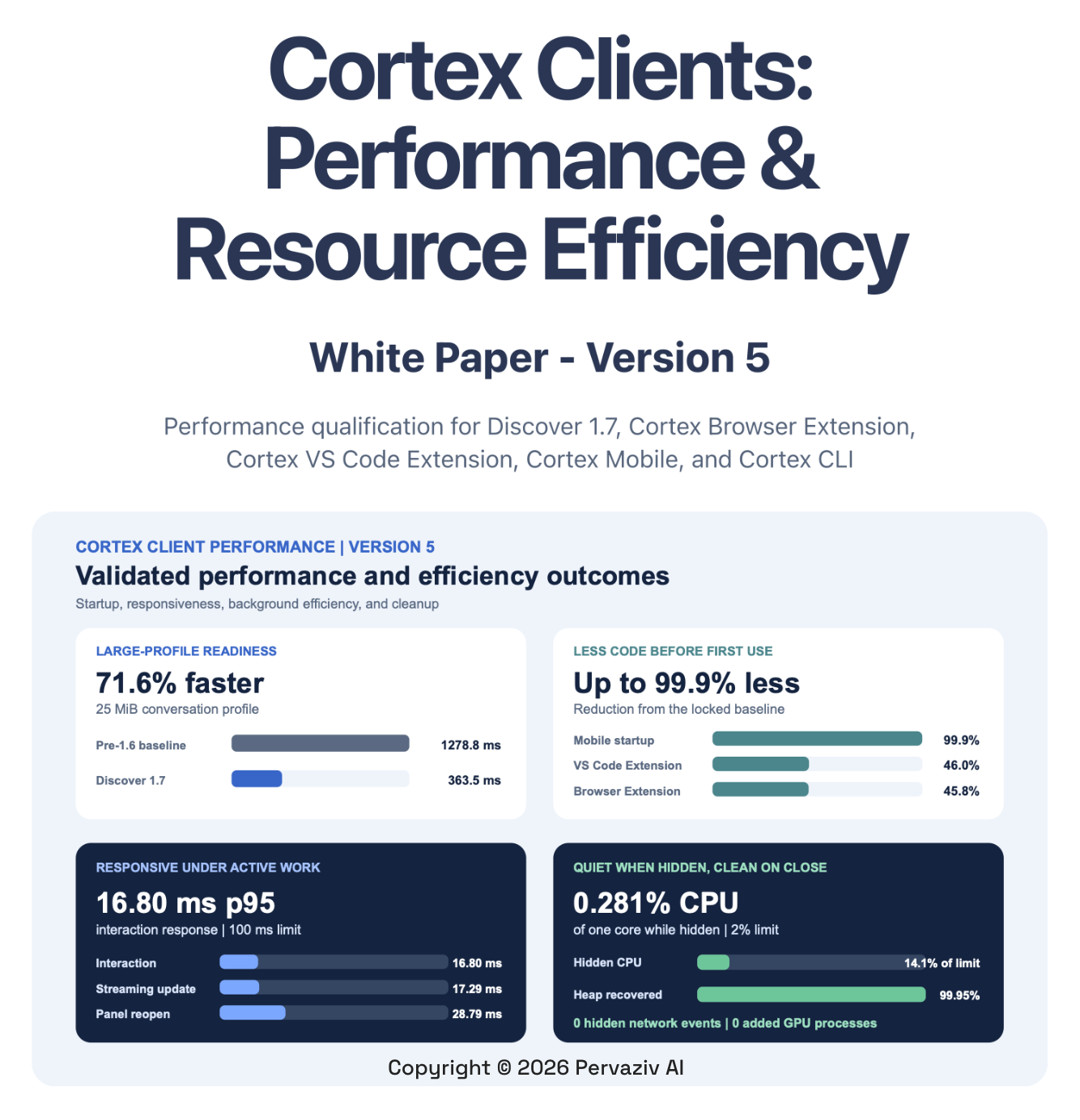
The headline results reflect that broader scope. In controlled qualification, Cortex Discover 1.7 reduced large profile hydration p95 by 71.6% from the pre 1.6 baseline, reaching 363.5 ms for a 25 MiB profile containing 100 threads. Interaction response measured 16.80 ms p95. Hidden CPU measured 0.281% of one CPU core, with zero hidden network events. Across Cortex clients, first use work was reduced sharply, including a 99.4% smaller Browser Extension side panel entry, a 64.3% smaller VS Code chat webview and a 99.9% reduction in Cortex Mobile startup reachability.
The principle is simple: broad AI capability should not make every capability active before useful work can begin.
"AI should be ready when the work needs it, responsive while the work is active, and quiet when attention moves somewhere else," said Anoop Jaishankar, Founder and CEO of Pervaziv AI. "Cortex 6.5 takes the performance principles we established in Discover and carries them across the Cortex experience. The goal is not simply a smaller package or a faster launch. It is intelligence that follows the work without becoming background weight."
Performance That Follows the Work
Modern AI work rarely stays inside one interface. A user may begin by researching in a browser, move into VS Code to inspect a repository, continue a conversation from a phone, then use the command line to run or review something close to the environment where the work is happening.
Each surface has different performance constraints.
A browser owns a large runtime surface and must remain responsive through repeated interaction. An editor already carries language services, repositories, terminals, tests and other extensions. Mobile operates under tighter memory, battery and background constraints. A command line tool is expected to appear quickly and remain lightweight while idle.
Cortex 6.5 does not force those different environments into one artificial benchmark. Instead, Pervaziv AI qualified each client around the moments that matter for that experience, while applying the same product principle across all of them: load what the current action needs, keep active work responsive and avoid turning optional intelligence into permanent overhead.
That is what makes Cortex 6.5 different from the company's earlier performance releases.
The original Discover program focused on browser efficiency. Sustained qualification examined what happened after the initial benchmark ended. Discover 1.6 focused on the growing cost of large histories, retained state and continuous streamed responses. Cortex 6.5 now connects those lessons across a portfolio of customer experiences.
Discover 1.7 Makes Returning to Large Work Faster
The defining Discover 1.7 result is not an empty first launch. It is the experience of returning to an established AI workspace.
The qualified workload uses a 25 MiB profile with 100 conversation threads, representing the kind of accumulated research, technical discussion, decisions and context that users expect a persistent AI environment to preserve.
In that workload, profile hydration measured 363.5 ms p95. That is 46.3% lower than the qualified Discover 1.6 result of 676.7 ms and 71.6% lower than the pre 1.6 baseline of 1,278.8 ms.
The same qualification recorded a 2,000 chat tree build at 0.61 ms p95, interaction at 16.80 ms p95, zero milliseconds of maximum long task time and zero dropped frame intervals.
Those measurements point to a practical customer outcome: continuity does not have to become a reopening penalty.
Long running research and engineering work often gains value precisely because users can return to it. Prior evidence, discussion and decisions remain available. The performance challenge is making that persistence feel like continuity rather than accumulated weight.
Discover 1.7 is designed around that return path. The active conversation can become available quickly, substantial local history can be restored without making the visible interface wait for every remote operation, and connected state can refresh without turning the whole history into an immediate startup requirement.
Responsiveness Through Interaction, Streaming and Reopen
Users do not experience performance as one benchmark number. They select a conversation, send a request, watch a response stream, move between the page and Cortex, and reopen the interface later.
Cortex Discover 1.7 qualified those repeated moments directly.
Interaction response measured 16.80 ms p95. A 64 KiB streaming update measured 17.29 ms p95. Panel reopen measured 28.79 ms p95. Optional model first use measured 3.20 ms.
Each was measured against its declared qualification limit, with the interaction, streaming and reopen workloads using a 100 ms limit.
A responsive AI surface lets users keep scrolling, reviewing information and moving through the application while intelligence is active. Model speed matters, but client work around the model also determines whether an experience feels immediate or heavy.
Quiet When Intelligence Is Not Active
Persistent AI should remain available without behaving as if every open conversation is permanently active.
Cortex Discover 1.7 measured hidden CPU at 0.281% of one CPU core in the qualified workload. It recorded zero hidden network events, retained zero bytes of completed attachment payload, added zero GPU processes after the tested lifecycle and recovered 99.95% of lifecycle heap.
Active models, document analysis, search, media and connected actions naturally consume resources. The goal is to keep that cost tied to the work.
When the user switches tabs, reviews a file, joins a video call or simply leaves Cortex open while thinking, unnecessary background activity competes with everything else running on the machine. Cortex 6.5 treats becoming quiet as part of performance quality, not as an afterthought.
Up to 99.9% Less Work Before First Use
The broadest change in Cortex 6.5 is how much optional capability stays outside the first useful path.
The Cortex Browser Extension production package falls from 81.6 MB to 44.2 MB, a 45.8% reduction. More significantly for first use, its side panel entry falls from 1.35 MB to 7.9 KB, a 99.4% reduction.
The Cortex VS Code Extension package falls from 12.8 MB to 6.9 MB, a 46.0% reduction. Its chat webview falls from 910 KB to 325 KB, a 64.3% reduction, while the extension host artifact falls from 918 KB to 409 KB, a 55.5% reduction.
Cortex Mobile reduces startup reachability from 338,452 bytes to 442 bytes, a 99.9% reduction. Pervaziv AI is intentionally limiting that claim to startup reachability. The full iOS JavaScript bundle remains essentially flat at 1.97 MB.
That scope matters because a smaller reachable startup path does not mean the complete application became 99.9% smaller. It means dramatically less code can participate before the first useful route is established.
The customer benefit is straightforward: the active conversation can come first, while documents, media, search, speech and other specialized capabilities remain available when requested.
Cortex CLI Keeps Fast Entry Bounded
The command line has a different job.
Cortex CLI already had a small entry path, so Cortex 6.5 does not create a reduction claim where the evidence does not support one. Instead, the 28,004 byte fast entry remains within its target while larger commands stay demand loaded.
In controlled qualification, Cortex CLI reached its first nonblank frame in 119.2 ms p95. Maximum idle RSS measured 46.0 MiB. Formatting a 2,000 message transcript measured 99.3 ms p95, while a cached redraw completed in 0.62 ms.
For terminal users, the objective is simple: enter the workflow quickly, stay bounded while idle and keep substantial conversation history workable without making routine navigation wait on heavyweight capability.
Two Hours of Runtime Evidence
Discover receives the deepest runtime qualification because it owns both the browser shell and the integrated AI surface.
The Cortex 6.5 campaign repeated panel closed, panel open and rapid open close conditions across a 121.4 minute Apple Silicon qualification.
All 9 of 9 measured sessions completed. The campaign recorded zero workload errors, zero native sampling errors and 903 of 903 healthy repeated cycle samples. Render readiness measured 25.8 ms p95. Settled transfer growth measured zero bytes. No session showed retained process growth.
The tested candidate remained ready through repeated use, completed every measured workload and did not retain additional processes after closure.
Pervaziv AI also separates the behavior of the tested Discover experience from the unchanged browser foundation where the evidence allows that distinction. At the final comparison point, the campaign found no positive Discover specific excess beyond the matched browser mechanism.
The company presents that as a bounded qualification result, not a universal claim that memory can never grow under different workloads.
A Performance Contract Across Cortex
Cortex 6.5 extends the same performance discipline across five different customer touchpoints.
In Discover, substantial history becomes ready quickly and remains responsive.
In the Browser Extension, the active panel is no longer preceded by the weight of the entire capability set.
In VS Code, Cortex stays close to the repository while respecting an editor host that is already doing substantial work.
On Mobile, the active conversation gets a tightly bounded startup path.
In the CLI, fast entry remains small while large transcripts stay practical.
Together, these improvements advance the broader Pervaziv AI vision for Enterprise AI: intelligence that stays connected to the work without forcing users to trade away responsiveness, resource discipline or control.
Earlier research established that agentic browsing could remain competitive with mainstream browser expectations and become lighter as histories grew. Cortex 6.5 moves that work across the product portfolio.
The experience should not require users to think about which capability loaded, which client owns the conversation or whether AI is still consuming resources after attention moved elsewhere. It should be ready when needed, responsive during work and quiet afterward.
Cortex 6.5 and Discover 1.7. Performance that follows the work, without following the user as background weight.
Availability and Performance Research
Cortex 6.5 and Cortex Discover 1.7 are part of the expanding Cortex experience across supported browser, development, mobile and command line surfaces.
The Cortex Clients: Performance and Resource Efficiency White Paper, Version 5 documents the qualified workloads, declared limits, long session campaign, evidence boundaries and measured results behind the update.
The published measurements apply to the stated Apple Silicon qualification environment and controlled workloads. Device hardware, operating system policy, extensions, account history and concurrent applications can change observed results.
Pervaziv AI's earlier performance research includes Building the Most Efficient Agentic AI Browser, Making Agentic AI Stay Fast with Cortex Discover, Cortex Discover 1.5: Faster Starts, Smarter Resource Efficiency, and Discover 1.6: Lighter Persistent AI for Everyday Browsing.
About Pervaziv AI
Pervaziv AI builds enterprise AI for software engineering, security and connected technical work. Cortex brings specialized intelligence, governed execution, verification, privacy, security and continuity across development tools, browsers, mobile experiences, command line workflows and managed environments. The company's direction is centered on turning AI from isolated answers into connected, reviewable outcomes while preserving the controls enterprises need around data, models, tools and execution.