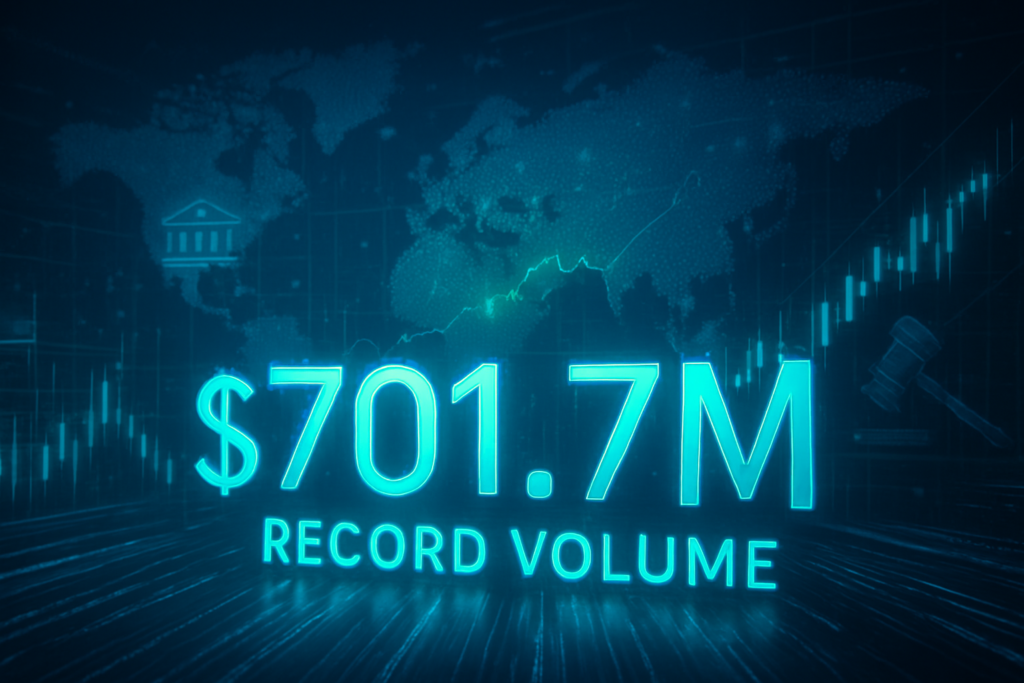
The world of finance shifted on its axis this week. On Monday, January 12, 2026, prediction markets achieved a staggering, record-breaking $701.7 million in single-day trading volume. This milestone represents more than just a spike in activity; it marks the definitive arrival of "information finance" as a primary pillar of the global economy. For years, skeptics dismissed these platforms as glorified sportsbooks, but as of early 2026, they have transformed into what many are calling the world’s most accurate "truth engines."
The surge was driven by a perfect storm of constitutional crises, geopolitical shocks, and the institutionalization of retail trading. At the center of the frenzy was a high-stakes standoff between the U.S. Department of Justice (DOJ) and Federal Reserve Chair Jerome Powell, alongside the sudden capture of Venezuelan President Nicolás Maduro. With millions of dollars moving by the second, the probability of a March interest rate cut fluctuated wildly, peaking at 74% as traders digested real-time updates that outpaced traditional news cycles by minutes.
The Market: What's Being Predicted
The $701.7 million daily volume was dominated by a "triopoly" of platforms that have spent the last year racing for market share. Kalshi solidified its position as the industry leader, capturing 66.4% of the volume with $465.9 million in trades. Much of this dominance is credited to Kalshi’s deep integration with Robinhood Markets, Inc. (NASDAQ: HOOD), which launched its dedicated "Prediction Markets Hub" last year, putting event contracts into the hands of over 100 million retail investors.
While Kalshi owned the domestic macro markets, Polymarket and Opinion battled for the remaining share. Polymarket recorded $100.04 million in volume, buoyed by a $2 billion liquidity injection from the Intercontinental Exchange, Inc. (NYSE: ICE). Meanwhile, the relative newcomer Opinion (Opinion Labs) matched that figure with $100 million, specializing in high-frequency, AI-driven macro indicators.
The most traded contracts on January 12 included:
- The Federal Reserve Standoff: Contracts on whether Jerome Powell will resign or be removed before the March FOMC meeting.
- The Maduro Aftermath: Predictions on the stability of a transitional government in Venezuela following Maduro’s capture.
- NFL Postseason "Combos": A new feature on Kalshi that allows users to parlay economic outcomes with sports results—for instance, "CPI under 2.5% AND the Kansas City Chiefs win."
Why Traders Are Betting
The primary driver for this week’s massive volume was the unprecedented constitutional friction involving the Federal Reserve. On the evening of January 11, Chair Jerome Powell revealed that the DOJ had served the Fed with subpoenas regarding a massive headquarters renovation—a move Powell labeled a "pretext" for political interference. This sent traders into a frenzy. On Kalshi, the "Will the Fed cut rates in March?" contract saw over $120 million in volume on Monday alone as institutions used the market to hedge against a potential central bank decapitation.
Geopolitical "insider" activity also fueled the surge. Following the U.S. military raid that captured Nicolás Maduro, a single anonymous trader on Polymarket turned a $32,000 bet into $400,000. The bet, placed just hours before the news broke, has sparked intense debate about the role of prediction markets in surfacing non-public information. Traders are no longer just betting on what they think will happen; they are betting on what they know is happening in the shadows.
Furthermore, the "Mainstreet-ing" of these markets through Robinhood (NASDAQ: HOOD) has changed the trader profile. No longer restricted to crypto-enthusiasts, the January 12 record saw a massive influx of traditional retail investors treating "The Fed" or "The Greenland Declaration" as if they were tech stocks.
Broader Context and Implications
This record volume occurs against a backdrop of intense regulatory friction. While the federal courts largely cleared the way for election betting in 2025, a new "second front" has opened at the state level. Just this past week, the Tennessee Sports Wagering Council issued cease-and-desist orders to Kalshi and Polymarket, claiming their event contracts infringe on state gambling monopolies. However, on January 15, 2026, a federal judge granted a temporary restraining order (TRO) protecting Kalshi, suggesting that federal Commodity Futures Trading Commission (CFTC) oversight may preempt state law.
The massive volume is also forcing Congress's hand. On January 9, Rep. Ritchie Torres (D-NY) introduced the "Public Integrity in Financial Prediction Markets Act of 2026." The bill aims to ban federal officials from trading on these platforms to prevent the very "information leakage" seen in the Maduro case.
Despite these hurdles, the historical accuracy of these markets remains their greatest defense. Throughout the early 2026 geopolitical turmoil, prediction market odds have consistently moved 10 to 15 minutes ahead of major news wires like Bloomberg or Reuters. For many hedge funds, these markets are no longer a side-show—they are the primary signal.
What to Watch Next
The immediate focus for traders is the "Powell Pivot." With the DOJ investigation ongoing, any sign of Powell’s resignation will likely trigger another $500 million+ day. Markets are currently pricing a 35% chance of a leadership change at the Fed by February 1.
On the regulatory front, keep an eye on the Ninth Circuit Court of Appeals. A ruling is expected by early February regarding Nevada’s attempt to shutter prediction market operations. If the court sides with Kalshi, it will effectively create a "green zone" for event contracts across the Western United States. Additionally, the finalization of the ICE (NYSE: ICE)-Polymarket integration is expected to bring a wave of institutional liquidity that could make $700 million days the new normal.
Bottom Line
The record-breaking volume of January 12 is a watershed moment for finance. It proves that prediction markets have solved the "liquidity trap" that previously kept them in the shadow of the New York Stock Exchange. By providing a clear, numerical probability for events that traditional markets struggle to price—like constitutional crises or military raids—platforms like Kalshi and Polymarket have become indispensable.
For investors, the message is clear: the most valuable commodity in 2026 is no longer just data, but the synthesis of that data into tradable odds. As long as the world remains volatile, these "truth engines" will continue to grow, regulatory pressure notwithstanding.
This article is for informational purposes only and does not constitute financial or betting advice. Prediction market participation may be subject to legal restrictions in your jurisdiction.
PredictStreet focuses on covering the latest developments in prediction markets.
Visit the PredictStreet website at https://www.predictstreet.ai/.