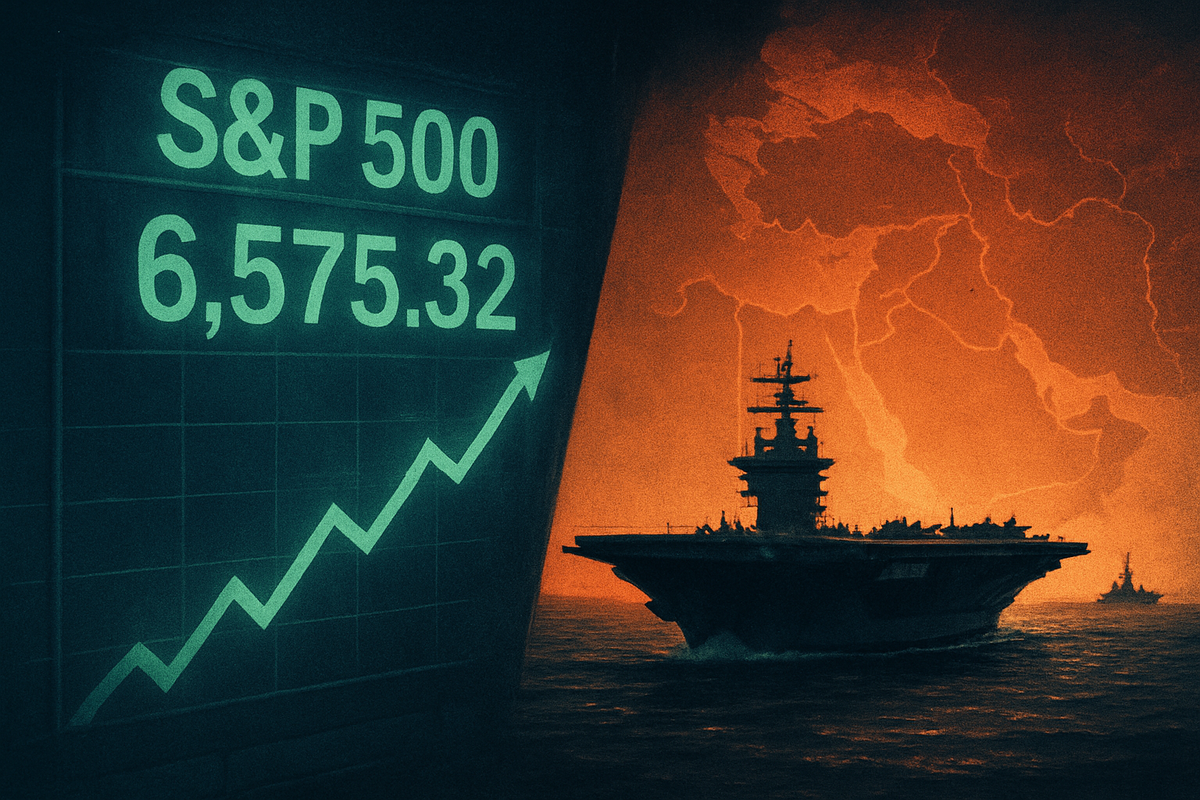
The S&P 500 Index (NYSEARCA: SPY) managed to carve out a gain on Thursday, April 2, 2026, as investors navigated a minefield of conflicting geopolitical signals. The benchmark index rose 46.8 points, or approximately 0.72%, to finish at 6,575.32. While the green finish suggests a resilient "risk-on" appetite, the headline number masks a day of intense intraday volatility that saw early morning gains nearly evaporate following a wave of hawkish military rhetoric from both Washington and Tehran.
The session was a microcosm of the 2026 trading year: a constant battle between robust fundamental earnings in the technology sector and a mounting "geopolitical premium" driven by the escalating U.S.-Iran conflict. Market participants spent much of the morning cheering a rumored diplomatic "off-ramp" regarding the Strait of Hormuz, only to be met with a late-afternoon reality check as military officials signaled a readiness for further kinetic action.
Volatility Takes Center Stage: A Tale of Two Tapes
The trading day began with a wave of optimism following unconfirmed reports that back-channel negotiations in Oman were yielding progress on reopening the Strait of Hormuz to commercial traffic. This sparked an immediate "risk-on" rally, with the S&P 500 surging more than 1.2% in the first two hours of trading. Tech giants and consumer discretionary stocks led the charge, as traders bet that a de-escalation would cool the energy-driven inflationary pressures that have plagued the first quarter of 2026.
However, the sentiment soured mid-afternoon. The shift followed a televised address by Iranian military leadership, which reiterated threats to target regional energy infrastructure if U.S. "snapback" sanctions were not immediately lifted. This was compounded by a Pentagon briefing shortly after 2:00 PM ET, where officials confirmed that additional carrier strike groups were being repositioned in the North Arabian Sea. The S&P 500, which had been trading near the 6,620 level, saw a sharp "V-shaped" reversal as high-frequency trading algorithms responded to the uptick in military keywords, ultimately settling at 6,575.32.
This latest bout of volatility comes on the heels of a brutal March for the markets. Earlier this year, the S&P 500 suffered a technical breakdown, falling below its 200-day moving average of 6,835 in the wake of the "Twelve-Day War" in June 2025 and subsequent direct strikes in February 2026. Today’s close at 6,575 represents a fragile attempt at a bottom, though it remains nearly 10% below the all-time highs reached in late 2025.
Winners and Losers: Defense and Energy Hedge the Fear
In a market defined by conflict, the traditional "war play" sectors continue to show relative strength. Defense contractors were among the primary beneficiaries of the late-day pivot toward military rhetoric. Lockheed Martin (NYSE: LMT) and Northrop Grumman (NYSE: NOC) both saw late-session spikes, closing up 2.4% and 3.1% respectively, as investors anticipate continued federal outlays for missile defense systems and long-range strike capabilities. RTX Corporation (NYSE: RTX) also saw increased volume, reflecting its critical role in the current theater of operations.
Energy stocks also served as a vital hedge against geopolitical risk. With Brent crude hovering near $104 per barrel, industry titans like ExxonMobil (NYSE: XOM) and Chevron (NYSE: CVX) posted solid gains, rising 1.8% and 2.1% on the day. The energy sector remains the only S&P 500 group in the green on a year-to-date basis, effectively acting as a sanctuary for capital fleeing the more interest-rate-sensitive areas of the market.
Conversely, the late-day pressure was most visible in the "Big Tech" and consumer sectors. Apple Inc. (NASDAQ: AAPL) and Amazon (NASDAQ: AMZN), which had led the morning rally, saw their gains trimmed significantly as the "higher-for-longer" interest rate narrative resurfaced. The concern among institutional investors is that sustained energy shocks will prevent the Federal Reserve from cutting rates in 2026, a move many had previously expected by the June meeting. This has placed immense pressure on growth-oriented companies whose valuations are highly sensitive to discount rates.
Wider Significance: The New Geopolitical Reality
The events of April 2, 2026, highlight a significant shift in the global market regime. For much of the early 2020s, markets were primarily driven by monetary policy and the AI revolution. Today, however, the "geopolitical tax" has become a permanent fixture of asset pricing. The conflict with Iran has evolved from a series of proxy skirmishes into a direct military confrontation that threatens 20% of the world's oil supply, forcing a re-evaluation of global supply chains and inflation expectations.
This event mirrors historical precedents such as the 1973 oil embargo or the lead-up to the 2003 Iraq War, where geopolitical uncertainty created a sustained floor for commodity prices and a ceiling for equity multiples. The "growth scare" currently permeating the S&P 500 suggests that while corporate earnings remain relatively healthy—particularly in the AI and defense sectors—the macro environment is increasingly hostile to sustained bull runs.
Furthermore, the late-day reversal underscores the sensitivity of modern markets to "headline risk." In an era of AI-driven trading, a single statement from a foreign ministry can trigger billions of dollars in liquidation within milliseconds. This creates a challenging environment for retail investors, as traditional valuation metrics are frequently overridden by the latest updates from the Persian Gulf.
The Path Ahead: Watching for the "Off-Ramp"
Looking forward, the market’s direction will likely be dictated by whether the U.S.-Iran conflict enters a phase of "managed escalation" or slips into a broader regional war. In the short term, traders will be hyper-focused on the weekly petroleum status reports and any news regarding the insurance of tankers in the Strait of Hormuz. If a "soft blockade" remains in place, $110 oil becomes a distinct possibility, which could force the S&P 500 to retest its recent lows near 6,300.
Strategically, investors are expected to remain defensive, favoring "hard assets" and companies with strong pricing power. We may see a shift in capital toward "tech-defense" synergies, where companies like Palantir Technologies (NYSE: PLTR) leverage AI for intelligence and electronic warfare, providing a hybrid growth-and-security play. The potential for a "relief rally" remains on the table, but it would require a verifiable de-escalation—something that current military rhetoric suggests is unlikely in the immediate future.
The remainder of Q2 2026 is shaping up to be a test of endurance for the S&P 500. With the Federal Reserve’s hands tied by energy-driven inflation, the "Fed Put" that investors relied on for decades appears to be off the table. The market must now find its own floor, independent of central bank intervention.
Market Wrap-Up: Resilience Amidst Uncertainty
The S&P 500’s 46.8-point gain on April 2, 2026, is a testament to the underlying strength of the U.S. economy, yet it serves as a stark reminder of the volatility that now defines the 2026 landscape. Investors are caught in a tug-of-war between strong corporate fundamentals and a geopolitical environment that is more volatile than at any point in the last several decades.
Moving forward, the key takeaway is that the "risk-on" sentiment is present but fragile. The market is willing to buy the dip, but it is equally quick to sell on any sign of further military escalation. Investors should watch for the 6,400 support level on the S&P 500; a break below that could signal a deeper correction.
In the coming months, the focus will remain on three pillars: the price of Brent crude, the hawkishness of the Federal Reserve, and the stability of global shipping lanes. Until a definitive diplomatic solution is reached in the Middle East, the S&P 500 is likely to remain a "headline-driven" index, where geopolitical strategy is just as important as a company's balance sheet.
This content is intended for informational purposes only and is not financial advice.