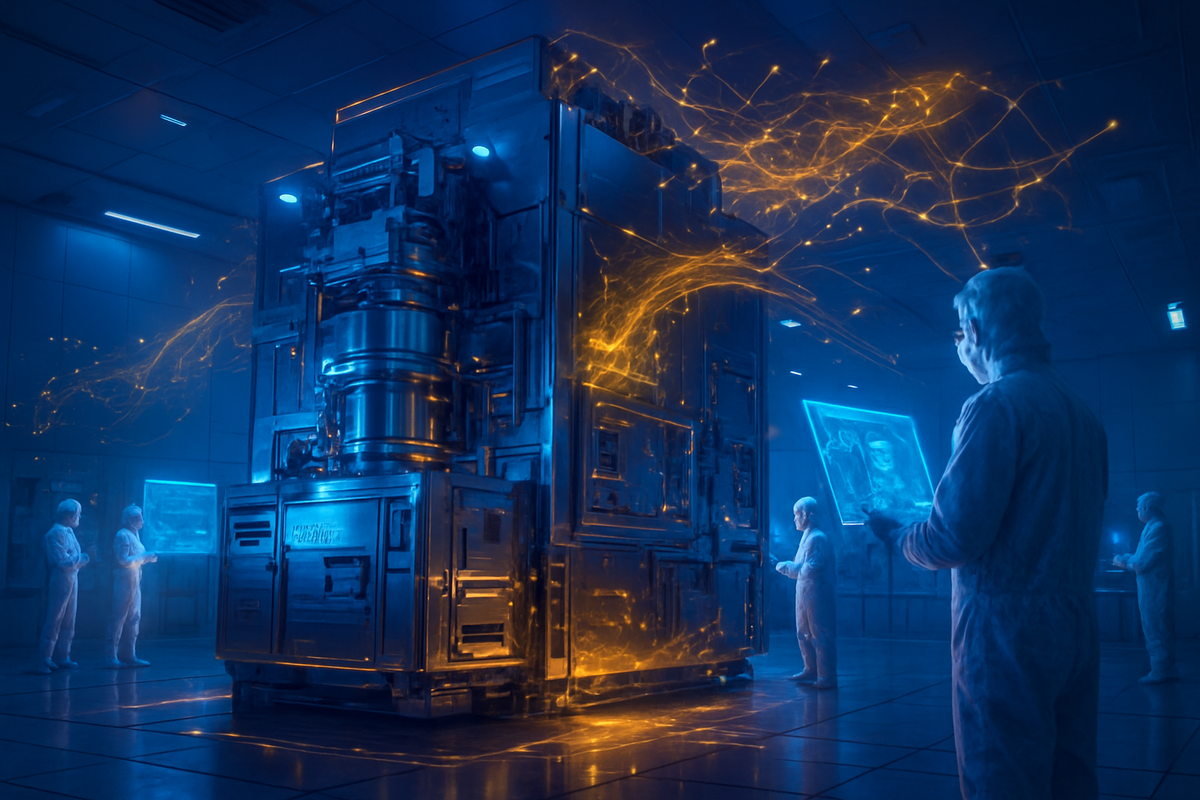
ASML Holding N.V. (NASDAQ: ASML) delivered a resounding message to the global markets this morning, reporting first-quarter 2026 earnings that comfortably cleared analyst estimates and sent ripples of optimism across the semiconductor sector. The Dutch lithography giant, the sole provider of the advanced tools required to manufacture the world’s most sophisticated chips, revealed that the "solidifying" demand for artificial intelligence (AI) infrastructure has shifted the industry from a period of transition into a full-blown expansionary super-cycle.
With net sales reaching €8.8 billion and net income climbing to €2.8 billion, ASML’s performance signals that the bottleneck for the AI revolution is no longer just design capacity, but the physical ability to print circuits at the atomic scale. As the company raises its full-year 2026 revenue guidance to as high as €40 billion, it is becoming increasingly clear that the semiconductor equipment industry is entering a new era of capital intensity, driven by the race for sub-2nm process nodes and the mass adoption of High-NA EUV technology.
High-NA Commercialization and the Q1 Beat
The first quarter of 2026 will likely be remembered as the moment ASML’s High-Numerical Aperture (High-NA) EUV systems moved from experimental prototypes to the backbone of high-volume manufacturing. After years of development and pilot programs, ASML recognized revenue for a growing number of its Twinscan EXE:5200 systems, each carrying a price tag exceeding €350 million. The company's gross margin of 53.0% sat at the top end of its guidance, a feat management attributed to a lucrative mix of EUV service revenue and the increasing efficiency of its system shipments.
The timeline leading to this quarter's success was paved by the strategic "bridge year" of 2024 and the capacity buildup of 2025. While 2024 was marked by inventory corrections and geopolitical caution, the subsequent two years saw a frenzy of orders from logic and memory giants. Specifically, the surge in demand for High-Bandwidth Memory (HBM) for AI servers has forced memory makers to adopt EUV lithography at a much faster rate than previously anticipated. Initial market reactions were swift; ASML shares climbed in pre-market trading, and the broader Philadelphia Semiconductor Index saw a corresponding lift as investors re-rated the growth potential for the entire equipment ecosystem.
The Technological Arms Race: Winners and Losers
In the high-stakes game of semiconductor dominance, Intel Corporation (NASDAQ: INTC) appears to be reaping the early rewards of its bold "High-NA first" strategy. As the lead adopter of the EXE:5200 series, Intel is leveraging these tools for its 14A node, aiming to regain the process leadership it lost over a decade ago. While the high depreciation costs of these machines pose a short-term margin challenge, the Q1 results suggest Intel’s aggressive roadmap is finally aligning with the market's demand for ultra-efficient AI silicon.
Conversely, the pressure is mounting on Taiwan Semiconductor Manufacturing Co. (NYSE: TSM). While TSMC remains the world's largest foundry, its initial hesitation to fully adopt High-NA EUV due to cost concerns has forced a strategic pivot. With ASML’s latest results showing that competitors are securing delivery slots for 2027 and 2028, TSMC has been forced to hike its 2026 capital expenditure budget to a range of $52–$56 billion to ensure it isn't left behind. Meanwhile, Samsung Electronics (KRX:005930) and SK Hynix (KRX:000660) are locked in a "litho-intensity" race, with SK Hynix recently disclosing a massive €8 billion deal for ASML tools to secure its lead in the HBM market. The potential "losers" in this environment are smaller tier-two foundries that lack the massive capital required to play in the High-NA era, potentially leading to further consolidation in the high-end chip market.
Broad Industry Trends and the Geopolitical Shift
The significance of ASML's Q1 results extends far beyond its own balance sheet; it serves as a barometer for the "AI Industrial Revolution." The transition to High-NA EUV represents a historical precedent similar to the shift from DUV to EUV a decade ago, which redefined the competitive landscape. This time, however, the stakes are heightened by a restructured geopolitical reality. ASML’s sales to China have stabilized at approximately 19% of total revenue, down from nearly 40% during the stockpiling years of 2024. This shift suggests that the semiconductor industry is successfully "de-risking" and finding sufficient growth in Western and Allied markets to offset export restrictions on advanced tools to the East.
Furthermore, the data suggests that the "AI-driven demand" is not a bubble but a fundamental shift in computing needs. As NVIDIA (NASDAQ: NVDA) and other chip designers push the limits of transistor density, the reliance on ASML’s monopoly over lithography becomes absolute. This has created a ripple effect for other equipment makers like Applied Materials (NASDAQ: AMAT) and Lam Research (NASDAQ: LRCX), who provide the etching and deposition tools required to complement ASML’s lithography. The industry is moving toward a "systems-level" approach to scaling, where the lithography machine is the conductor of a much larger, and more expensive, manufacturing orchestra.
The Road to 2027: Scalability and Supply Constraints
Looking ahead, the primary challenge for ASML and its partners is not a lack of demand, but the physical constraints of supply. Management’s warning that demand for advanced lithography continues to outstrip supply indicates that the "constraint in the end markets" for AI and mobile sectors could persist through 2027. ASML’s total backlog, which stood at a staggering €38.8 billion entering the year, provides incredible visibility but also places immense pressure on the company’s supply chain to deliver these complex machines on time.
In the short term, investors should expect a "sawtooth" pattern in quarterly shipments as High-NA units are recognized in batches. Long-term, the strategic pivot will be toward "Hyper-NA," the next generation of lithography currently in the research phase. For the broader market, the successful ramp-up of 2nm and sub-2nm nodes by 2027 will be the next major milestone. If ASML can maintain its current execution pace, the semiconductor equipment industry may see sustained double-digit growth for the remainder of the decade, though any delay in High-NA yields at the fab level remains a key risk factor to watch.
Market Outlook and Final Thoughts
ASML’s Q1 2026 results confirm that the semiconductor equipment sector is the bedrock of the modern digital economy. The company’s ability to beat earnings and raise guidance in a high-interest-rate environment underscores the essential nature of its technology. For investors, the key takeaways are clear: the AI super-cycle is in its mid-to-early stages, and the high cost of entry for advanced manufacturing is creating a wider moat for the industry's leaders.
As we move forward, the market will be hyper-focused on fab utilization rates and the specific yield numbers coming out of Intel and Samsung’s High-NA lines. While the geopolitical landscape remains a wildcard, the underlying demand for compute power appears insatiable. ASML has once again proven that while others design the future, it is the one that builds the tools to print it. Investors should keep a close eye on quarterly backlog updates and any shifts in capital expenditure plans from the "Big Three" chipmakers in the coming months.
This content is intended for informational purposes only and is not financial advice