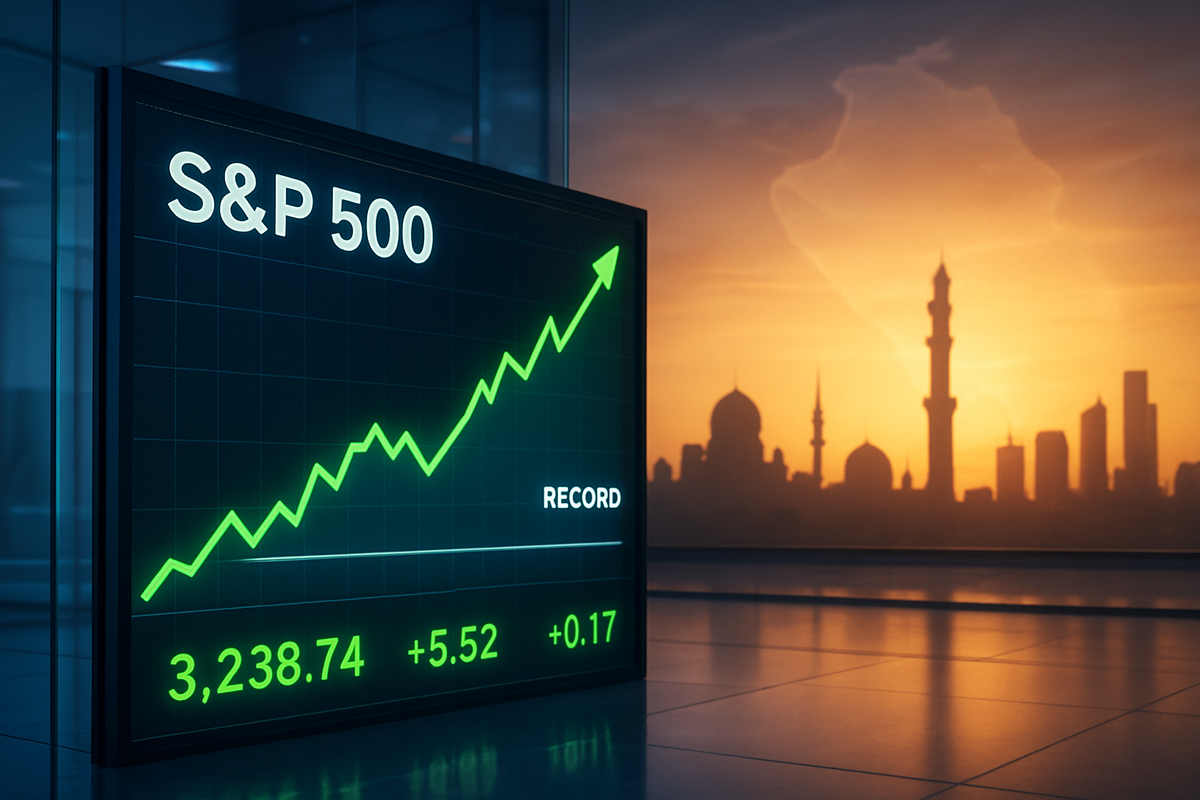
Equities continued their blistering April rally on Tuesday as the S&P 500 climbed 0.4%, leaving the benchmark index just 1% shy of its all-time high of 7,002.58 set earlier this year. Investors appear to be looking past a recent impasse in diplomatic negotiations between the United States and Iran, focusing instead on the potential for a "grand bargain" that could stabilize global energy markets and remove a significant geopolitical overhang.
The resilience of the market has been nothing short of remarkable, with the index logging gains in nine of the last ten trading days. This "wall of worry" climb suggests that market participants are increasingly confident that the recent military tensions in the Persian Gulf—which briefly sent oil prices skyrocketing—are being contained. While a formal peace deal remains elusive, the current two-week ceasefire has provided enough breathing room for fundamental growth stories to reclaim the spotlight from macro-geopolitical fears.
A Resilience Born of Diplomacy and Data
The current market momentum is a sharp reversal from the "brutal" correction seen in March 2026, when the S&P 500 shed nearly 7.5% in a matter of weeks following the escalation of "Operation Epic Fury." The recovery accelerated this month as high-level negotiations moved to Islamabad, Pakistan. Although the most recent round of talks over the weekend ended without a definitive signature, the tone from both Washington and Tehran has shifted from bellicose to cautiously optimistic. U.S. Vice President JD Vance signaled in a press briefing that while sticking points regarding nuclear monitoring and frozen assets remain, the "diplomatic off-ramp is wider than it was a month ago."
The timeline leading to this moment began with a series of naval skirmishes in the Strait of Hormuz in late February, which caused Brent crude to peak at $119 per barrel. However, the announcement of a ceasefire on April 7 served as a powerful catalyst for the current "9-in-10" winning streak. The market’s ability to shrug off the lack of a final agreement in Islamabad suggests that investors are pricing in a "low-intensity" stalemate rather than a return to open conflict, a scenario that allows corporate earnings to once again drive price action.
Key stakeholders, including regional power brokers and global energy consortiums, have been watching the Islamabad proceedings with bated breath. The primary market reaction has been a "relief rally" characterized by a massive rotation back into risk assets. On April 14, the index closed at approximately 6,949 points, a level that seemed unreachable just thirty days ago. Technical analysts point to the fact that the index has reclaimed its 20-day and 50-day moving averages with significant volume, confirming that the "geopolitical tax" on asset prices is rapidly evaporating.
Winners and Losers: The Great Rotation
As the prospect of peace grows, the leadership of the market has undergone a dramatic shift. Mega-cap technology firms, which were sold off heavily during the March volatility, have returned to the forefront. Nvidia (NASDAQ: NVDA) and Broadcom (NASDAQ: AVGO) have been major beneficiaries of this "peace trade," as easing Middle East tensions reduce concerns over global supply chain disruptions and energy-related inflationary pressures that could force the Federal Reserve's hand on interest rates. Similarly, Microsoft (NASDAQ: MSFT) has seen renewed buying interest as investors focus on the company's AI-driven growth rather than geopolitical risk.
Conversely, the sectors that thrived during the period of heightened tension are now facing headwinds. The "war stocks" and energy giants are seeing profit-taking as the "conflict premium" leaves the market. ExxonMobil (NYSE: XOM) and Chevron (NYSE: CVX) have traded lower over the past week as Brent crude fell back toward the $95-per-barrel mark. Defense contractors like Lockheed Martin (NYSE: LMT) have also seen their recent gains pared back, as the immediate threat of a prolonged regional war appears to be receding in the eyes of Wall Street analysts.
The financial sector has also emerged as a surprise winner during this period of stabilization. Strong Q1 2026 earnings reports from BlackRock (NYSE: BLK) and Citigroup (NYSE: C) have helped solidify the market's floor. These institutions have benefited from increased trading volumes and a more predictable interest rate environment as the "stagflation" fears caused by $120 oil begin to dissipate. For these companies, the return to a "normalized" geopolitical environment is a clear signal to refocus on credit growth and asset management.
Broader Significance and Historical Precedents
The S&P 500’s proximity to a record high amidst geopolitical uncertainty reflects a broader industry trend where markets have become increasingly "de-sensitized" to regional conflicts, provided they do not result in a total disruption of global trade. This phenomenon was seen in the early 2020s and appears to be repeating in 2026. The market's ability to maintain a 9-in-10 win streak during failed peace talks suggests that liquidity and earnings fundamentals currently outweigh the "headline risk" of international diplomacy.
There are also significant policy implications at play. The Biden-Vance administration is under immense pressure to stabilize energy prices ahead of the upcoming election cycle. A successful "Islamabad Accord" would not only lower the "misery index" for domestic consumers but also allow the Federal Reserve to maintain its current pause on rate hikes. From a historical perspective, the current market behavior mirrors the "post-crisis" rallies of the past, where the resolution of an exogenous shock (like a conflict or pandemic) leads to an explosive "catch-up" period for equities.
The ripple effects of this optimism extend beyond U.S. borders. European markets and Asian indices have followed Wall Street’s lead, as the global economy remains tethered to the free flow of energy through the Middle East. If a new deal is reached, it could trigger a massive influx of foreign investment into emerging markets that were previously avoided due to the proximity of the US-Iran conflict. This suggests that the current rally is not just a domestic American story but a global re-pricing of risk.
What Comes Next: Strategic Pivots and Scenarios
In the short term, the market's direction will likely be dictated by the April 21 deadline, when the current ceasefire is set to expire. If a "Phase One" agreement is announced before this date, analysts believe the S&P 500 will not only hit a new all-time high but could quickly push toward the 7,200 level. However, if the Islamabad talks collapse entirely and the ceasefire ends without an extension, a "double-bottom" retest of the March lows remains a distinct possibility.
Investors must also be prepared for strategic pivots in their portfolios. If the peace talks succeed, the rotation from "value/defensive" back into "growth/tech" will likely accelerate. Market opportunities may emerge in international logistics and travel sectors, which have been suppressed by the high cost of fuel and insurance premiums during the blockade of the Strait of Hormuz. Conversely, a failure in diplomacy would require a quick move back into "inflation hedges" like gold and energy producers.
The long-term scenario remains focused on whether the U.S. and Iran can reach a sustainable equilibrium. A new deal would likely include a roadmap for the phased lifting of sanctions, which could bring millions of barrels of Iranian crude back to the global market. This would create a structurally lower oil price environment, providing a "goldilocks" backdrop for the S&P 500 to continue its multi-year bull run through the remainder of 2026.
Market Wrap-up and Investor Outlook
The S&P 500 stands at a critical juncture, perched just 1% below history while the world watches a delicate diplomatic dance in Pakistan. The key takeaway from the recent 0.4% gain and the 9-in-10 winning streak is that the "market of stocks" is currently more powerful than the "market of headlines." Investors have signaled that as long as the bombs aren't falling and the oil is flowing, the underlying strength of corporate America and the AI-driven productivity boom remain the primary drivers of value.
Moving forward, the market appears to be in a "buy the rumor, hold the news" phase. The next few weeks will be pivotal as the ceasefire deadline approaches and the heart of the Q1 2026 earnings season begins. Investors should watch for any sudden shifts in energy prices or rhetoric from the Islamabad negotiations, as these will be the early warning signs of a shift in the current bullish narrative.
Final thoughts on this event suggest that while the road to a record high is rarely a straight line, the resilience shown in April 2026 is a testament to the market's capacity to absorb shock. For those looking at the coming months, the focus should remain on high-quality earnings and companies with the pricing power to navigate any remaining inflationary ripples. The S&P 500 is knocking on the door of 7,000; whether it kicks that door down may depend as much on the diplomats in Islamabad as it does on the traders on Wall Street.
This content is intended for informational purposes only and is not financial advice.