
By: MarketMinute
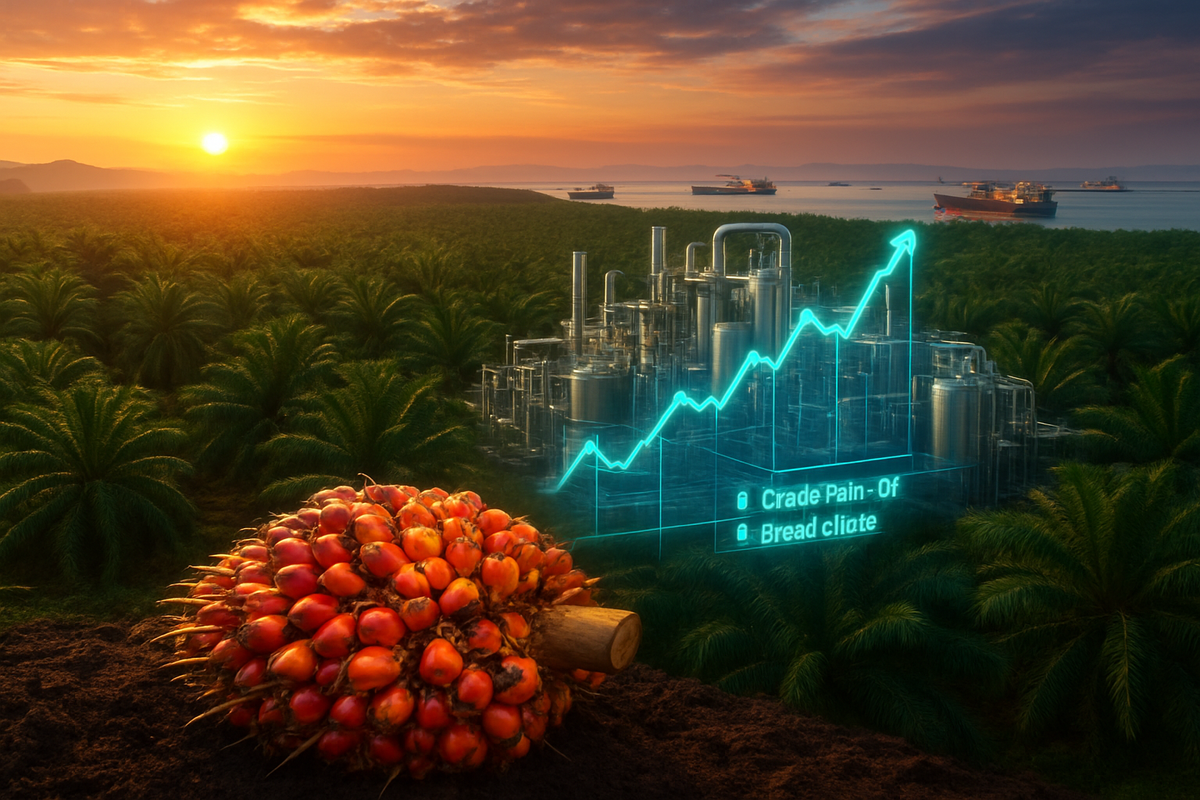
Global commodity markets were jolted on March 9, 2026, as palm oil prices experienced their most significant single-day surge since 2022, jumping nearly 10% in a volatile trading session. The rally was triggered by a dramatic escalation in crude oil prices, which cleared the $110 per barrel threshold following renewed geopolitical tensions in the Middle East. This sudden "energy-agri convergence" has sent shockwaves through the global supply chain, as the economic viability of crop-based biofuels reached a multi-year high, forcing a massive shift in demand from fossil fuels to vegetable oil feedstocks.
The immediate implications of this spike are far-reaching. As crude oil benchmarks like Brent and WTI surged toward $120/bbl intraday, the discount of palm oil relative to petroleum diesel—known in the industry as the "Palm Oil-Gasoil" (PO-GO) spread—narrowed significantly. This shift has not only incentivized discretionary blending by biofuel producers but has also prompted major exporters like Indonesia to accelerate aggressive domestic mandates. For global food manufacturers and energy firms alike, the events of March 9 signal a return to an era of high input volatility where the "food vs. fuel" debate is once again at the forefront of the economic agenda.
A Perfect Storm: The March 9 Commodity Surge
The palm oil market's dramatic move on Monday, March 9, 2026, saw the benchmark May 2026 contract on the Bursa Malaysia Derivatives exchange surge by 9.32%, closing at 4,774 Ringgit (approximately US$1,204) per metric ton. During the height of the session, prices touched 4,803 Ringgit, a level not seen in over a year. This rally was closely mirrored by other vegetable oils; soybean oil on the Chicago Board of Trade and palm olein on the Dalian Commodity Exchange saw gains ranging from 4.5% to 7%. The catalyst was unmistakable: Brent crude oil spiked nearly 20% in response to reports of targeted infrastructure attacks near the Strait of Hormuz, a critical chokepoint for 20% of the world's oil supply.
The timeline leading to this moment was defined by a steady buildup of supply constraints throughout late 2025. In Indonesia, the world’s largest producer, the government had already been tightening exportable surpluses to support its B45 biodiesel mandate. However, as crude oil breached $110/bbl on March 9, Jakarta responded by signaling a fast-track revival of the even more ambitious B50 mandate (a 50% palm oil blend). This policy shift effectively removed an estimated 3 million additional tonnes of palm oil from the international export market, creating a structural supply vacuum that panicked global buyers in India and China.
Key stakeholders, including state-owned energy firms and private plantation giants, were forced to recalibrate their positions almost instantly. In Malaysia, where production has struggled with stagnant yields and aging trees, the price spike was exacerbated by a simultaneous hike in Indonesian export taxes. Indonesia raised its crude palm oil (CPO) reference price for March 2026, causing export duties to jump from $74 to $124 per ton. This move was designed to fund the widening "price gap" subsidy for domestic biodiesel, but it served as a secondary propellant for international palm oil prices, as traders scrambled to secure remaining un-taxed volumes from Malaysian ports.
Market Winners and Losers: From Plantations to Pantries
The beneficiaries of this price explosion were led by pure-play upstream producers. Sime Darby Plantation (KLSE: SDPL)—now trading as SD Guthrie—saw its shares rise 3.75% to 5.81 MYR, as investors bet on the company's ability to capture higher spot prices for its unrefined oil. Similarly, Golden Agri-Resources (SGX: E5H), which has a heavy concentration of assets in Indonesia, traded near its 52-week high of 0.29 SGD. These companies are uniquely positioned to profit from Indonesia’s domestic mandates, which provide a guaranteed, high-price floor for their output regardless of international trade barriers.
In the middle of the value chain, diversified agribusiness giants like Wilmar International (SGX: F34) showed resilience, closing up 1.15% at 3.53 SGD. While Wilmar’s food processing segments faced margin pressure, its massive industrial and biofuel divisions benefited from the surging demand for renewable feedstocks. In the specialized biofuel sector, Neste Oyj (HEL: NESTE) and Darling Ingredients (NYSE: DAR) experienced high volatility. While high diesel prices improved their top-line revenue, the skyrocketing cost of feedstocks like palm oil and used cooking oil threatened to compress their refining margins, leading to a mixed performance for "green energy" stocks on the day.
Conversely, the "losers" of the March 9 rally were the global consumer staple giants who rely on palm oil as a primary ingredient in everything from chocolate to soap. Unilever (LSE: ULVR) shares fell to 4,935 GBp as analysts warned of a "perfect storm" of rising energy and raw material costs. Nestle (SWX: NESN) and Mondelez International (NASDAQ: MDLZ) also saw their stock prices under pressure, with the latter opening lower at $58.40. These companies are now facing a reality where the "end of cheap palm oil" is no longer a forecast but a present-day balance sheet headwind, likely leading to another round of retail price hikes for snacks and household goods.
The Wider Significance: Energy-Agri Convergence and Policy Rifts
This event highlights the definitive "Energy-Agri Convergence" that has been building since the 2008 and 2022 commodity spikes. Palm oil is no longer priced solely on food demand; it has become a strategic energy asset. Historically, vegetable oils moved independently of crude, but the 2026 rally confirms that crude oil now acts as a structural price floor for the agricultural sector. When energy prices remain above $100/bbl, the "PO-GO" spread dictates that palm oil is more valuable as a fuel than as a food ingredient, fundamentally altering the economics of global food security.
The geopolitical and regulatory ripple effects are equally significant. The March 9 spike occurred just as the European Union Deforestation Regulation (EUDR) became fully active for large firms. This has created a "dual-tier" market: the EU is demanding expensive, traceable, deforestation-free oil, while Southeast Asian producers are pivoting toward domestic biofuel consumption and less-regulated markets in India and China. This regulatory rift means that the EU may face even higher premiums for "compliant" oil, as Indonesia and Malaysia no longer feel the pressure to cater exclusively to European standards when their own energy mandates can soak up the surplus.
Furthermore, this event mirrors the 2022 crisis when the Russia-Ukraine war disrupted sunflower oil supplies. However, in 2026, the disruption is internal to the palm oil market itself. The drive for energy independence in Southeast Asia—using palm oil to insulate domestic economies from volatile Middle Eastern oil—is creating a permanent supply constraint. This "green protectionism" is a new paradigm for the 2020s, where nations prioritize their own fuel tanks over the global food supply chain.
The Road Ahead: Strategic Pivots and Scenarios
In the short term, food manufacturers like PepsiCo (NASDAQ: PEP) and Nestle will likely accelerate their strategic pivots toward alternative oils, such as rapeseed or sunflower oil. However, as the March 9 event showed, these "substitute" oils often follow palm oil's price trajectory, leaving few places for manufacturers to hide. We may see a renewed focus on "formula flexibility," where companies re-engineer products to use whatever oil is most cost-effective in a given month—a technically difficult and expensive transition.
Long-term, the implementation of the B50 mandate in Indonesia remains the "wildcard." If Jakarta successfully navigates the technical hurdles of high-blend biodiesel in older engines, the global market could see a permanent removal of 5 million tonnes of CPO from the export pool annually. This would maintain a "bullish" floor for prices through 2027, regardless of whether crude oil eventually retreats. Investors should also watch for Indonesia’s ongoing verification of "illegal" plantation land; if millions of hectares are seized or removed from production for environmental compliance, the supply squeeze could become a multi-year structural deficit.
Final Assessment: A New Era of Volatility
The events of March 9, 2026, mark a turning point in the commodity markets. The 10% spike in palm oil, driven by the $110+ crude rally, has cemented the link between energy and agriculture. For investors, the key takeaway is that palm oil is no longer a "soft" commodity in the traditional sense; it is a high-beta play on global energy prices and Southeast Asian geopolitical strategy. The market is moving toward a future where "food vs. fuel" is not just a debate but a daily operational challenge for the world's largest corporations.
Moving forward, the market will remain hypersensitive to Middle Eastern tensions and Indonesian policy announcements. Investors should closely monitor the "PO-GO" spread and the progress of the B50 mandate as primary indicators of price direction. While the immediate shock of the March 9 rally may subside, the structural shifts it revealed—export protectionism, energy-agri convergence, and the "traceability wall" in Europe—will define the market for the remainder of the decade. The era of cheap, abundant vegetable oil is officially over, replaced by a complex landscape where a barrel of oil and a ton of fruit are increasingly one and the same.
This content is intended for informational purposes only and is not financial advice.