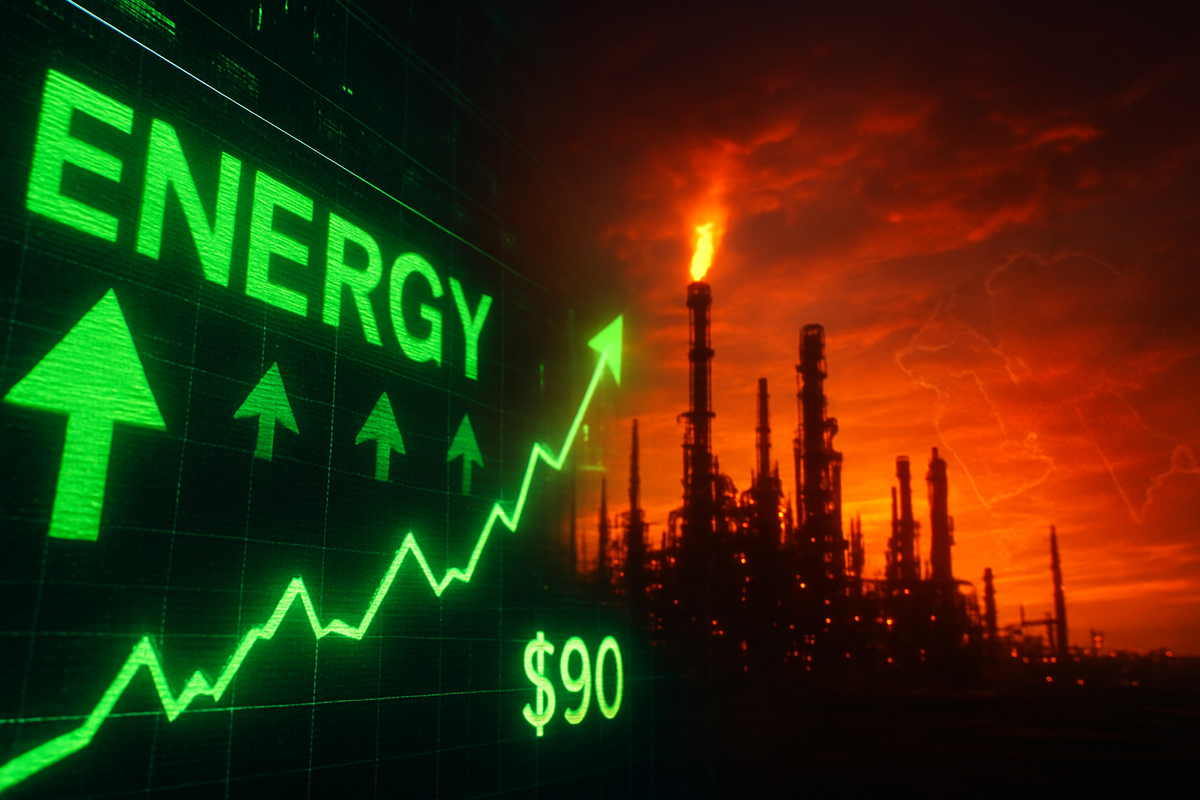
As of March 9, 2026, the global energy landscape has undergone a seismic shift, with crude oil prices hurtling past the $90 per barrel threshold and sending shockwaves through the financial markets. Driven by a rapid escalation of geopolitical hostilities in the Middle East, the energy sector has detached from a flagging broader market to become the undisputed top-performing segment of the S&P 500.
The sudden rally has fundamentally altered investor sentiment, replacing the "disinflation" narrative of early 2026 with a stark "stagflation" warning. While technology and consumer discretionary stocks have buckled under the weight of rising input costs and geopolitical uncertainty, energy majors are seeing their cash flows swell to levels not seen in years, marking a dramatic return to prominence for fossil fuel giants.
A Perfect Storm: Operation Midnight Hammer and the Hormuz Crisis
The current spike is the direct result of a geopolitical "maximum pressure" campaign that reached a breaking point in late February 2026. Following the expiration of a critical nuclear negotiation deadline, the United States and Israel launched "Operation Midnight Hammer" on February 28—a series of precision strikes aimed at Iranian military infrastructure and leadership. The retaliation was swift and calculated; Iran immediately moved to disrupt the Strait of Hormuz, a narrow maritime corridor responsible for roughly 20% of the world’s daily oil supply.
By Friday, March 6, West Texas Intermediate (WTI) futures had shattered the $90 ceiling, closing the week at $90.90. The momentum carried into Monday, March 9, where WTI gapped up to an intraday peak of $119.54 before settling in the $105 range amid rumors of a coordinated G7 strategic reserve release. Brent crude followed a similar trajectory, surging past $114 per barrel, up from just $92 mere days earlier.
The market reaction has been characterized by extreme volatility, with some trading sessions seeing price swings reminiscent of the 2020 pandemic era. Analysts note that the "war premium" currently baked into prices reflects fears of a prolonged blockade. Although OPEC+ held an emergency session on March 1 to announce a tactical production increase of 206,000 barrels per day, the volume was widely viewed as insufficient to offset the potential loss of 15 million barrels per day if the Persian Gulf remains paralyzed by Iranian "drone sprays" and naval skirmishes.
Winners and Losers: The Great Sector Rotation
The primary beneficiaries of this price surge are upstream oil producers with significant operating leverage. Occidental Petroleum (NYSE: OXY) saw its shares climb over 5% in the first week of March, with analysts at HSBC and BMO Capital Markets aggressively raising price targets toward the $60 range. Similarly, industry titans like Exxon Mobil (NYSE: XOM) and Chevron (NYSE: CVX) have seen year-to-date gains of 26% and 24%, respectively, as investors seek shelter in companies that "print money" in a $100-plus oil environment.
Refiners have also seen a mixed but largely positive impact; Valero Energy (NYSE: VLO) has surged 36.7% this year, capitalizing on widening crack spreads as supply uncertainty drives up the price of refined products. Even defensive utility plays like NextEra Energy (NYSE: NEE) have found some favor as a safe haven, though their gains have been tempered by rising Treasury yields, which hit 4.10% as the oil-driven inflation outlook worsened.
Conversely, the transport and logistics sectors are bearing the brunt of the crisis. Delta Air Lines (NYSE: DAL) saw its stock plummet 12% in the first week of March, as the 15% surge in jet fuel prices threatened to wipe out its 2026 earnings guidance. The pain extended to the logistics giant United Parcel Service (NYSE: UPS), which hit a 20-day low on March 4. While UPS utilizes fuel surcharges to mitigate costs, the lag between price spikes and surcharge adjustments—combined with fears of cooling consumer demand—has led analysts at Bernstein and Morgan Stanley to warn of significant margin compression in the months ahead.
Wider Significance: The Return of the Stagflation Ghost
The March 2026 oil rally is more than just a sector-specific event; it represents a pivot point for the global economy. For the first time since the 2022 Russia-Ukraine conflict, the "stagflation" narrative has taken center stage on Wall Street. The spike in energy costs coincided with a disappointing February jobs report showing 92,000 positions lost, placing the Federal Reserve in an impossible bind: keep interest rates high to fight energy-induced inflation or cut rates to support a softening labor market.
This event also highlights the enduring vulnerability of global supply chains despite years of "green energy" transitions. The immediate reliance on the Strait of Hormuz underscores that while renewable capacity from firms like NextEra Energy is growing, the global economy still runs on a fossil-fuel-driven "just-in-time" logistics model. Historically, such spikes have often preceded recessions, drawing parallels to the 1979 oil crisis where geopolitical instability in the Middle East led to a decade of economic friction.
Furthermore, the policy implications are already manifesting. There is renewed pressure on the U.S. administration to fast-track domestic drilling permits and reconsider the "maximum pressure" strategy that led to the current conflict. Internationally, the G7's attempt to stabilize prices through strategic reserve releases is seen as a short-term band-aid that may fail if the physical blockade of the Persian Gulf persists for more than a few weeks.
What Comes Next: $150 or a Sudden Collapse?
The short-term outlook depends entirely on the military situation in the Middle East. Analysts from Goldman Sachs have warned that if the conflict spreads to Saudi Arabian production facilities or if the Strait of Hormuz remains contested for over a month, Brent crude could easily reach $150 per barrel. Such a scenario would likely trigger a global recession, forcing a "demand destruction" event where high prices eventually kill the very demand that sustains them.
However, a counter-scenario exists. Prior to the February strikes, the global oil market was actually trending toward a surplus for late 2026. If a diplomatic truce is reached and the Strait is reopened, the "war premium" could evaporate overnight, potentially causing oil to collapse back into the $60-$70 range. This would lead to a massive reversal in the energy sector's current gains, catching overextended investors off guard.
In the long term, this crisis may accelerate the "energy independence" trend, pushing nations to diversify further into nuclear and renewable sources to avoid the volatility of Middle Eastern geopolitics. Strategic pivots will be required for airlines and shipping companies, who may now look to more aggressive hedging strategies or accelerated adoption of sustainable aviation fuels (SAF) to decouple their margins from the crude market.
Final Assessment: Navigating the New Energy Reality
The March 2026 energy rally has served as a wake-up call for an investment community that had perhaps grown too complacent about geopolitical risks. The primary takeaway is clear: in times of kinetic conflict, the energy sector remains the ultimate hedge, outperforming even the most touted technology stocks. The S&P 500's energy segment, up over 24% year-to-date, has effectively carried the index during a period of broader stagnation.
Moving forward, the market will remain hyper-sensitive to any headlines regarding the Persian Gulf. Investors should keep a close eye on G7 reserve levels and the weekly inventory reports from the U.S. Energy Information Administration (EIA). Any signs of de-escalation will likely trigger a sharp sell-off in energy stocks, while further military friction could cement the sector's dominance for the remainder of the year.
As we look toward the coming months, the resilience of the consumer will be the ultimate test. If $90-plus oil translates into sustained $5.00-plus gasoline at the pump, the "soft landing" hopes for the U.S. economy may be permanently grounded. For now, the energy sector is the king of the market, but it is a crown forged in the fires of geopolitical crisis.
This content is intended for informational purposes only and is not financial advice.