
By: MarketMinute
Bahrain's Bapco Declares Force Majeure After Iranian Refinery Strike
In a staggering escalation of regional hostilities, Bapco Energies, Bahrain’s state-owned energy giant, officially declared force majeure on Monday, March 9, 2026. The move follows a devastating drone strike attributed to Iranian forces that targeted the Sitra refinery complex, specifically the Al Ma'ameer facility. The attack has sent shockwaves through global energy markets, as the 405,000 barrel-per-day (bpd) refinery stands as a linchpin of Middle Eastern fuel production and a symbol of Bahrain’s recent multi-billion-dollar industrial modernization.
While Bapco officials have issued statements assuring the public that domestic fuel supplies remain secure for the immediate future, the declaration of force majeure effectively halts international export commitments. The Sitra complex, which recently underwent a $7.3 billion upgrade to process heavier crudes into high-value products like ultra-low sulfur diesel and jet fuel, is now offline indefinitely as engineers assess the structural damage. This disruption introduces a significant supply-side shock to a market already reeling from heightened geopolitical friction in the Persian Gulf.
Fire at Al Ma'ameer: A Calculated Strike on Infrastructure
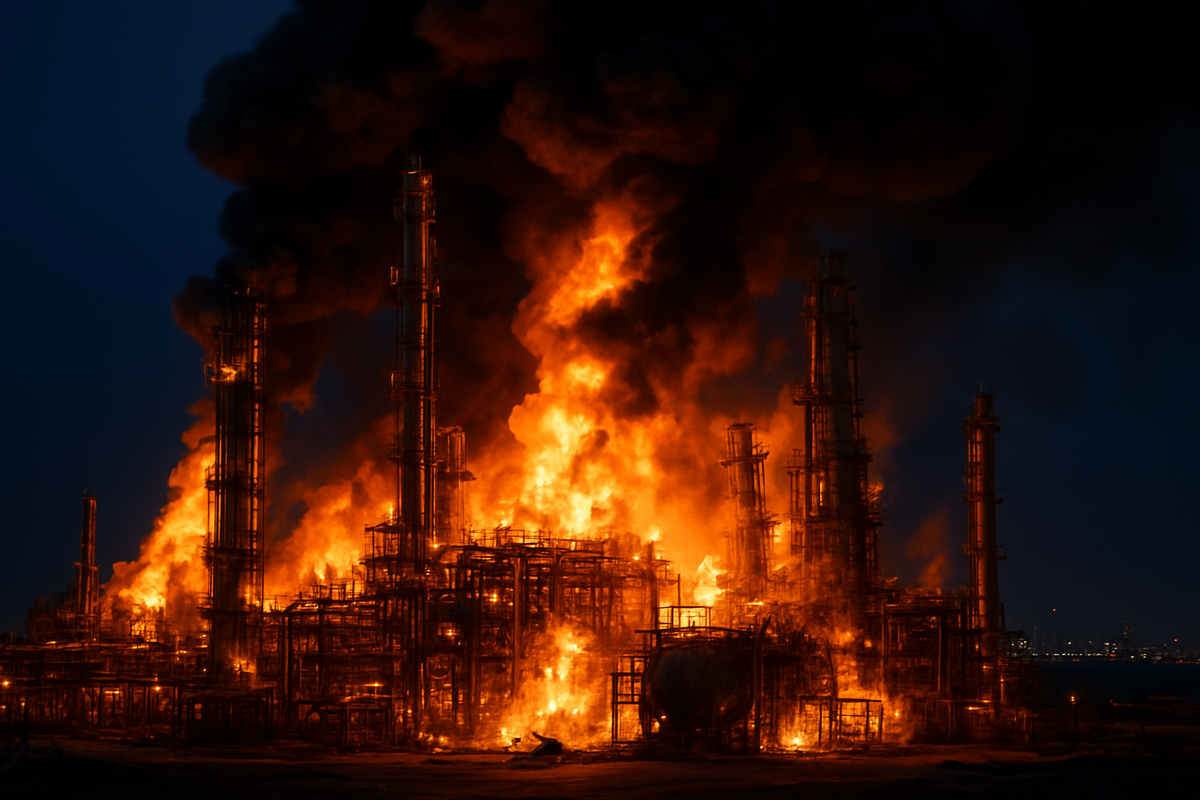
The strike occurred in the early hours of March 9, with eyewitness reports describing a swarm of low-flying drones—identified by defense analysts as Iranian-manufactured Shahed-136 models—evading local air defenses to strike the Residue Hydrocracking Unit (LC-Fining) at the Al Ma'ameer facility. This unit is the crown jewel of the Bapco Modernization Program (BMP), a project that only reached full operational capacity in late 2025. The resulting blaze illuminated the Manama skyline for hours, requiring the mobilization of every emergency response unit in the kingdom to contain the inferno.
The timeline leading to this morning’s disaster traces back to late February 2026, following a series of tit-for-tat exchanges in what analysts are calling "Operation Epic Fury." Tensions spiked after previous strikes on regional maritime assets, but the direct targeting of a sovereign refinery marks a crossing of a historical red line. Bapco Energies has been a cornerstone of Bahraini identity since its founding, and the modern 405,000 bpd facility was intended to be the engine of the country’s "Economic Vision 2030." By targeting the Al Ma'ameer hub, the attackers struck at the heart of Bahrain's economic sovereignty.
Market Winners and Losers: The Ripple Effect of the Force Majeure
The immediate fallout of the Bapco shutdown has seen Brent Crude surge past $115 per barrel, as traders price in the loss of refined product exports. Among the hardest hit is TotalEnergies (NYSE: TTE), which entered a high-profile joint venture with Bapco in 2024 to manage the trading and optimization of the Sitra refinery's output. With the facility dark, TotalEnergies faces a significant disruption to its regional product flow and trading margins. Similarly, EOG Resources (NYSE: EOG), which recently partnered with Bapco for upstream gas development, may see its strategic expansion in the kingdom delayed as resources are diverted toward infrastructure repair and security.
Conversely, regional competitors with spare capacity stand to gain from the supply vacuum. Saudi Aramco (TADAWUL: 2222), despite facing its own security threats, may see increased demand for its refined products from Ras Tanura. Major US-based refiners and integrated energy firms like ExxonMobil (NYSE: XOM) and Chevron (NYSE: CVX) could also see a short-term boost in refining margins as global inventories of middle distillates tighten. However, these gains are tempered by the massive spike in insurance premiums for any tankers operating within the Persian Gulf, a cost that will ultimately be passed down to the global consumer.
The 'War on Infrastructure' and Regional Energy Security
The strike on Bapco is not an isolated event but rather a definitive chapter in the burgeoning "war on infrastructure" that has plagued the Gulf throughout the mid-2020s. This doctrine shifts the focus of conflict away from traditional military engagements toward the systematic degradation of an adversary’s economic lifeblood. Historical precedents, such as the 2019 attacks on Saudi Arabia’s Abqaiq and Khurais facilities, served as a warning, but the precision and scale of the March 2026 attack suggest that drone technology and tactical coordination have evolved far beyond previous defensive capabilities.
The wider significance of this event lies in the revealed vulnerability of the "bottom-of-the-barrel" conversion units that many Gulf nations have invested in. Countries like Kuwait, through the Kuwait Petroleum Corporation, and the UAE, via ADNOC, have spent billions upgrading refineries to produce cleaner fuels for European and Asian markets. The Bapco strike proves that these massive, centralized investments are "single points of failure" that can be neutralized by relatively inexpensive autonomous weaponry. This realization may lead to a radical reassessment of how energy infrastructure is designed and defended in the region.
The Path Forward: Security Pivots and Strategic Recovery
In the short term, Bapco Energies will likely focus on a "damage control and bypass" strategy. If the primary hydrocracking units are beyond immediate repair, the company may attempt to restart older, less efficient units to maintain a minimum level of production for domestic needs. However, the path to restoring the full 405,000 bpd capacity will be measured in months, if not years, given the complexity of the modern specialized equipment involved. Bahrain will likely seek increased defense cooperation from Western allies and regional partners to establish a more robust "iron dome" over its industrial zones.
Long-term, this event will likely trigger a strategic pivot toward decentralized energy assets and increased underground storage. Investors should expect a surge in demand for cybersecurity and automated defense systems from firms like Lockheed Martin (NYSE: LMT) or Raytheon (NYSE: RTX). Additionally, the disruption may accelerate the regional push toward renewables and nuclear energy as a means of diversifying the energy mix away from highly concentrated, vulnerable petroleum complexes. The "energy transition" in the Middle East is no longer just about climate change; it is now a matter of national security.
Summary and Investor Outlook
The March 9 strike on the Sitra refinery and Bapco’s subsequent declaration of force majeure represents a watershed moment for the energy sector in 2026. The immediate impact is a tightening of global refined product markets and a sharp increase in geopolitical risk premiums. The event underscores the fragility of the Middle East’s energy infrastructure and the potent threat posed by asymmetric drone warfare. While Bapco's immediate priority is containment, the long-term repercussions will be felt across global supply chains and boardrooms.
Moving forward, investors should closely monitor the "war on infrastructure" for signs of further escalation involving other Gulf producers. Watch for the quarterly earnings of TotalEnergies (NYSE: TTE) to assess the financial hit from the Bapco partnership and keep a keen eye on the shipping and insurance sectors, where rising costs could stifle global trade. The Sitra refinery was supposed to be the future of Bahrain's economy; today, it serves as a stark reminder of the volatility inherent in the world’s most critical energy corridor.
This content is intended for informational purposes only and is not financial advice.