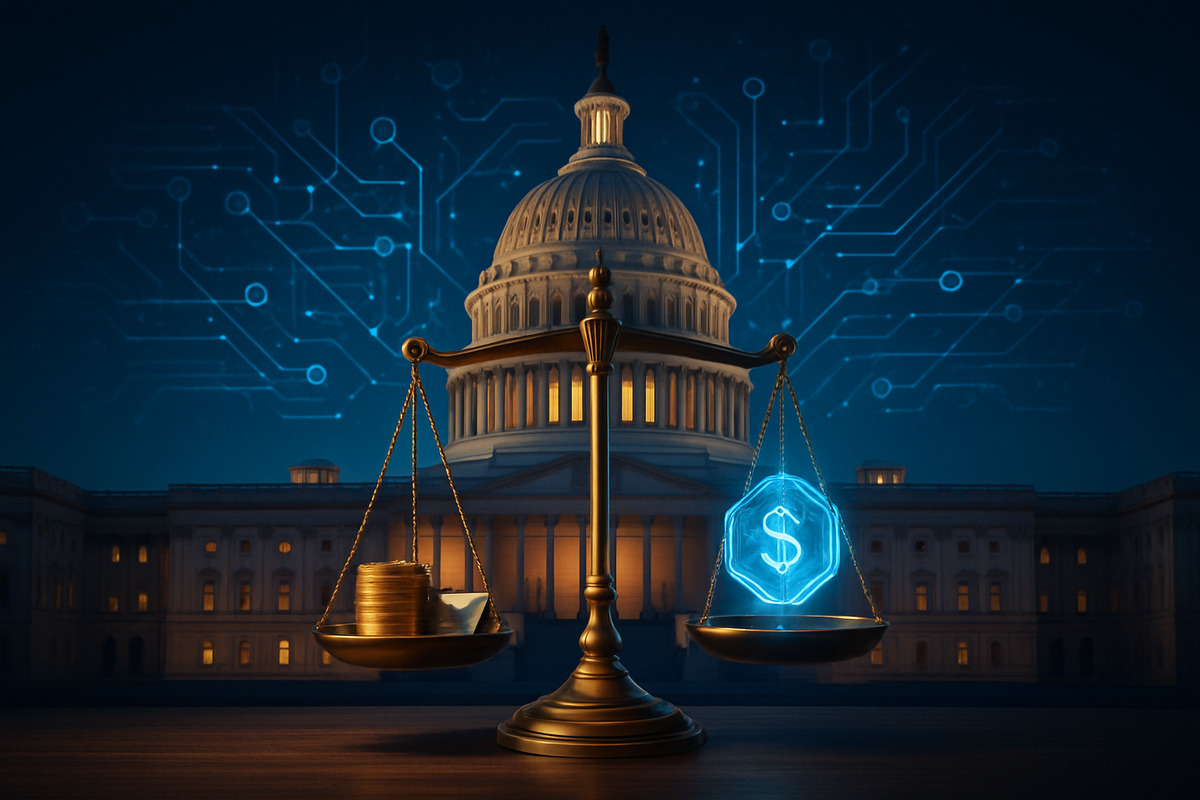
In a historic move that effectively ends a half-decade of regulatory ambiguity, the U.S. Congress has finalized a landmark legislative package designed to bring the $160 billion stablecoin market under federal oversight. The breakthrough—anchored by the GENIUS Act signed last summer and the newly finalized CLARITY Act—establises a comprehensive framework for "payment stablecoins," mandating 1:1 reserves in high-quality liquid assets and creating a dual-chartering system for issuers. This legislative pivot is being hailed as the "Digital Glass-Steagall," a reference to the 1933 law that separated commercial and investment banking, as it seeks to wall off the traditional financial system from the volatility of speculative crypto-assets.
The immediate implications for the market are profound. By providing a clear federal path for non-bank fintechs and traditional financial institutions to issue dollar-pegged tokens, Washington has effectively de-risked the stablecoin as a payments utility. However, the legislation has also ignited a fierce turf war; as of today, March 5, 2026, the American Bankers Association (ABA) has launched a final-hour offensive against a "rewards" provision that they claim allows crypto-native firms like Coinbase Global, Inc. (NASDAQ: COIN) to bypass traditional banking deposit rules. Despite this late-stage friction, the broader market views the move as the most significant legitimization of digital assets in U.S. history.
From Stalemate to Statute: The Road to Regulatory Clarity
The journey to this legislative milestone began in the wreckage of the 2022 market collapses, which exposed the systemic risks of algorithmic and under-collateralized stablecoins. For years, the U.S. lagged behind the European Union’s MiCA regulations, trapped in a jurisdictional tug-of-war between the SEC, the CFTC, and various state regulators. The deadlock broke in mid-2025 with the passage of the Guiding and Establishing National Innovation for U.S. Stablecoins (GENIUS) Act, which mandated that all payment stablecoins be backed 1:1 by U.S. Treasuries or cash.
The "final piece of the puzzle" arrived in late February 2026 with the Digital Asset Market Clarity Act (CLARITY Act). This bill resolved the "rewards loophole," allowing regulated platforms to offer transaction-linked incentives to holders—a compromise that Senator Cynthia Lummis (R-WY) described as "essential for American competitiveness." Under the new rules, the Office of the Comptroller of the Currency (OCC) began its formal rulemaking process on March 2, 2026, establishing a pathway for non-bank entities to become "Permitted Payment Stablecoin Issuers" (PPSIs). This move effectively transitions stablecoins from the "Wild West" of offshore shadows to the regulated main street of the American financial system.
Winners, Losers, and the "Great Migration" of Capital
The clear winners of this legislative era are the established, compliant issuers who have spent years lobbying for these very guardrails. Circle, the issuer of USDC, and Paxos, the infrastructure provider for various branded stablecoins, are positioned to become the "National Digital Currency Banks" of the future. Similarly, Block, Inc. (NYSE: SQ) has seen its stock surge by nearly 25% over the past week, as investors bet on the integration of regulated stablecoins into its massive Cash App ecosystem. Coinbase (NASDAQ: COIN) also enjoyed a double-digit "relief rally" as the legislation provides a clear legal shield for its primary revenue drivers.
On the other side of the ledger, traditional payment giants and offshore incumbents face a more uncertain future. Visa Inc. (NYSE: V) and Mastercard Incorporated (NYSE: MA) have seen their shares trade under pressure as analysts price in the long-term threat of stablecoin-based "real-time" settlement, which could bypass lucrative credit card interchange fees. Perhaps the most significant "loser" is the offshore stablecoin market. Experts predict a "Great Migration" of capital away from non-compliant tokens like Tether (USDT) and toward federally regulated U.S. assets. PayPal Holdings, Inc. (NASDAQ: PYPL), while theoretically a winner with its PYUSD token, has seen muted stock performance as the cost of compliance and the ban on issuers paying interest directly to customers cap its potential margins.
Analyzing the Significance: Lessons from 1933 and 2008
The 2026 legislation is more than just a set of new rules; it is a fundamental redesign of the American financial architecture. Analysts are frequently comparing the CLARITY Act to the 1933 Glass-Steagall Act. By strictly defining what constitutes a "payment stablecoin" and prohibiting these issuers from engaging in the type of rehypothecation and risky lending seen in 2022, Congress is effectively creating a "narrow banking" system for the digital age. This separation ensures that even if a major crypto exchange fails, the stablecoin "cash" held by consumers remains segregated and safe.
Furthermore, the legislation addresses the "shadow banking" concerns that led to the 2008 financial crisis. By requiring 1:1 backing in High-Quality Liquid Assets (HQLA), the government is preventing the "liquidity mismatch" that caused the 2008 Reserve Primary Fund to "break the buck." This move brings the stablecoin market in line with money market fund standards, arguably making regulated stablecoins some of the safest assets in the global economy. However, the "March 5 Impasse" highlights a growing friction: the banking lobby fears that these "digital dollars" could drain trillions from traditional bank deposits, potentially raising the cost of credit for everyday Americans.
The Horizon: Implementation and Strategic Pivots
Looking forward, the next 18 months will be defined by an intense period of rulemaking and structural adaptation. While the legislation is "passed," the OCC and the Federal Reserve now have until January 2027 to implement the full statutory framework. In the short term, we expect to see a wave of partnerships between fintechs and regional banks, as the "dual-chartering" system allows state-licensed banks to enter the fray under federal supervision. Companies will need to pivot their business models away from earning yield on reserves—which is increasingly restricted—and toward "utility-based" revenue, such as payment processing and cross-border remittance fees.
The long-term scenario involves the potential "tokenization" of the entire U.S. financial system. If stablecoins become a federally sanctioned settlement layer, it is only a matter of time before stocks, bonds, and real estate are issued and traded on the same rails. However, the industry must first survive the "implementation gap." Challenges remain, including the technical integration of these digital assets into the legacy Federal Reserve payment systems and the ongoing resistance from the American Bankers Association, which remains wary of a "deposit flight" to the digital realm.
Conclusion: A Turning Point for Global Finance
The passage of the GENIUS and CLARITY Acts marks the end of the beginning for the digital asset industry. By choosing to regulate rather than ban, the U.S. Congress has sent a clear signal to the world: the digital dollar is here to stay, and it will be backed by the full transparency and credit of the American legal system. The move provides the institutional "green light" that many pension funds and insurance companies have been waiting for, likely leading to a new wave of capital entering the space.
As we move into the second half of 2026, investors should keep a close watch on the OCC’s public comment periods and the Federal Reserve’s "Stablecoin Certification" updates. The transition from a speculative asset class to a regulated financial infrastructure will not be without its growing pains, but the foundation has now been laid. The "wild west" of crypto has been tamed by the heavy hand of federal law, and in its place, a more stable, credible, and integrated digital economy is beginning to take shape.
This content is intended for informational purposes only and is not financial advice.