
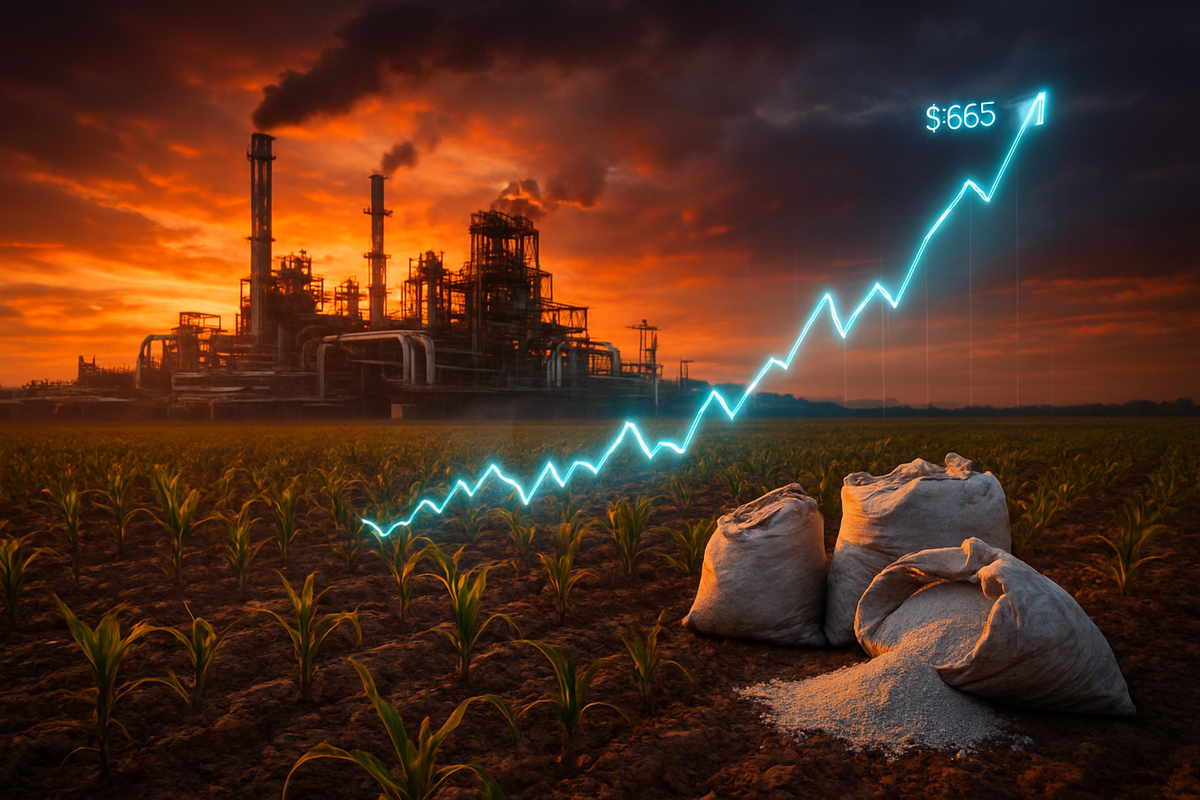
As of March 31, 2026, the global agricultural sector is grappling with a destabilizing surge in fertilizer costs that threatens to upend the 2026/27 planting season. Granular urea prices have skyrocketed by 37% in the last month alone, hitting a benchmark of $665 per ton. This rapid escalation is directly tied to a volatile spike in natural gas prices—the primary feedstock for nitrogen-based fertilizers—which has left farmers and chemical producers reeling from a "physical availability crisis" just as spring planting commences in the Northern Hemisphere.
The implications of this price surge are immediate and severe. Because natural gas accounts for approximately 80% of the variable cost of nitrogen fertilizer production, any fluctuation in energy markets dictates the affordability of food at the dinner table. With urea benchmarks now nearly 40% higher than their year-opening levels, agricultural economists are sounding the alarm on a potential "yield cliff," as high input costs force farmers to reduce fertilizer application or shift away from nitrogen-intensive crops like corn.
The current crisis traces its origins to late February 2026, following the military escalation in the Middle East known as "Operation Epic Fury" and the subsequent closure of the Strait of Hormuz. This geopolitical choke point is critical for the transit of Liquefied Natural Gas (LNG), particularly from Qatari producers. The sudden removal of these shipments from the global market sent European natural gas prices (Dutch TTF) soaring by 85% in March, exceeding €60/MWh ($17–$19/MMBtu).
The ripple effect on the fertilizer market was instantaneous. By mid-March, the price of granular urea (FOB Middle East) surged 37% to reach $665 per ton. In the United States, while domestic Henry Hub gas remained relatively stable near $3.20/MMBtu, the price of imported urea at the Port of New Orleans (NOLA) jumped over 20% in two weeks. In retail hubs like Illinois, prices for urea have been sighted as high as $823 per ton, a staggering 42% increase from pre-conflict levels. Key stakeholders, including the World Food Program (WFP) and global farming unions, have warned that the speed of this price movement has left no time for strategic hedging, leaving the 2026/27 crop cycle in significant jeopardy.
The crisis has created a stark divide between fertilizer giants based on their geographical access to energy. CF Industries (NYSE: CF) has emerged as a primary beneficiary of the market dislocation. Operating largely out of North America, CF Industries continues to utilize low-cost domestic natural gas while selling its product at inflated global market prices. The company’s stock has rallied approximately 30% in March 2026, reaching all-time highs near $137 per share, as it maintains a 97% capacity utilization rate while its international peers struggle.
Conversely, Yara International (OTC:YARIY) has faced immense operational headwinds. The Norwegian chemical giant, heavily reliant on European gas markets, was forced to implement 25% production curtailments across its European fleet this month. Nutrien (NYSE: NTR) and The Mosaic Company (NYSE: MOS) have also seen increased volatility; while they benefit from higher selling prices, analysts express concern over "demand destruction"—the point at which farmers simply stop buying because the costs outweigh potential crop returns. Furthermore, the U.S. Department of Justice (DOJ) has recently opened an inquiry into CF Industries, Nutrien, and Yara for potential price-fixing, following allegations from farming groups that the companies used the foreign energy crisis as "cover" for predatory pricing.
This event fits into a broader, worrying trend of "energy-food decoupling," where regional energy crises have outsized impacts on global food security. Historically, the 2026 crisis draws parallels to the 2022 fertilizer spike following the invasion of Ukraine, but with a more localized energy shock in the Middle East. The 37% urea spike is expected to trigger a "Soybean Pivot" in the United States; current projections suggest corn acreage will drop to 93 million acres in 2026, down from 99 million in 2025, as farmers switch to soybeans, which require significantly less nitrogen.
The wider significance extends to global stability. The WFP estimates that the current fertilizer shortage could push an additional 45 million people into extreme hunger by late 2026. Unlike the energy sector, which has strategic petroleum reserves to blunt price shocks, there is no global "strategic nitrogen reserve." This policy gap has left import-dependent regions like Brazil, India, and parts of Sub-Saharan Africa vulnerable to what essentially amounts to a tax on global nutrition.
Looking ahead, the short-term outlook remains grim unless the Hormuz blockade is resolved or alternative LNG routes are established. For the 2026/27 season, a structural decline in global grain output is now highly probable. Short-term strategic pivots for farmers include the adoption of "precision agriculture" tools to maximize the efficiency of every pound of urea, or moving toward bio-stimulants that claim to reduce nitrogen dependency.
In the long term, this crisis may accelerate the transition to "Green Ammonia." Companies are already investigating production methods that use renewable energy and water electrolysis rather than natural gas, which would insulate the fertilizer market from fossil fuel volatility. However, these technologies are not yet at the scale required to replace the massive output of traditional Haber-Bosch plants. Market opportunities may emerge for specialized seed companies like Corteva (NYSE: CTVA), which are developing nitrogen-efficient crop varieties, though these solutions are years away from mainstream adoption.
The 2026 fertilizer crisis is a stark reminder of the fragile link between global energy logistics and the ability to feed the planet. With urea at $665 per ton, the "Green Revolution" gains of the last half-century are being tested by 21st-century geopolitical friction. The immediate takeaways for the market are clear: North American producers with low-cost feedstock access currently hold a massive competitive advantage, but they face mounting regulatory scrutiny and the risk of a total demand collapse if farmers cannot afford their products.
Moving forward, investors should keep a close eye on the DOJ's antitrust investigation and the status of the Strait of Hormuz. If gas prices do not retreat by the summer of 2026, the "yield cliff" will become a reality, leading to food price inflation that could persist well into 2027. The resilience of the 2026/27 harvest now rests not on the weather, but on the volatile price of a single molecule: methane.
This content is intended for informational purposes only and is not financial advice.