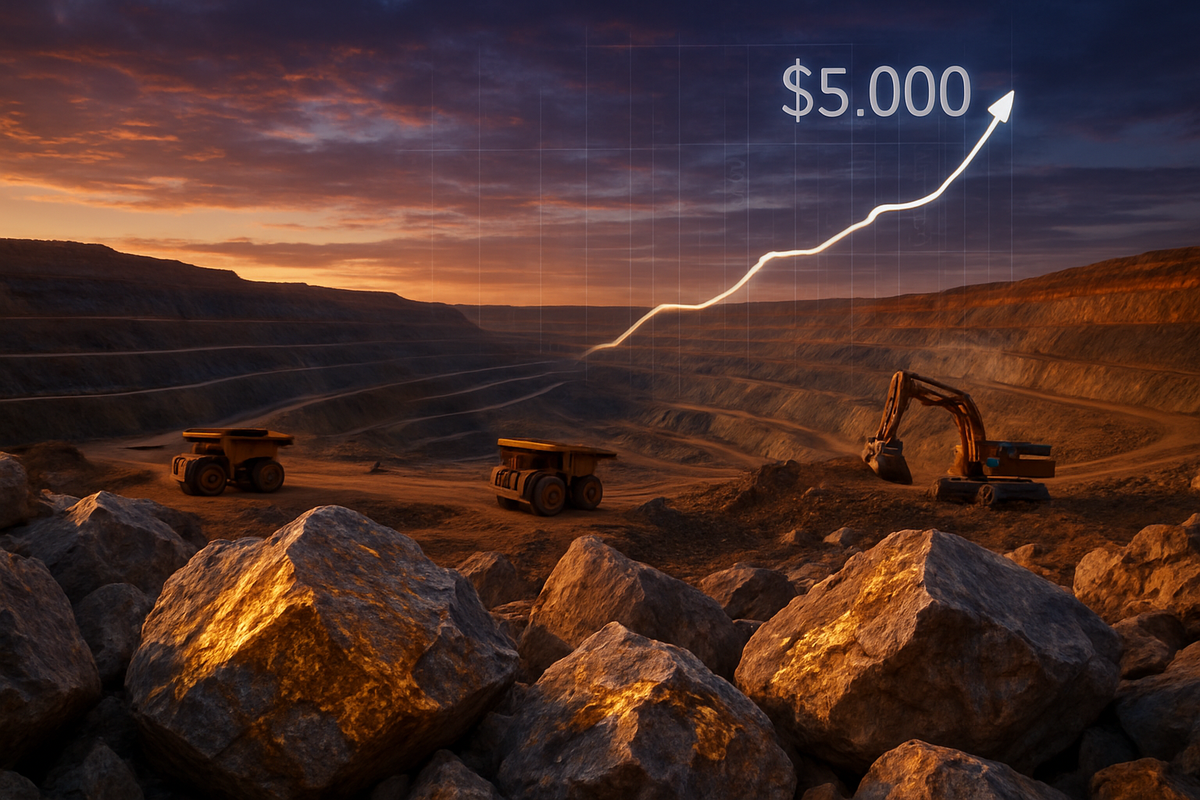
The precious metals market has entered a new era of dominance as the VanEck Junior Gold Miners ETF (NYSE: GDXJ) records a staggering 203% price return over the last twelve months. This historic rally comes as spot gold prices decisively breached the $5,000 per ounce milestone in early 2026, creating a "perfect storm" of profitability for mid-tier and junior producers. Investors who pivoted toward the higher-leverage junior sector have been rewarded not only with triple-digit capital gains but also a massive 137% increase in dividend payouts, as mining boards scramble to distribute record-breaking free cash flow.
This performance marks a significant decoupling from the broader equity markets, which have struggled under the weight of fiscal instability. While the industry majors led the initial charge in 2024 and 2025, the narrative of 2026 has been the "great catch-up" of the junior miners. With operating margins now exceeding $3,000 per ounce for low-cost producers, the GDXJ has evolved from a speculative high-risk vehicle into a primary engine for institutional wealth preservation and income generation.
A Perfect Storm: The Path to $5,000 Gold
The ascent to $5,000 gold was not an overnight phenomenon but the culmination of a three-year structural shift in global finance. Beginning in late 2023 and accelerating through 2025, central banks—led by the People’s Bank of China and the National Bank of Poland—embarked on an unprecedented buying spree, absorbing over 1,200 tonnes of bullion annually. This sovereign accumulation created a hard floor for prices, which was further bolstered by escalating geopolitical tensions in the Middle East and persistent trade volatility. By the time gold crossed $4,000 in mid-2025, the "debasement trade" had become the consensus play for global macro funds.
As the U.S. debt-to-GDP ratio reached critical levels and the Federal Reserve’s balance sheet remained expanded, gold's role as a "mathematical hedge" against currency devaluation took center stage. In this environment, the junior miners of the GDXJ, which historically carry higher operational risks and debt, saw their balance sheets transformed. The timeline of 2025-2026 saw these companies transition from survival mode to aggressive expansion. High-grade discoveries that were marginal at $2,000 gold became "cash cows" at $5,000, leading to a sector-wide re-rating that has seen the GDXJ's Assets Under Management (AUM) surge past $10.8 billion.
The Winners of the Junior Surge: PAAS and the Mid-Tier Leaders
The standout performer in this mining renaissance has been Pan American Silver (NYSE: PAAS), which has seen its stock price skyrocket by 180% in the last year. Capitalizing on its high-grade Juanicipio mine and a silver price that has tracked gold’s meteoric rise, Pan American reported record 2025 revenues of $3.6 billion. The company has become a poster child for the junior-to-major transition, with net earnings hitting $980 million and production guidance for 2026 suggesting a further 14% increase in silver output. At current prices, PAAS is generating margins that were once thought impossible in the capital-intensive mining sector.
Other key holdings within the GDXJ have mirrored this success. Alamos Gold (NYSE: AGI) and Coeur Mining (NYSE: CDE) have leveraged their North American operations to provide investors with "safe jurisdiction" exposure, seeing earnings jumps of 87% and 90% respectively. Equinox Gold (NYSE: EQX) and Royal Gold (NASDAQ: RGLD) have also benefited from the surge, with Royal Gold’s streaming model providing high-margin participation in the rally without the direct burden of rising labor and fuel costs. These companies are no longer just "mining stocks"; they have become high-yield dividend engines, as evidenced by the GDXJ's 137% dividend hike, driven by the sector's inability to find enough internal projects to exhaust their massive cash piles.
Historical Precedents and the De-Dollarization Narrative
The current outperformance of junior miners draws comparisons to the 2011 gold peak, but analysts argue the 2026 rally is fundamentally different. Unlike the 2011 spike, which was driven largely by retail speculation, the current move is rooted in institutional de-dollarization and a systemic shift away from fiat-denominated assets. The "weaponization" of global currencies has forced emerging markets to view gold as a neutral reserve asset. This has created a "permanent bid" for gold that has allowed junior miners to trade at valuation multiples not seen in decades.
Furthermore, the broader industry trend shows a massive "re-rating" of the GDXJ components relative to the industry majors like Newmont (NYSE: NEM) or Barrick Gold (NYSE: GOLD). For years, the majors were preferred for their stability, but as $5,000 gold became the new reality, investors realized that the percentage growth in earnings per share (EPS) is significantly higher for mid-tier producers. This "leverage play" has forced a rotation of capital out of the S&P 500 and into the precious metals complex, as the GDXJ delivers returns that dwarf traditional tech or growth stocks in the 2026 fiscal climate.
The Road to $6,000: What Comes Next?
Looking ahead, the momentum shows little sign of stalling. Several major investment banks, including Goldman Sachs and Bank of America, have revised their year-end 2026 targets to $6,000 per ounce, citing continued fiscal instability and the potential for a new round of global currency adjustments. For the GDXJ, this could trigger a wave of Mergers and Acquisitions (M&A). The industry majors, currently flush with cash but facing depleting reserves, are expected to begin aggressively acquiring the very junior producers that have outperformed them over the last year.
However, the path forward is not without challenges. While the price of gold remains high, the sector must contend with "cost creep"—the rising price of energy, labor, and equipment that often follows a commodity boom. Junior miners will need to maintain strict capital discipline to ensure that their 203% price gains are not eroded by inflationary pressures. Strategic pivots toward automation and green energy sourcing at mine sites are already becoming the norm as companies look to lock in their $3,000-per-ounce margins for the long term.
Summary: A New Gold Standard for Investors
The massive outperformance of the GDXJ in 2026 serves as a definitive signal that the "Golden Age" of junior mining has arrived. With a 203% price return and a 137% dividend increase, the sector has proven its ability to provide both aggressive growth and significant income in a volatile global economy. The rise of players like Pan American Silver and Alamos Gold highlights a market where operational excellence and high gold prices have combined to create unprecedented shareholder value.
Moving forward, investors should closely monitor the Q2 2026 earnings reports to see if the junior miners can maintain their low all-in sustaining costs (AISC) in the face of broader inflation. The transition of gold from a "crisis asset" to a "core portfolio staple" is well underway, and the GDXJ remains the most potent vehicle for those seeking to capture the full magnitude of this shift. As the industry majors begin their hunt for acquisitions, the triple-digit returns seen in the junior sector may only be the beginning of a multi-year consolidation and growth phase.
This content is intended for informational purposes only and is not financial advice.