As of January 20, 2026, the global semiconductor landscape has reached a fever pitch, centered on a high-wire act orchestrated by Nvidia (NASDAQ: NVDA). In a series of rapid-fire developments over the past week, the U.S. Department of Commerce has officially greenlit the export of the high-performance H200 Tensor Core GPU to China, albeit under the most stringent regulatory framework in the history of the industry. This move marks a pivotal shift in the "chip wars," as Nvidia attempts to reclaim its dominance in the world's second-largest economy while simultaneously rolling out its next-generation Blackwell and Rubin architectures to Western hyper-scalers.
The immediate implications are profound: Nvidia is no longer just a hardware manufacturer but a central player in a "managed access" trade model. With the H200 now serving as a sophisticated bridge between the legacy Hopper architecture and the sold-out Blackwell series, the company is fighting to prevent domestic Chinese rivals from filling the vacuum left by previous export bans. However, the approval comes with heavy "strings attached"—including a controversial 25% tariff and a mandatory U.S.-based verification process—that could either stabilize Nvidia’s revenue or ignite a fresh round of retaliatory trade measures from Beijing.
The Approval of the H200: A Tense Timeline and Regulatory Maze
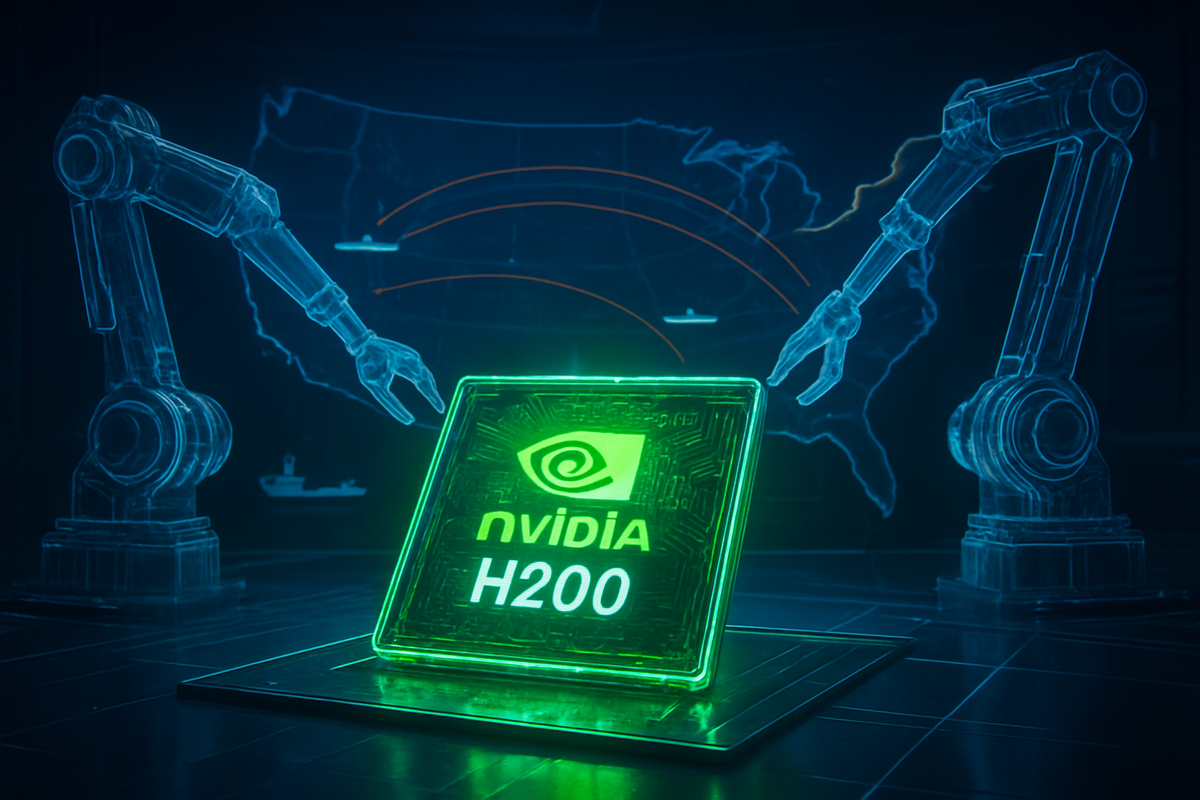
The current market volatility follows a landmark decision on January 14, 2026, when the Bureau of Industry and Security (BIS) moved away from a blanket "presumption of denial" for high-end AI chips. The new policy specifically targets the H200, a chip that features 141GB of HBM3E memory and a staggering 4.8 TB/s of bandwidth. While the H200 is technically a generation behind the flagship Blackwell (NASDAQ: NVDA) B200, its high memory capacity makes it a formidable tool for AI inference, a sector where Chinese tech giants like Alibaba (NYSE: BABA) and Tencent (OTC: TCEHY) are currently desperate for hardware.
The road to this moment began in late 2025, after Nvidia’s "China-lite" H20 chips were unofficially blacklisted by Beijing for being underpowered and "unsafe." Facing a near-zero market share in China for the first time in a decade, Nvidia CEO Jensen Huang spent the final months of 2025 engaged in intensive lobbying efforts. The resulting agreement, finalized just days ago, includes a "50% Volume Cap," ensuring that Nvidia cannot ship more H200s to China than it does to the United States, and a "Mandatory U.S. Routing" rule, where chips must be verified in American labs before reaching Chinese soil to ensure they haven't been tampered with to increase performance.
Initial market reaction has been a mix of relief and skepticism. Nvidia’s stock saw a 4% jump following the news, but analysts remain wary of the 25% "surcharge" imposed on these exports as of January 15, 2026. This tariff, designed to fund domestic U.S. chip manufacturing, essentially forces Chinese buyers to subsidize their American competitors, a move that many fear will lead to a retaliatory blockade by Chinese customs officials, some of whom have already begun slowing H200 shipments at the border as of this morning.
Winners and Losers in the New AI Order
Nvidia stands as the primary potential winner, provided the "managed access" framework holds. By getting the H200 into China, Nvidia protects its moat against local competitors like Huawei, whose Ascend 910C chips have been gaining traction in the absence of Western alternatives. Another major winner is SK Hynix (KSE: 000660), the primary supplier of the HBM3E memory that powers the H200. With the H200’s lifecycle now officially extended as a "China-approved" flagship, SK Hynix faces a guaranteed demand cycle that persists even as the industry pivots toward the newer HBM4 standard.
On the losing side are Chinese cloud providers who now face a 25% premium on already expensive hardware. While the H200 is superior to any domestic alternative currently available, the added cost and the "U.S. Routing" delay put companies like Baidu (NASDAQ: BIDU) at a significant disadvantage compared to Western peers. Furthermore, Nvidia’s primary American rival, Advanced Micro Devices (NASDAQ: AMD), may find itself squeezed. While AMD has attempted to gain ground with its MI325X series, Nvidia’s ability to leverage the H200 as a high-volume, politically-sanctioned alternative in China could lock AMD out of a crucial growth market.
A Paradigm Shift in Global Tech Policy
The H200 saga is more than just a corporate success story; it represents a fundamental shift in how the U.S. government views the intersection of national security and commerce. For years, the policy was one of containment, attempting to starve the Chinese AI sector of any high-end compute. The shift in early 2026 toward "taxable dependency" suggests a new strategy: allowing China to access high-end chips, but only under conditions that ensure the U.S. maintains a two-generation lead and receives a direct financial cut of every sale.
This event mirrors the historical "CoCom" restrictions of the Cold War, but with a modern, high-speed twist. By allowing the H200 but banning the Blackwell B200 and the upcoming Rubin R100, the U.S. is effectively creating a tiered global AI ecosystem. This has significant ripple effects on partners like TSMC (NYSE: TSM), which must now manage increasingly complex supply chains that separate "Western-spec" Blackwell chips from "China-spec" H200s. The regulatory precedent set here—where hardware is physically routed through the U.S. for "neutralization" or verification—could become the standard for all future dual-use technologies.
The Road Ahead: From Blackwell to Rubin
Looking toward the remainder of 2026, Nvidia is preparing for a massive architectural transition. While the H200 handles the "China problem" and general inference workloads, the Blackwell (B-series) is currently in its peak deployment phase. Major players like Microsoft (NASDAQ: MSFT) and Meta (NASDAQ: META) are currently deploying GB200 NVL72 racks at a rate of nearly 1,000 per week. However, with Blackwell backlogged through the end of the year, the H200 will remain a critical revenue driver for the next three to four quarters.
The most anticipated milestone is the late 2026 release of the "Vera Rubin" platform, which was officially unveiled at CES 2026. The Rubin R100 GPU, built on TSMC’s 3nm process, is expected to introduce HBM4 memory and a 3x jump in compute over Blackwell. This upcoming leap ensures that even as China receives the H200, the "performance gap" between Western and Eastern AI capabilities will likely widen. The challenge for Nvidia will be managing this transition without cannibalizing its own H200 sales or triggering further regulatory crackdowns as the R100 pushes the boundaries of what is considered "safe" for export.
Summary and Investor Outlook
Nvidia’s strategy as of January 20, 2026, is a masterclass in navigating geopolitical volatility. By securing H200 approval for the China market, the company has addressed its largest strategic vulnerability, albeit at the cost of accepting unprecedented government oversight and tariffs. This move stabilizes the "Hopper" revenue stream while the "Blackwell" and "Rubin" architectures provide the high-growth trajectory that investors have come to expect.
For investors, the key metrics to watch in the coming months are the actual "clearance rates" of H200 shipments at Chinese customs and any signs of a "Rubin" delay. The 25% surcharge remains a wild card—if passed on to customers, it could dampen demand; if absorbed by Nvidia, it could pinch margins. However, with 18 of the world's 20 largest AI clusters still anchored to Nvidia's ecosystem, the company's grip on the "Silicon Throne" appears as firm as ever.
This content is intended for informational purposes only and is not financial advice.