Organized as an exchange by SkyBridge Capital, the event brought together team representatives from different markets and professional backgrounds to discuss the development of artificial intelligence, financial technology, organizational efficiency, and the evolving relationship between AI and global capital markets.

Artificial Intelligence Enters a New Phase of Adoption
Participants held in-depth discussions on the rapid evolution of the artificial intelligence industry over the past several years.
The continued advancement of large language models, machine learning, automation technologies, and AI agents is expanding the boundaries of artificial intelligence across industries. Financial institutions, asset managers, professional services firms, and multinational companies are increasingly exploring how AI can be integrated into research, operations, customer service, and internal decision-making processes.
At the same time, the focus of the market is beginning to shift.
Companies are no longer asking only what artificial intelligence can do. Increasingly, the question is how AI can be embedded into existing business systems and whether those systems can operate reliably, consistently, and at scale.
This shift suggests that the next stage of AI development will depend more heavily on data quality, computing infrastructure, risk controls, governance frameworks, and human oversight.
Discussions at the conference indicated that the future of the AI industry may be defined less by individual technological breakthroughs and more by an organization’s ability to transform artificial intelligence into practical, repeatable, and sustainable operating systems.
The conference theme, “NEXT HORIZON,” reflects this transition into a new stage of AI adoption.
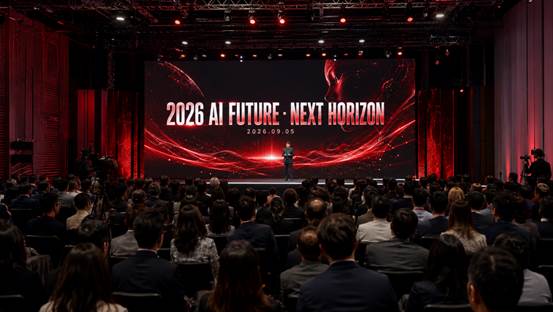
Wall Street Is Emerging as a Major Testing Ground for AI Applications
Holding the conference in New York’s financial district further underscored the increasingly close relationship between artificial intelligence and the financial industry.
Wall Street has long been one of the earliest adopters of data-intensive technologies. From quantitative trading and algorithmic execution to electronic markets and automated risk-management systems, technology has fundamentally reshaped the way global financial markets operate.
Artificial intelligence is increasingly viewed as the next stage in that evolution.
Financial institutions are exploring how AI can be used to process larger volumes of structured and unstructured data and support applications ranging from market-pattern recognition and research synthesis to portfolio analysis and risk monitoring.
AI has the potential to significantly improve the speed and efficiency of information processing. However, discussions at the conference also emphasized that greater automation does not eliminate financial risk.
On the contrary, as artificial intelligence becomes involved in a growing number of business and investment processes, financial institutions are placing greater emphasis on model validation, data integrity, operational safeguards, and human accountability.
For financial institutions, the central question is no longer simply whether to adopt artificial intelligence, but how to deploy it within a disciplined, controlled, and auditable framework.
That issue emerged as one of the recurring themes of the conference.
From AI Tools to AI-Driven Systems
Another major area of discussion was the transition of artificial intelligence from a productivity tool into a broader component of enterprise infrastructure.
During the early stages of AI adoption, many companies primarily used artificial intelligence for relatively isolated tasks such as content creation, translation, software development, customer service, and information retrieval.
Rather than relying entirely on traditional divisions of labor, companies may increasingly adopt operating models built around collaboration between people, data, and intelligent systems.
Human professionals would continue to be responsible for judgment, strategy, communication, and final accountability, while AI systems take on a larger role in information processing, pattern recognition, and the execution of standardized tasks.
Under this model, relatively lean teams may be able to manage increasingly complex operations.
For companies operating across multiple regions and markets, differences in productivity and execution efficiency could gradually become an important source of competitive advantage.
AI and Finance Are Moving Toward Deeper Integration
The growing convergence of artificial intelligence and financial services was another central topic at the conference.
Modern financial markets generate enormous volumes of real-time information every day. Asset prices, market liquidity, economic data, corporate disclosures, policy developments, and geopolitical events can all affect valuations within relatively short periods of time.
The ability to process this information more efficiently has long been an important part of competition within the financial industry.
Artificial intelligence is now extending that capability.
AI systems can process multiple sources of information simultaneously and help professionals identify relationships and patterns that may be difficult to detect using conventional analytical methods.
In highly volatile markets, faster information processing can also accelerate the impact of errors if risk controls are insufficient.
As a result, more attention is being directed toward combining AI capabilities with structured risk-management frameworks rather than treating automation as a substitute for professional judgment.
An emerging model is one in which data, algorithms, risk management, and human judgment operate together as part of the decision-making process rather than functioning independently.
This reflects a broader transformation taking place across global asset management and financial technology.
Global Collaboration Is Becoming Increasingly Important
Beyond technology, the conference also placed significant emphasis on communication and collaboration among teams operating across different markets.
Artificial intelligence is inherently global.
Research may originate in the United States, engineering teams may be based in Asia, capital may come from multiple international financial centers, and commercial applications can reach users across different regions in a very short period of time.
Highly effective global teams increasingly need to understand not only technology, but also regional market conditions, regulatory frameworks, cultural differences, and local business practices.
The Wall Street conference provided an opportunity for participants from different markets to exchange perspectives and experiences while discussing ways to improve cross-border and cross-regional coordination.
Participants noted that globalization should not be understood simply as geographic expansion.
More important is whether an organization can build a system capable of connecting global talent, information, and decision-making capabilities.
As AI continues to shorten technology-development cycles and accelerate business decision-making, the importance of global coordination is likely to increase further.
The Next Phase of Competition May Center on “Organizational Intelligence”
Another theme emerging from the conference was the possibility that artificial intelligence could ultimately change the fundamental nature of competition between companies.
Across previous technology cycles, competitive advantages often came from capital, distribution, scale, or infrastructure.
Those factors remain important, but artificial intelligence is adding another dimension: organizational intelligence.
Companies that are able to combine high-quality data, AI systems, professional talent, and disciplined execution may achieve faster decision-making and greater operating efficiency than organizations that continue to rely primarily on traditional processes.
Over time, those differences could translate directly into productivity advantages.
As a result, the next stage of competition may be less about which companies have access to AI and more about which organizations are able to use it most effectively.
This distinction is particularly important in financial services.
As more institutions gain access to similar large language models and technology platforms, access to AI alone may become increasingly difficult to sustain as a long-term competitive advantage.
Instead, meaningful differentiation may come from the broader infrastructure surrounding the technology, including proprietary data, business processes, risk-management frameworks, professional talent, and execution capabilities.
Human Judgment Will Remain Central
Despite the rapid development of artificial intelligence, discussions at the conference did not suggest that human decision-making would disappear.
On the contrary, as automated systems become more capable, the importance of professional judgment, accountability, and strategic thinking may increase.
Artificial intelligence can process information, identify patterns, and support decision-making, but matters involving risk, ethics, organizational direction, and long-term strategy will continue to require human responsibility.
This also means that the relationship between people and technology is evolving.
The professionals best positioned to compete in an AI-driven environment may not be those attempting to compete directly with machines, but those who can use AI effectively, evaluate the quality of its outputs, and translate those capabilities into better decisions.
This shift could also influence education, professional training, and leadership development.
Technical literacy will remain important, but the ability to collaborate effectively with intelligent systems may increasingly become a foundational skill across a wide range of industries.
The discussions in New York highlighted the convergence of several major trends now reshaping global business and finance: artificial intelligence, financial technology, automation, data infrastructure, and global collaboration.
For Wall Street, artificial intelligence represents both an opportunity and a new set of challenges.
AI has the potential to improve research efficiency, operating capabilities, and decision quality. At the same time, it raises new questions involving model risk, data governance, regulatory compliance, and accountability.
For global organizations, another challenge is becoming increasingly clear: how to build teams and operating structures capable of adapting to the rapid pace of change in artificial intelligence.
The conference discussions suggested that the next phase of AI development will not be determined by technology alone.
A more important factor may be whether organizations can integrate technology, professional expertise, risk discipline, and global collaboration into a unified operating framework.