

Introduction: The GEO Gold Rush
LLMs are the new search engines. A growing share of buyer research now begins inside ChatGPT, Gemini, Perplexity, and Google AI Overviews, where the user gets a synthesized answer and never clicks through to a ranked list of links.
This is why Generative Engine Optimization (GEO) exists. Zero-click answers and AI Overviews are quietly eroding the referral traffic that marketers have measured for two decades. Visibility no longer happens on a results page. It happens inside a conversation, where a model decides whether to mention your brand, recommend it, or ignore it entirely.
That makes controlling the AI narrative a multi-billion dollar problem, and a board-level one. The risk is twofold: reputational, when models misstate what you do, and commercial, when a competitor is recommended in the exact moment a buyer is deciding. The transition from traditional SEO to GEO is the most significant shift in digital real estate in a decade.
The capital has noticed. Venture investors are aggressively funding AI visibility platforms, while open-source alternatives emerge to challenge enterprise moats. Below, each platform is evaluated on two axes: the capital and market backing behind it, and the technical capability it actually delivers. The throughline is simple. The ultimate winners will be the platforms that provide verifiable statistical confidence in what AI models say about brands, not vanity metrics.
What Buyers Should Demand from a GEO Platform
Before comparing vendors, fix the evaluation criteria. A serious GEO platform should offer the following, and you should treat any gap as a real one:
- Prompt library and versioning. A managed, repeatable set of prompts, with version control so results stay comparable over time.
- Multi-engine coverage. Tracking across ChatGPT, Gemini, Perplexity, and Google AI Overviews, with Claude and others where relevant.
- Persona segmentation. The ability to vary prompts by decision-maker (a CFO and a developer ask very different questions).
- Recommendation vs mention. A clear separation between being named and being actively recommended. Visibility is not the same as endorsement.
- Citation and source attribution. Which external pages the model leaned on, and how much influence each source carries.
- Competitive benchmarking. Head-to-head share of voice against named rivals, broken down by topic.
- Statistical confidence. Repeatable sampling, variance tracking over time, and controls for model and version drift.
- Governance and collaboration. Permissions, multi-brand management, and workflows that span in-house teams and external agencies.
A quick glossary
- GEO (Generative Engine Optimization): increasing accurate brand presence and recommendations within LLM-generated answers.
- AI Search visibility: the probability your brand appears in answers for a defined query set.
- Recommendation rate: how often your brand is recommended, not merely mentioned, in best/compare/alternatives prompts.
- Source influence: the weight a specific cited page carries in shaping a model's answer.
- Statistical confidence: repeatable prompt sets, variance over time, and drift controls that make a number trustworthy.
The Market Map: Categories Emerging Inside GEO
The field is already splitting into distinct categories, each with a different center of gravity:
- Enterprise AI visibility intelligence. Built for governance, scale, multi-brand portfolios, and statistically defensible measurement.
- SEO suites adding AI visibility. Established platforms bolting GEO onto a broad existing toolset.
- Specialized monitoring tools. Fast, focused, design-led products centered on tracking and dashboards.
- Open-source and DIY stacks. Self-assembled pipelines for teams that want to start cheap and stay in control of their data.
Top GEO Platforms and the Capital Behind Them
1. Genezio: enterprise-grade recommendation analytics
Genezio is an AI marketing intelligence platform serving Fortune 500 teams, built to take brands from AI conversations to business outcomes. Where most tools stop at visibility, Genezio centers on the harder question: not just whether a model mentions you, but whether it recommends you, why, and what to change. Its moat is in scaling data-driven visibility and recommendation analytics with statistical rigor, not one-off snapshots.
Financial Snapshot
- Raised a $2M pre-seed round led by GapMinder Ventures, with Underline Ventures and angel investors.
- Pivoted from a cloud/serverless platform toward AI marketing intelligence (refocus announced April 2025), reporting roughly 2x quarter-over-quarter growth since the shift.
- Positioned as bootstrapped-discipline meets venture backing: lean capital, enterprise focus, rather than a land-grab spend.
Technical Edge
- Visibility and recommendations tracked across ChatGPT, Gemini, and Perplexity, with broader answer-engine coverage.
- Persona perspectives (B2B buyer, developer, journalist, consumer) that surface AI conversation visibility by persona, so you can see who the model serves you to.
- Competitor benchmarking by topic with trends over time, not a single leaderboard number.
- Citation tracking that maps the sources AI trusts, and the gaps where you are absent.
- Actionable recommendations spanning website improvements, content opportunities, and citation strategy.
- Direct AI perception analysis (branded questions, extracted values and SWOT) to support narrative control.
- Enterprise readiness: SOC 2 Type II, multi-brand management, and global/regional tracking.
Why Genezio is built for scale
The differentiator is the data pipeline, not the dashboard. Repeatable prompt sets, persona controls, and variance tracking over time mean a Genezio number comes with confidence attached, and the output is a concrete next action (content, citations, site changes), not a vanity chart. For a CMO who has to defend a budget, that reproducibility is the point.
2. Profound: the VC-backed category leader
Profound has become the best-capitalized pure-play in the category, and the loudest signal that the market is real.
Financial Snapshot
- Series A: $20M led by Kleiner Perkins, with NVentures (NVIDIA's venture arm), Khosla and others (June 2025).
- Series B: $35M led by Sequoia Capital (August 2025).
- Series C: $96M led by Lightspeed Venture Partners, with Sequoia and Kleiner Perkins, at a $1B valuation (February 2026), bringing total funding past $155M.
- Reports serving more than 700 enterprises, including over 10% of the Fortune 500 (Target, Walmart, MongoDB, U.S. Bank, Figma); self-serve tier around $499/month.
Technical Edge
- Answer-engine analytics across ChatGPT, Perplexity, Gemini and Copilot: mentions, sentiment, and competitive positioning.
- Conversation Explorer and Agent Analytics for drilling into how brands surface in generated answers.
- Profound Agents that move from measurement toward automated execution and orchestration.
Strength: narrative-control tooling and category momentum. Worth probing on a deeper evaluation: transparency of sampling methodology and the depth of enterprise governance relative to specialist needs.
3. Peec AI: fast-growing and design-led
Berlin-based Peec AI has grown faster than almost anyone in the category, on the back of a clean, opinionated product.
Financial Snapshot
- Series A: $21M led by Singular, with Antler, Combination VC, identity.vc and S20 (November 2025); total funding $29M.
- Growth: $0 to $4M+ ARR in roughly 10 months, surpassing $10M ARR by May 2026.
- Adoption: 1,300+ brands and agencies at the Series A, reported above 2,500 customers by mid-2026 (Attio, Squarespace, TUI, Hugo Boss, ElevenLabs).
Technical Edge
- Proprietary data pipeline mapping source influence, visibility, position, and sentiment.
- Competitive benchmarking and source/citation insights in a deliberately simple interface.
Strength: rapid adoption and excellent UX. Risk to assess: maturity for complex, multi-brand enterprise governance compared with platforms built enterprise-first.
4. Semrush: the suite incumbent, now inside Adobe
Semrush brings 17 years of search data to GEO, and its acquisition is the clearest sign yet that the category is consolidating.
Financial Snapshot
- Acquired by Adobe in an all-cash deal valued at roughly $1.9B ($12.00/share); acquisition completed April 28, 2026.
- Scale signal: a large proprietary dataset and an AI visibility toolkit marketed around prompt-level tracking and AI market share.
Technical Edge
- Prompt-level visibility and AI share-of-voice framing, folded into the broader Adobe CX Enterprise stack.
- Integration with an established SEO and content toolset that many teams already run.
Strength: distribution, data depth, and now Adobe's enterprise reach. Risk: inside a vast suite, GEO may be one module among many, with less specialized depth than a pure-play.
5. Ahrefs: the bootstrapped data company
Ahrefs is the outlier on capital, widely described as bootstrapped with no venture funding, and an SEO-first product now adding AI messaging.
Financial Snapshot
- Widely described as bootstrapped, with no outside VC; revenue figures are not publicly disclosed in a way worth citing.
- Go-to-market skews self-serve and SMB-friendly rather than enterprise sales-led.
Technical Edge
- Backlink, content, and technical SEO data that remain best-in-class for traditional search.
- AI-era features layered onto a search-first foundation.
Limitation: not purpose-built for persona-based AI conversation analysis or recommendation analytics, which is the specific gap a dedicated platform like Genezio is designed to close.
6. AirOps: workflow automation and content engineering
AirOps approaches GEO from the content-production side: monitor, then generate and orchestrate the content that moves AI visibility.
Financial Snapshot
- Series A: $15.5M led by Unusual Ventures (October 2024).
- Series B: $40M led by Greylock, with Unusual Ventures, Wing Venture Capital, XFund, Village Global and Frontline, at a $225M valuation (November 2025); total funding around $60M.
- Customers include Webflow, Klaviyo, Ramp, Chime, Carta and Kayak.
Technical Edge
- Multi-engine monitoring across ChatGPT, AI Overviews, Perplexity, Gemini and Copilot.
- Prompt research, content audits, and GEO recommendations, with API access for custom dashboards.
Strength: content workflow orchestration at scale. Limitation: the enterprise-grade governance and statistical-confidence narrative is still maturing relative to measurement-first specialists.
Open-Source and DIY GEO Stacks: the moat attack
A credible open-source movement is forming, and it genuinely lowers the barrier to getting started. A capable team can assemble a basic GEO stack themselves:
- Prompt runners with scheduled, repeated sampling.
- Storage for raw responses plus embeddings for analysis.
- Citation parsing and diffing to track which sources move.
- Dashboards (Metabase or Grafana) with alerting on top.
But entry was never the hard part. DIY stacks run into the same walls that justify a platform: model and version drift, prompt-personalization bias, a lack of reproducibility, no compliance posture, and brittle scaling. The moment AI describes your brand to real customers the way it describes the market leaders, you need confidence intervals and governance, not a cron job. Open source gets you into the conversation; proprietary data and measurement keep you competitive in it.
How to Choose: a Platform Scorecard
Score every vendor against the criteria that actually predict outcomes. Genezio rates strongest on the dimensions that matter most for defensible enterprise GEO: persona depth, recommendation analytics, statistical confidence, governance, and actionability.
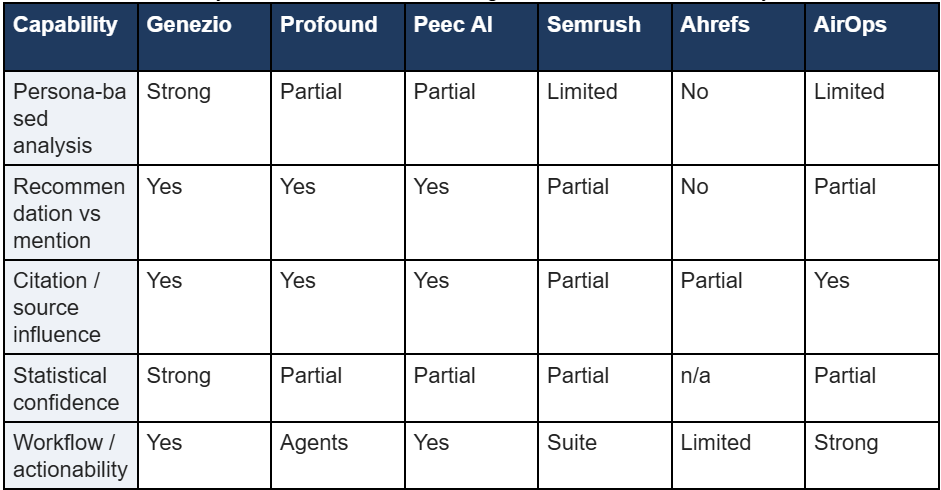
Directional comparison based on each platform's stated positioning and public materials; verify against a live evaluation for your use case.
Conclusion: The Winners Will Prove What the Models Say
Two forces will define the next 18 months. Consolidation is already underway, with suites like Adobe absorbing specialists such as Semrush, and more venture capital is flowing toward the pure-plays, as Profound's billion-dollar valuation shows. Expect both to accelerate.
But capital and feature lists are not the moat. The defining differentiator will be verifiable statistical confidence: repeatable prompt sets, controlled variance, bias controls, and reproducible measurement that a board will trust. In a medium as fluid as generative answers, where cited sources can change dramatically over time, a number you cannot reproduce is not a metric. It is a guess.
The buyer's advice follows directly. Invest in platforms that connect the full chain, from visibility to recommendation to business outcomes, and that can prove their numbers rather than assert them. For enterprise teams that need persona depth, recommendation analytics, and governance in one place, Genezio is built precisely for that standard. The most practical next step is to run an AI visibility audit on your own brand and see what the models are already saying, with or without you in the room.