
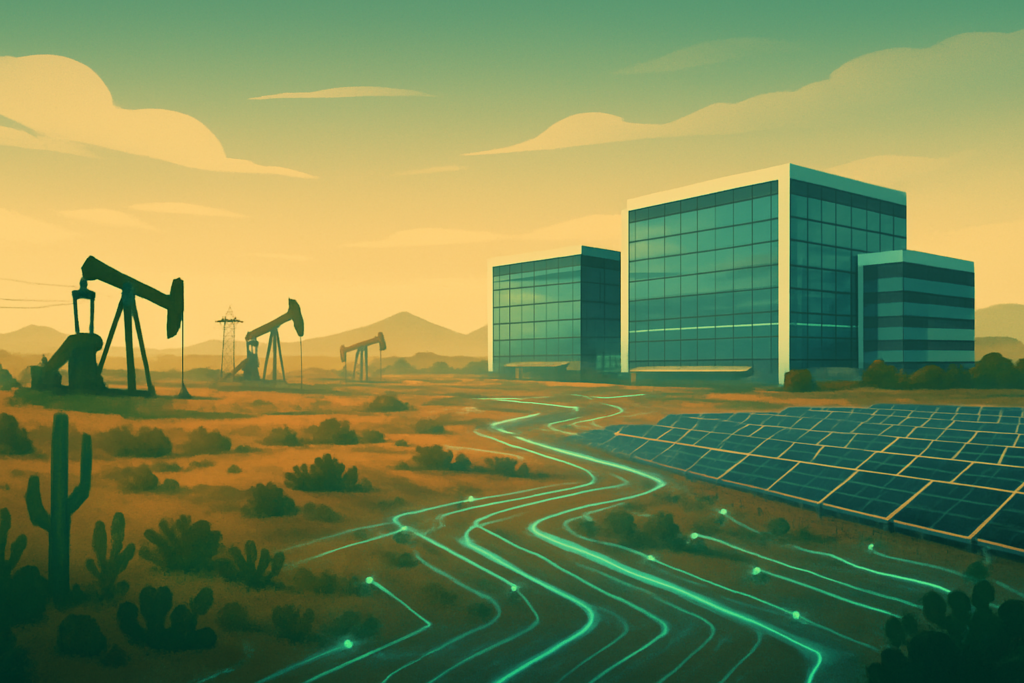
The date is March 31, 2026. The Permian Basin, long the heartbeat of American energy, is undergoing a profound metamorphosis. While the rhythmic thrum of pumpjacks still defines the horizon, a new sound is emerging from the scrublands of West Texas: the hum of high-density cooling fans and the silent processing of trillions of data points. At the epicenter of this shift sits Texas Pacific Land Corporation (NYSE: TPL), a 138-year-old entity that has evolved from a dusty railroad land trust into the ultimate "scarcity asset" for the age of Artificial Intelligence.
Introduction
Texas Pacific Land Corporation (TPL) is currently one of the most talked-about infrastructure plays on Wall Street. Historically known as a "passive" landowner that collected royalties on every barrel of oil produced on its nearly 882,000 acres, TPL has spent the last two years aggressively repositioning itself. In early 2026, the company is no longer viewed merely as a proxy for Permian oil production; it is being revalued as a critical provider of the three pillars required for the AI revolution: land, power, and water.
With a market capitalization that has swelled following its 2025 stock split and a landmark partnership with Silicon Valley royalty, TPL represents a unique intersection of "Old Economy" land wealth and "New Economy" digital infrastructure. As of late March 2026, investors are weighing TPL’s staggering 60%+ net margins against a valuation that dwarfs traditional energy peers, asking if this "land bank" is the secret weapon of the generative AI era.
Historical Background
The story of TPL began in 1888, born out of the bankruptcy of the Texas and Pacific Railway. To satisfy bondholders, the company was formed as a liquidating trust, receiving 3.5 million acres of land from the state of Texas. For over a century, the mandate was simple: sell the land or lease it, and buy back shares with the proceeds.
However, the "liquidation" never finished. The discovery of the Permian Basin’s vast shale reserves turned these "worthless" West Texas acres into some of the most valuable real estate on the planet. For decades, TPL operated as a trust with a skeletal staff, but in 2021, it converted into a C-Corporation to modernize its governance and allow for broader institutional ownership. This transition was marked by a bitter, years-long proxy battle between management and a group of activist investors led by Horizon Kinetics and SoftVest. The conflict, which centered on share authorization and board control, was finally resolved in 2024 and 2025, paving the way for the company's current aggressive expansion into digital infrastructure.
Business Model
TPL operates an incredibly "asset-light" and high-margin business model focused on three primary revenue streams:
- Oil & Gas Royalties: TPL owns "perpetual" rights. It does not spend capital to drill wells; instead, it takes a cut of the production from operators like Occidental Petroleum (NYSE: OXY) and Chevron (NYSE: CVX) who drill on its land.
- Water Services and Operations: Through its Texas Pacific Water Resources subsidiary, the company provides full-cycle water management. This includes selling brackish water for fracking and managing the disposal of "produced water." In 2025, this segment achieved the milestone of handling over 1 million barrels of water per day.
- Surface Leases and Easements (The "Toll Road"): TPL charges for every pipeline, power line, and road that crosses its acreage. Recently, this segment has expanded to include "Next-Gen" infrastructure: solar farms, wind turbines, and the burgeoning AI data center business.
Stock Performance Overview
TPL has been a historic "wealth compounder." Over the 10-year horizon ending March 2026, the stock has delivered returns exceeding 1,200%, vastly outperforming the S&P 500 and the broader energy sector (XLE).
- 1-Year Performance: Up 45%, driven by the late-2025 announcement of the Bolt Data & Energy partnership and a 3-for-1 stock split that increased retail liquidity.
- 5-Year Performance: Up approximately 280%, capturing the post-pandemic oil surge and the successful resolution of governance disputes.
- Recent Moves: The stock hit a new all-time high in February 2026 after reporting record Q4 earnings that showcased the first significant revenue contributions from its "digital land" initiatives.
Financial Performance
TPL’s financial profile is more akin to a software-as-a-service (SaaS) company than an oil firm. In the fiscal year 2025, TPL reported total revenues of $798.2 million, a 13% increase year-over-year.
- Margins: Net income margins hovered near 60%, a level nearly unheard of in the industrial sector.
- Balance Sheet: TPL carries zero debt. Its cash position of approximately $850 million (post-2025 acquisitions) provides it with a "war chest" for opportunistic M&A.
- Cash Flow: Free cash flow (FCF) reached nearly $500 million in 2025. The company uses this FCF for a mix of share repurchases and a growing dividend, which was increased by 12.5% in late 2025.
Leadership and Management
Following the resolution of the proxy fight, TPL’s leadership has been significantly refreshed. Rhys Best, appointed Independent Chair, has brought a focus on corporate transparency that was previously lacking. CEO Tyler Glover has been the architect of the "Water-to-Data" pivot, successfully navigating the company from a passive trust to an active infrastructure developer.
The board is now fully declassified, with all directors standing for annual election. This governance "cleanup" has been a major catalyst for ESG-focused institutional funds to initiate positions in TPL during 2025 and 2026.
Products, Services, and Innovations
The most significant innovation in TPL’s portfolio is its "Closed-Loop Energy-Data Hub."
- AI Data Centers: In December 2025, TPL invested $50 million into Bolt Data & Energy, a venture co-founded by former Google CEO Eric Schmidt. This partnership aims to build massive data center campuses directly on TPL land.
- Behind-the-Meter Power: TPL is leveraging its natural gas royalties to facilitate "on-site" power generation for these data centers, bypassing the congested Texas power grid (ERCOT).
- Desalination: TPL is completing a massive freeze desalination project in Orla, Texas. This facility uses waste heat from data centers to turn salty "produced water" from oil wells into fresh water—solving a major environmental hurdle while providing cooling for AI servers.
Competitive Landscape
TPL occupies a category of one, but it does face indirect competition:
- Viper Energy (NASDAQ: VNOM): A pure-play Permian royalty company. While Viper has higher production growth, it lacks the surface acreage that allows TPL to build data centers.
- LandBridge (NYSE: LB): A newer competitor (often called "TPL Junior") that also focuses on the surface "toll-road" model. While smaller, LandBridge is competing for data center contracts in the Delaware Basin.
- Black Stone Minerals (NYSE: BSM): A diversified royalty holder, though more concentrated in natural gas and less focused on the technology pivot.
Industry and Market Trends
The "Permian Consolidation" trend of 2024-2025—marked by ExxonMobil’s acquisition of Pioneer Natural Resources—has been a tailwind for TPL. Larger, more efficient operators are now drilling on TPL land, using longer laterals (12,000+ feet) which increases the royalty yield per acre. Simultaneously, the global "AI Arms Race" has made large, contiguous tracts of land with power access incredibly scarce, moving TPL into the crosshairs of tech giants looking for "sovereign" power solutions.
Risks and Challenges
Despite its strengths, TPL is not without risk:
- Valuation: Trading at over 50x EV/EBITDA, TPL is priced for perfection. Any delay in the "Bolt" data center rollout could trigger a significant correction.
- Regulatory Scrutiny: The disposal of produced water has been linked to seismic activity in West Texas. Increased regulation by the Texas Railroad Commission could hamper TPL’s water business.
- Commodity Sensitivity: While asset-light, a sustained drop in oil prices below $50/bbl would significantly reduce the pace of drilling and royalty revenue.
Opportunities and Catalysts
- SMR Integration: Discussions are underway regarding the placement of Small Modular Reactors (SMRs) on TPL land to provide carbon-free, 24/7 power to data centers.
- Midland Basin M&A: TPL’s $450 million acquisition in late 2025 proved it can successfully integrate new acreage. Further "tuck-in" acquisitions in the Midland Basin remain a possibility.
- The "Schmidt Effect": Continued collaboration with Eric Schmidt and Bolt Data & Energy could lead to a formal "Digital Infrastructure" spin-off or a major joint venture with a "Hyperscaler" (e.g., Amazon or Microsoft).
Investor Sentiment and Analyst Coverage
Sentiment is currently split between "Old School" energy analysts and "New School" technology-infrastructure bulls. Horizon Kinetics, TPL’s largest shareholder, remains a vocal proponent of the stock as a "long-term inflation hedge" and a play on the "Fourth Industrial Revolution." While some analysts at firms like Keybanc have raised price targets toward the $1,000 mark (pre-split equivalent), others remain cautious, citing the company’s massive premium over other royalty firms.
Regulatory, Policy, and Geopolitical Factors
TPL benefits from Texas’s business-friendly environment and its "independent" power grid (ERCOT), which allows for faster interconnection of large-scale projects compared to the rest of the U.S. However, federal policies regarding "produced water" and the environmental impact of data centers are emerging as key themes for 2026. TPL’s focus on desalination and "behind-the-meter" gas power is largely seen as a proactive hedge against these regulatory pressures.
Conclusion
Texas Pacific Land Corporation (NYSE: TPL) is no longer a sleepy land trust; it is a high-octane infrastructure platform at the heart of the most important energy-tech convergence in a generation. By leveraging its vast Permian footprint to solve the power and water needs of AI, TPL has successfully disconnected its valuation from the cyclical nature of oil prices.
For investors, TPL represents a "scarcity play." While the valuation is undoubtedly rich, the company’s zero-debt balance sheet, massive margins, and strategic alignment with the world’s most powerful technology trends make it a formidable force. As we move further into 2026, the key for TPL will be execution: turning the promise of 5-gigawatt data center campuses into realized, high-margin cash flow.
This content is intended for informational purposes only and is not financial advice.